AD Agencies
Why India’s ad industry is watching the skies more than the markets
As IMD slashes its rainfall forecast, brands are splitting budgets between a thirsty rural market and a convenience-hungry urban one


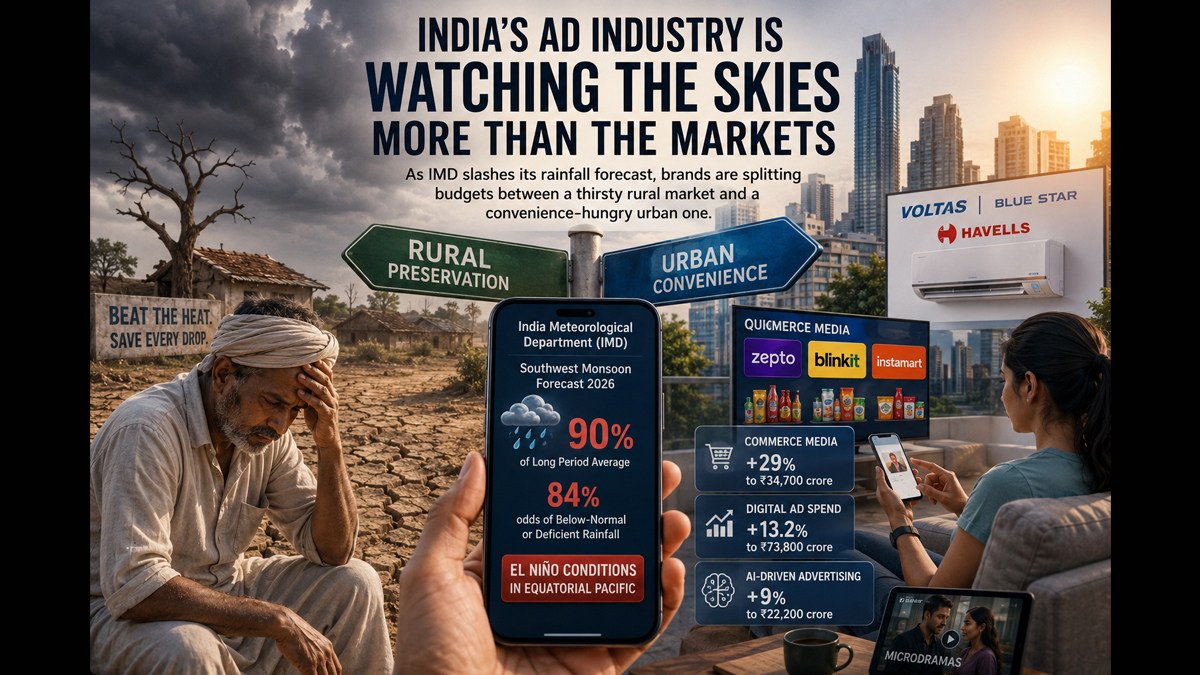
MUMBAI: India’s boardrooms are not panicking over a regulator or a rival. They are panicking over barometric pressure. In late May 2026, the India Meteorological Department (IMB) downgraded its southwest monsoon forecast to just 90 per cent of the long period average, putting the odds of below-normal or deficient rainfall at a worrying 84 per cent. Blame a strengthening El Niño pattern in the equatorial Pacific. This is the first sub-par monsoon projection the subcontinent has faced in three years, and central India, north-west India and the rain-fed southern agricultural belts are staring straight down the barrel of a moisture deficit.
For an advertising industry chasing a Rs 2,00,000 crore milestone this calendar year, a choked monsoon is an instant handbrake on rural consumer spending. Media planners and chief marketing officers are now scrambling to execute a dual-track strategy, hedging bets between an inflation-hit rural market and a digitised, convenience-obsessed urban one.
Linear TV takes a 6.8 per cent hit
For decades, mass-market linear television was the undisputed heavyweight for FMCG brands chasing rural volume. Not anymore. According to WPP Media’s This Year, Next Year midyear 2026 report, total television advertising revenue in India is projected to fall by 6.8 per cent, landing at roughly Rs 43,600 crore. Premium video demand has not disappeared, it has simply deserted traditional broadcast grids in favour of streaming, programmatic connected TV and ultra-short formats.
Because mass CPG portfolios pin a chunk of their linear TV spending to anticipated rural harvest returns, the IMD’s deficient warning has triggered a defensive contraction. Marketers are backing away from big, long-term upfront commitments, leaning instead on performance-led models that let them pull the plug fast if a regional drought worsens.
FMCG growth softens into the 3 to 4 per cent zone
Data from Worldpanel by Numerator, formerly Kantar, paints an increasingly tricky picture. In the January-March quarter of 2026, the FMCG sector clocked a healthy topline value growth of 13.1 per cent, with rural demand tracking above 4 per cent for a second straight quarter.
But the collision of weather-related agricultural stress with persistent West Asia energy volatility, which keeps crude prices jumpy, is set to flatten actual consumption. In a worst-case scenario where food inflation hardens alongside rising fuel costs, FMCG volume growth could soften to a range-bound 3 to 4 per cent for the year, down from earlier baseline expectations of 5 per cent. The forecast spread tells its own story: a base case of around 5 per cent, crude-linked headwinds alone pulling that to 4 to 4.5 per cent, and an adverse case, factoring in the deficient monsoon, dragging it down to 3 to 4 per cent.
That macro pressure is already changing how people shop and, in turn, how brands talk to them. Consumers are consolidating their trips, buying less often but spending more per occasion, with average spend per occasion climbing to Rs 145 in the first quarter of 2026. On the media side, broad-brush, top-of-mind television advertising is giving way to localised below-the-line activations, hyper-regional print and targeted digital campaigns, all designed to protect market share against cheaper local players as rural consumers begin trading down.
A golden hour for fans and air conditioners
While the delayed monsoon is setting off alarms in corporate agri-rooms, it has handed consumer durable and cooling appliance brands an unexpected, extended sales window. Prolonged, brutal heatwaves through June across northern hubs including Uttar Pradesh, Punjab, Haryana and Gujarat have kept cash registers ringing for AC and cooling players such as Voltas, Blue Star and Havells.
Rather than pivoting their spend toward monsoon-proofing or early festive curtain-raisers, durable brands have simply extended peak summer ad budgets deep into mid-June. Ad-tech platforms report a sharp rise in weather-triggered automated advertising, with brands using real-time programmatic APIs tied to localised weather stations to serve digital and connected TV creatives only when a specific pin code crosses extreme temperature or humidity thresholds. The result: every rupee is spent exactly where discomfort, and purchase intent, is highest.
Commerce media surges 29 per cent
In urban India, extreme heat layered on top of delayed rains is rewriting daily meal planning and cooking habits altogether. Disruptions to LPG distribution networks and patchy local food pricing are pushing consumers firmly toward quick-cook, easy-to-prepare meal formats.
The biggest winner from this shift is commerce media. Urban consumers are increasingly routing their daily needs through quick-commerce players like Blinkit, Zepto and Instamart rather than the traditional grocery run. WPP Media’s 2026 data shows commerce media revenue in India is projected to leap by 29 per cent this year, reaching Rs 34,700 crore. Put that alongside the wider digital ad-spend picture: total social and digital spend is forecast at Rs 73,800 crore, up 13.2 per cent, while AI-driven and intelligence-led advertising is expected to hit Rs 22,200 crore, up 9 per cent.
FMCG brands are now pushing digital budgets straight onto these quick-commerce storefronts, placing ads right at the digital point of sale. Layered on top of that is a fresh wave of microdramas and bite-sized episodic content, through platforms like Zee’s Z Bullet, JioStar’s Tadka and MX Player’s Fatafat, soaking up performance ad dollars to keep audiences glued to their phones during long, hot, indoor days.
A tale of two Indias
For media planners staring down the rest of 2026, a one-size-fits-all strategy simply will not cut it. The delayed monsoon has cleaved the Indian consumer base into two starkly different realities: an urban convenience track, fuelled by programmatic connected TV, quick-commerce retail media networks and snackable microdramas, where instant gratification rules the wallet; and a rural preservation track, anchored in on-ground below-the-line activation, value packaging tweaks and defensive regional digital execution, all aimed at holding the line against an inflationary squeeze.
The agencies and CPG brands that come out on top by festive season will be the ones who stop treating the monsoon as just a weather report, and start treating it as a live data feed dictating where every advertising rupee goes next.