Connect with us

Brands

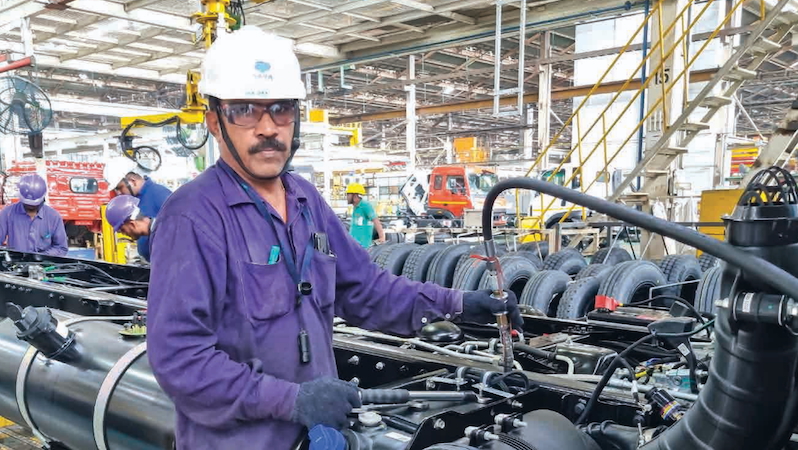
Tata Motors overhauls board as it splits commercial vehicle unit

Published

on

MUMBAI: Tata Motors is reshuffling its boardroom as India’s biggest carmaker prepares to spin off its commercial vehicle business into a separate listed entity. The Mumbai-based company announced sweeping changes to its leadership on 26 September, with three independent directors stepping down and a new managing director taking the helm.

The biggest change sees Shailesh Chandra appointed as managing director and chief executive, replacing Girish Wagh, who will move to head the soon-to-be-listed TML Commercial Vehicles. Chandra, currently joint managing director of Tata Motors Passenger Vehicles and Tata Passenger Electric Mobility, will serve a three-year term from 1 October.

Three independent directors are departing as part of the reorganisation. Hanne Sorensen, a former Tata Consultancy Services board member, will step down on 30 September  but remain on the board of Jaguar Land Rover, Tata Motors’ British luxury car unit. Kosaraju Veerayya Chowdary and Guenter Karl Butschek will both leave on 1 October  to join the commercial vehicles entity’s board.

Advertisement

Replacing them is Sudha Krishnan, a former senior civil servant who retired in 2020 as member finance to India’s Space Commission and Atomic Energy Commission.  Krishnan, who has four decades of experience in public policy and finance, will serve a five-year term as independent director.

The changes come as Tata Motors executes a composite scheme of arrangement approved by India’s National Company Law Tribunal. The demerger, which becomes effective on 1 October, will see shareholders receive one share in TML Commercial Vehicles for every share they hold in Tata Motors.

In another significant move, P B Balaji will resign as group chief financial officer on 17 November  to become chief executive of Jaguar Land Rover. He will be replaced by Dhiman Gupta, currently chief financial officer of Tata Passenger Electric Mobility. Unusually,  Balaji will rejoin Tata Motors’ board as a non-executive director on the same day he steps down from his executive role.

Advertisement

The restructuring reflects Tata Motors’ strategy to separate its commercial vehicle operations from its passenger car and Jaguar Land Rover businesses. The company is also transferring Rs 2,300 crore worth of non-convertible debentures to the commercial vehicles unit as part of the demerger.

The board changes were approved at a meeting that ran from 2pm to 5pm on 26 September, with all appointments subject to shareholder approval.


Advertisement
Click to comment

Leave a Reply

Your email address will not be published. Required fields are marked *

Brands

Godrej clarifies ‘GI’ identifier after logo similarity debate

Says GI is not a logo, will not replace Godrej signature across products.

Published

on

MUMBAI: In a branding storm where shapes did the talking, Godrej is now spelling things out. Godrej Industries Group (GIG) has issued a clarification on its newly introduced ‘GI’ identifier, addressing questions around its purpose and design following a wave of online criticism. At the centre of the debate were two concerns: whether the new mark replaces the long-standing Godrej logo, and whether its geometric design mirrors other corporate identities.

The company has drawn a clear line. The Godrej signature logo, it said, remains unchanged and continues to be the sole logo across all consumer-facing products and services. The ‘GI’ mark, by contrast, is not a logo but a corporate group identifier intended for use alongside the Godrej signature or company name, and aimed at stakeholders such as investors, media and talent rather than consumers.

The need for such a distinction stems from the 2024 restructuring of the broader Godrej Group into two separate business entities. With both continuing to operate under the same Godrej name and signature, the identifier is positioned as a way to differentiate the Godrej Industries Group at a corporate level.

Advertisement

The rollout, however, triggered a broader conversation on design originality. Critics pointed to similarities between the GI mark’s geometric composition and logos used by companies globally, raising questions about distinctiveness.

Responding to this, GIG said its intellectual property and legal review found that such overlaps are common in minimalist, geometry-led design systems. Basic forms such as circles and rectangles appear across dozens of brand identities worldwide, the company noted.

It added that the identifier emerged from an extensive design process and was chosen for its simplicity, allowing it to sit alongside the Godrej signature without competing visually. While acknowledging that elemental shapes may appear less distinctive in isolation, the group emphasised that the mark is part of a broader identity system that includes a custom typeface, sonic branding and other proprietary elements.

Advertisement

Following legal and ethical assessments, the company said it found no impediment to using the identifier, reiterating that the GI mark is a corporate tool not a consumer-facing symbol.

In short, the logo isn’t changing but the conversation around it certainly has.

Advertisement
Continue Reading

Advertisement News18
Advertisement
Advertisement
Advertisement
Advertisement Whtasapp
Advertisement Year Enders

Indian Television Dot Com Pvt Ltd

Signup for news and special offers!

Copyright © 2026 Indian Television Dot Com PVT LTD

This will close in 10 seconds