MAM
TAM or BARC, the market has to decide: Sir Martin Sorrell

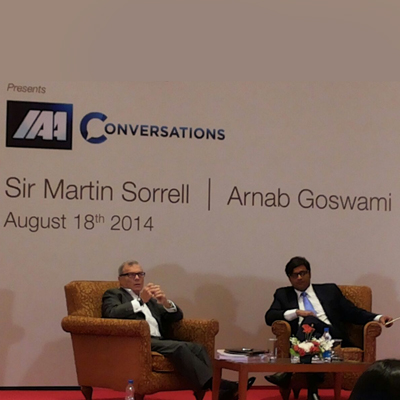
MUMBAI: They are known as the lions who go for the kill in their respective fields. One heads the world’s largest advertising communications group by revenue, which he has built up in around three decades. And the other is known for his innate ability to decimate almost every guest who dares to be a part of his nationally televised daily news show.
Yes, we are talking about none other than WPP CEO Sir Martin Sorrell and Times Now editor-in-chief Arnab Goswami who got together on stage to have a public chat under the umbrella of the Indian chapter of the International Advertising Association (IAA) in Mumbai.
Before the IAA conversation between the two commenced almost all those assembled – the who’s who of the media industry – were hard pressed to second guess as to who would have the upper hand: the calulator (read: Sorrell, as The Economist had once labelled him, when he battled with David Ogilvy to take over O&M) or the microphone (read: Arnab).
Their curiosity was laid to rest quickly and it became clear that it would not be a “I’ll eat you up for high tea” Arnab interview when it was Sorrell who fielded the first question, querying how the 2014 Lok Sabha elections went for him. Goswami laughingly responded saying that not many know that the Congress (I) took out an internal report to know the reasons for the debacle. And the number one reason in that report was Arnab Goswami as he was the only TV journalist to have interviewed the party’s vice president Rahul Gandhi.
And with India’s sad performance during the ongoing Test series in England, cricket was bound to be spoken about. Talking about the recession of ‘91-‘92, Sorrell took the example of how he handled the situation comparing it to the crisis the Indian team was going through and how MS Dhoni should be handling it.
So, do you still push yourself, asked Goswami. And yes, came the prompt reply from the man who believes that with the development of the new technologies, the way people consumed media has changed over the years due to disruption. “If you see what consumers consume and what our clients invest in, there are two major differences. The first being the traditional media which consists of magazines and newspapers, 20 per cent is invested in it and on the other side, 46 per cent is invested on mobile,” said Sorrell. He emphasised that though the study represents the west, India is also headed in the same direction.
Responding to Goswami’s question about the position of Indian media in the next 20-30 years, Sorrell highlighted that with the economic changes taking place in the country under the new government, the country can only move forward. “India is in a better position than the US because it leapfrogged from legacy media to smartphones. And the country will play an important role in digital growth as well,” he asserted adding that the traditional businesses need to be digitised at the earliest, as Indian media needs to go with the flow.
However, not everyone at the audience believed in Sorrell’s India digital growth design. Madison World chairman Sam Balsara believes that in the country where print and TV is still booming, digital cannot overtake the two here at least for some time now.
A firm believer in data and gut, Sorrell also believes that media has to play the roles of both – influencing the market behavior and analysing it too.
After a few more exchanges on what role data plays in Sorrell’s businesses, the conversation shifted from media and advertising to television and the ongoing case of television viewership ratings in India.
Kantar Media, part of the WPP Group, the 50 per cent shareholder in Indian television ratings agency TAM Media Research had moved the Delhi High Court when the government, early this year, approved the regulations policy guidelines for TV rating agencies. According to it, no single entity can hold paid-up equity in excess of 10 per cent simultaneously in a rating agency and a broadcaster, advertiser or advertising agency and is compelled to increase the panel home size by 10,000 ever year until the size reaches 50,000 panel homes.
“In a country of 1.2 billion, just a few thousand peoplemeters. The math doesn’t match up. Did you really need a regulation to tell you to increase the sample data?” asked Goswami who added that he has been waiting for 15 years to ask the question.
To this, Sorrell said that the decision to increase the number of peoplemeters was taken long before the regulations came out. “One must not forget that the number of peoplemeters reflects the cost of science. Anywhere in the world, the industry has to pay for that cost. The research agency has three equal partners, that is, one-third is media agencies, one-third advertisers and one-third broadcasters. It involves cost and the industry needs to contribute to it.”
He went on to add that the way media is consumed is changing and so the media rating agencies too will have to change. He cited the example of TV networks in the US using ‘C7 ratings’, which includes same-day viewing plus seven additional days, as opposed to three, and how WPP was the first one to recognise that change.
“The market had decided for the 10,000 peoplemeters then, and later on the government decided to increase that,” he added.
Does Sorrell see TAM and BARC working together?
“The market will have to decide that; if they are ready to pay for both then good. However, if we look elsewhere, the market doesn’t pay for two rating currencies,” he said.
To this BARC India CEO Partho Dasgupta smiled and said, “It’s good that he acknowledged that there can be only one currency.”
The two-hour long conversation ended with Goswami asking Sorrell that if he would start his career all over again like he did at 40 then what would be on his mind. “I would have started maybe a little earlier, say 30-35 years of age, and gone private after collecting all my assets,” he replied.
Spoken like a true number cruncher.