Connect with us

MAM

Prime Video and PivotRoots collaborate to create multi-brand integrated campaign for Made In Heaven Season 2

Published

on

Mumbai: Prime Video, one of India’s most popular video streaming services, has once again captivated its audiences with the much-awaited Season 2 of its critically acclaimed series Made In Heaven. Buoyed by the critical acclaim of the Emmy-nominated show, Prime Video orchestrated a strategic and exhilarating campaign powered by PivotRoots – a Havas Company, to reignite the buzz among fans and introduce the show to new audiences, aiming to make this season an even greater success.  

Leveraging high-impact strategic partnerships across prominent platforms, the campaign achieved a resounding success in both contextual communication and visually appealing creatives. PivotRoots vice president-media Ashok Shinde said, “For a show that constantly pushes boundaries, we identified popular and frequently visited media destinations by the intended audience and crafted integrations that harped on the marquee themes from the show. This allowed the show to be omnipresent with a creative approach that reiterated the return of the grandest wedding celebration, which one shouldn’t miss.”  

Strategic Partnerships:  

Advertisement

Prime Video’s campaign spearheaded by PivotRoots, engaged in strategic collaborations with top platforms, establishing a strong and contextual presence across various user journeys:  

1. Uber Collaboration  

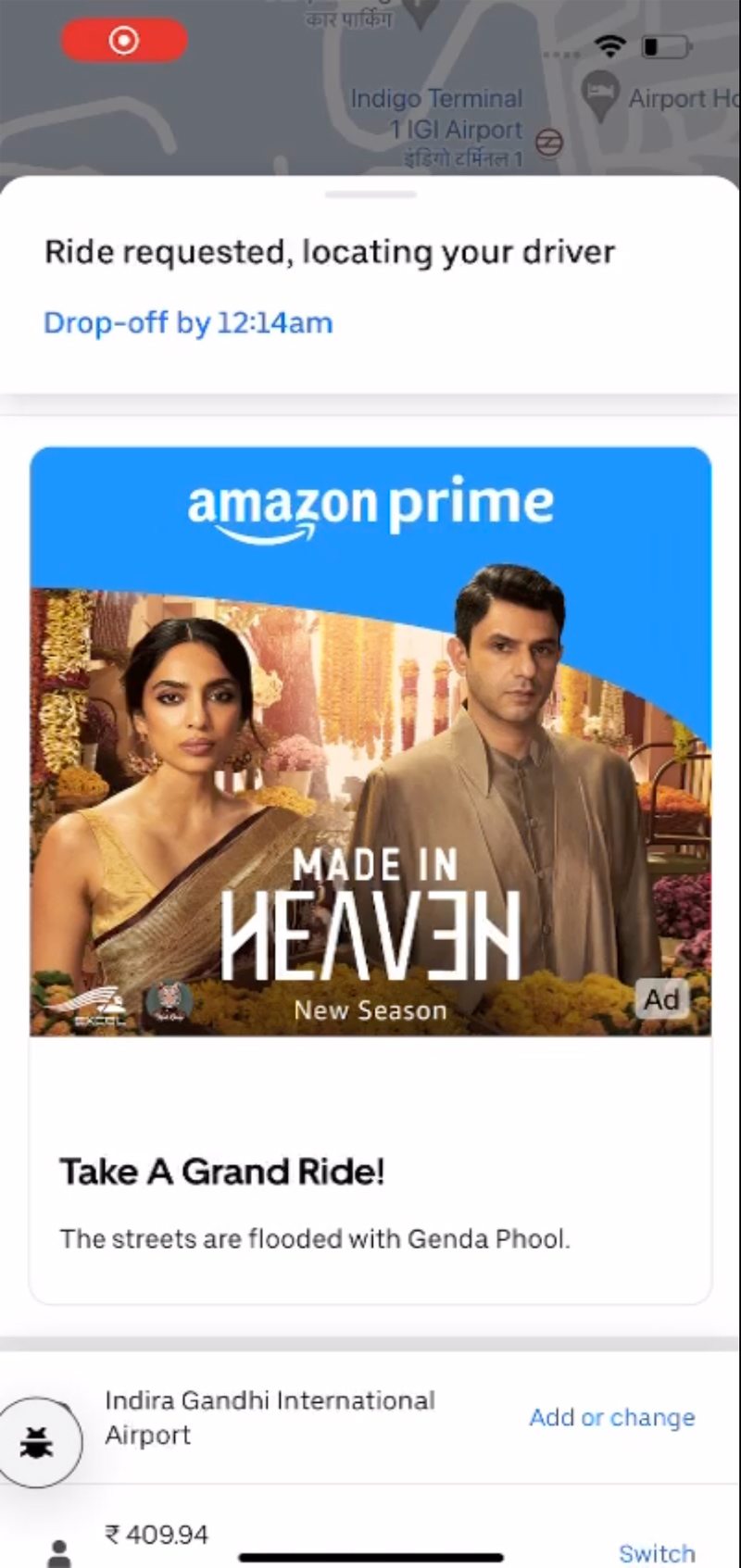
Partnering with Uber, one of the largest on-demand rideshare applications, the campaign ensured a comprehensive and engaging user journey. From requesting a trip to throughout the ride, the show’s communication was seamlessly integrated into the app. The creative concept revolved around the notion that Genda Phools (marigold flowers) were adorning the streets, heralding the return of grand wedding celebrations. With every step of the journey, the user was greeted with a celebratory tone and contextual copy, culminating in the grand release announcement.  
Advertisement

Uber advertising head of programmatic and partnerships Jillian Kranz said, “With an average view time of over 100 seconds, Journey Ads are a powerful and effective way to capture consumers’ attention during their trip, driving purchases and building brand awareness amongst a highly in-demand demographic. The Made in Heaven campaign seamlessly integrated Amazon’s messaging, creating and sustaining excitement for the show.”

Httpool by Aleph managing director Amit Gupta mentioned, “We are thrilled to share the remarkable success of the collaboration between Amazon Prime Video and Uber, made possible through our valued partnership with PivotRoots and Httpool by Aleph.”

2. Swiggy Integration

Advertisement

Recognizing the extensive user engagement on Swiggy, India’s leading on-demand convenience delivery platform, the campaign took over one of the most frequently visited sections of the app – the order track screen which appears once a user completes placing an order. Here, the delivery icon transformed into an image of a truck adorned with Genda flowers, symbolizing the arrival of festivities. At the top of the map, PivotRoots strategized to place an icon of Genda Phool accompanied by contextual copy, revealing the comeback of Made In Heaven. An animated innovation banner further strengthened the connection between the campaign and the imagery, leaving a lasting impact.

Swiggy head of ads and monetization Ajit Panigrahi said, “Swiggy’s post-order food tracking screen is viewed with great excitement as users wait for their favourite dishes to be delivered, just like Made in Heaven Season 2, which has been one of the most awaited shows on OTT. We collaborated with Amazon Prime and PivotRoots, to creatively communicate this in the form of a contextual map integration on the food post order page, also giving users a view of the trailer on the same page.”

3. MakeMyTrip Partnership

Advertisement

Given the show’s exotic locales, a partnership with MakeMyTrip, the country’s leading travel platform, was formed to deepen user engagement. This collaboration resulted in the creation of Made In Heaven Holiday Packages inspired by the show’s lead characters. The packages, adorned with visuals from the series, resonated with the characters’ personalities. These packages were prominently featured in a branded hub across various touchpoints within the app, delivering maximum visibility and engagement.

MakeMyTrip chief marketing officer & chief business officer – corporate Raj Rishi Singh said, “Travel is often inspired by visuals from popular films and television shows that appeal to our sensibilities. Made in Heaven has been one such cultural phenomenon, inspiring conversations and giving us mood boards for various occasions, including travel. We are pleased to have partnered with Amazon Prime Video and PivotRoots to curate travel packages based on protagonists from the show, inspiring millions to travel with itinerates made in heaven.”

4. Media Buying

Advertisement

Additionally, as part of various media buys, PivotRoots collaborated with 25 + top sites and apps including niche partners like Ferns and Petals, Wedding Sutra, Wed Me Good and Conde Nast Traveller to deploy high-impact contextual banners.  By taking over key touchpoints on popular platforms, the campaign driven by PivotRoots, was able to reach a large and engaged audience which helped Prime Video’s Made In Heaven Season 2 to become one of the most talked-about shows of the year.


Click to comment

Leave a Reply

Your email address will not be published. Required fields are marked *

MAM

When Instant Business Loans Are Better Than Working Capital Limits

Published

on

Most business owners treat their working capital limit like a safety net. It sits there, attached to their current account, ready to be drawn on whenever cash gets tight. And for routine operations, that arrangement works fine. But there are specific situations where a lump-sum loan disbursed quickly into your account is the smarter financial move. Knowing when to pick one over the other can save you real money and keep your business from getting stuck.

The Fundamental Difference People Overlook

A working capital limit, often structured as an overdraft or a revolving credit facility, gives you access to funds up to a pre-approved ceiling. You draw what you need, pay interest on what you use, and replenish it as receivables come in. It is designed for short-term, recurring needs like paying suppliers or covering payroll gaps.

Advertisement

A term loan disbursed quickly, on the other hand, drops a fixed amount into your account. You repay it in instalments over a set period, with a clear end date. The interest rate is typically fixed or at least predictable. These two products solve different problems, and treating them as interchangeable is where businesses get into trouble.

When Speed and Certainty Matter More Than Flexibility

Here’s a scenario that plays out constantly. A retailer gets an opportunity to buy inventory at a steep discount, but the supplier wants full payment within 48 hours. The retailer’s working capital limit is already partially drawn. The available balance might cover part of the order, but not all of it. Requesting a limit enhancement takes days, sometimes weeks, because the bank reassesses your financials.

Advertisement

An instant business loan solves this cleanly. You apply, get approval quickly, and the full amount lands in your account. You buy the inventory, sell it at full margin, and repay the loan over the next few months. The cost of interest on that loan is far less than the profit you would have lost by passing on the deal.

This pattern repeats across industries. A logistics company needs to repair a critical vehicle immediately. A restaurant has to replace kitchen equipment before the weekend rush. A manufacturer lands a large order but needs raw materials upfront. In each case, the need is urgent, specific, and finite. A revolving facility wasn’t built for these moments.

The Hidden Cost of Over-Relying on Working Capital Limits

Advertisement

There’s a psychological trap with revolving credit. Because it’s always available, business owners tend to lean on it for everything, including expenses that really should be financed separately. When you use your overdraft to fund a one-time capital purchase, you reduce the buffer available for daily operations. Then, when a genuine cash flow gap appears the following week, you’re scrambling.

Worse, many working capital limits come with annual renewal. If your financials have dipped, the bank can reduce your limit or decline renewal altogether. If you’ve been using the facility for purposes it wasn’t designed for, your utilisation patterns can actually work against you during the review.

A distinct term loan keeps your working capital limit clean. Your revolving facility handles day-to-day operations. Your loan handles the one-off expense. This separation makes your balance sheet easier to read and your banking relationship easier to manage.

Advertisement

Interest Rate Math That Favours Term Loans

Working capital limits often carry floating interest rates pegged to the bank’s benchmark. The rate adjusts, and over time, especially when monetary policy tightens, your cost of borrowing can creep up without you noticing because you’re only looking at the small daily interest debit.

A fixed-rate term loan gives you certainty. You know exactly what each instalment will be, which makes cash flow forecasting more accurate. For a specific expense with a known amount and a defined payback period, this predictability matters. You can map the repayment against the revenue that expense is expected to generate.

Advertisement

A working capital loan structured as a revolving facility makes sense when your borrowing needs fluctuate week to week. But when you know exactly how much you need and roughly how long it will take to pay back, a term product is almost always cheaper in total interest cost. The discipline of fixed repayments also prevents the slow balance creep that plagues overdraft users.

When Your Facility Is Maxed and Opportunity Knocks

Perhaps the most compelling case is the simplest one. Your existing limit is fully utilised. Business is good, money is coming in, but right now the account is stretched. A new opportunity appears. You can either let it pass or find additional funding fast.

Advertisement

Waiting for a limit increase is not a strategy when timing matters. Applying for a separate short-term loan, getting approval the same day or the next, and funding the opportunity directly is a concrete action with a measurable return. You are not adding long-term debt to your balance sheet. You are financing a specific transaction that pays for itself.

The smartest business owners don’t treat all credit as the same. They match the product to the need. Revolving facilities handle rhythm. Term loans handle moments. Getting that distinction right is one of the quieter advantages a well-run business holds over its competitors.

Advertisement
Continue Reading

Advertisement News18
Advertisement
Advertisement
Advertisement
Advertisement Whtasapp
Advertisement Year Enders

Indian Television Dot Com Pvt Ltd

Signup for news and special offers!

Copyright © 2026 Indian Television Dot Com PVT LTD

This will close in 10 seconds