MAM
Pocket FM creator payouts surpass Rs 300 crore in 2025
Eyes Rs 1,000 crore milestone by 2026 with 1 million creators expected.


MUMBAI: Stories are no longer starving artists, they’re feeding creators, and AI is handing out the forks. As the India AI Impact Summit debates the future of responsible tech, Pocket FM has dropped real numbers showing how artificial intelligence is quietly turning bedroom ideas into bank balances across the country.
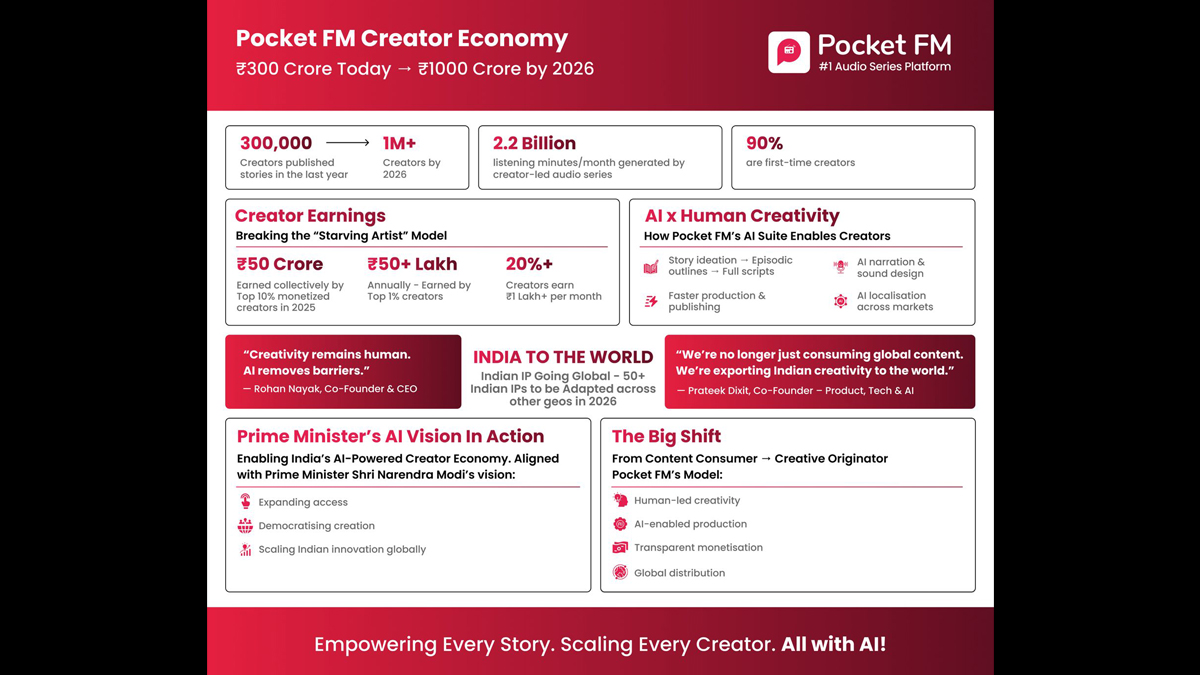
The audio storytelling platform revealed its creator economy has already crossed Rs 300 crore in total payouts, with projections to hit Rs 1,000 crore by the end of 2026. In 2025 alone, more than 10 per cent of its monetised creators collectively earned over Rs 50 crore. Over 300,000 first-time creators published their debut stories in the past year, and with AI tools speeding up the writing process, the company expects to welcome its 1 millionth creator by next year.
The secret sauce? Pocket FM’s AI Suite, think of it as a virtual writers’ room that never sleeps. Pocket FM co-founder for product Tech and AI Prateek Dixit explained, “The Planner Agent designs long-term arcs and character journeys, the Context Agent safeguards narrative continuity across episodes, and the Drama Agent refines pacing, tension, and cliffhangers. Together… these agents enable creators to build cohesive, long-form stories while preserving creative ownership and significantly reducing execution complexity.”
The economics are shifting too. More than 20 per cent of creators now earn over Rs 1 lakh per month, and the top 1 per cent pull in more than Rs 50 lakh annually. Around 90 per cent of the community are first-timers, and a quarter are students juggling college with storytelling careers. AI handles the heavy lifting on structure, continuity and production polish, so humans can focus on the heart of the tale.
Pocket FM co-founder and CEO Rohan Nayak tied the growth to a bigger vision,’ “Creativity remains human, and Pocket FM’s AI Suite is designed to remove barriers to bringing that creativity to life. This reflects prime minister Narendra Modi Ji’s vision of an AI-enabled creator ecosystem where a story idea can reach audiences at scale regardless of where it comes from. This marks the end of the traditional ‘starving artist’ model.”
The ripple is going global. In 2025, Indian originals such as Mahagatha, Brahmyoddha – The Destroyer, and Brahmand Ka Rakshak were localised for listeners in the United States and Europe. Plans for 2026 include localising more than 50 Indian IPs. Pocket FM’s proprietary multilingual models don’t just translate words, they adapt cultural references, pacing and emotional beats so stories feel native wherever they land.
The platform now generates more than 2.2 billion minutes of monthly listening from creator-led audio series, proving demand for homegrown, long-form fiction is booming.
While summit panels wrestle with AI’s risks to jobs and originality, Pocket FM offers a counter-narrative, technology as an amplifier, not a replacement. Creators keep the pen (and the royalties), barriers crumble, and Indian tales travel further than ever. In a country racing toward 950 million internet users by 2030, the next blockbuster might just start as a late-night voice note and end up on screens worldwide.