Brands
Miles ahead Uber’s 2025 data shows India riding faster and farther

MUMBAI: If kilometres could talk, 2025 would have been a very chatty year for Uber in India. Kicking off the new year, Uber India has released highlights from its annual data report, How India Ubered, offering a snapshot of how, when and where Indians moved over the past year.
The numbers tell a story of scale and momentum. In 2025, Uber trips in India covered more than 11.6 billion kilometres, a 26.5 per cent jump over 2024. Put differently, that is the equivalent of over 3.2 million journeys from Srinagar to Kanyakumari in a single year, or 8,840 such trips every day.
Even as travel volumes surged, rider behaviour remained largely courteous. Kochi once again topped the charts with the highest average rider rating at 4.91 out of 5, with 98.3 per cent of trips earning a full five stars from drivers. Thiruvananthapuram followed at 4.87, while Pune and Chandigarh also featured among the best-rated cities. The national average rider rating stood at 4.76.
Usage patterns revealed some familiar habits. The most popular time to book an Uber was 6:00 pm, Fridays remained the busiest day of the week, and November emerged as the most travelled month. December 12, 2025, marked the single busiest day of the year. For Uber Rentals, the two-hour package was the most frequently chosen option.
City-wise trends highlighted contrasts in travel behaviour. Mumbai and Kolkata recorded the highest share of late-night trips, while Mumbai, Guwahati and Chennai led weekend travel as a proportion of total rides. Bhubaneswar and Thiruvananthapuram stood out for the highest share of office-hour trips. On the tourism front, Agra, Mysore, Puri and Lonavala emerged as the most frequented destinations via Uber Intercity.
Sustainability and premium offerings also gained traction. Indians clocked 365 million kilometres in Uber EVs during the year, spending a cumulative 54 million hours in electric vehicles. Uber Black logged over 34 million kilometres, driven largely by airport and work commutes in Delhi, Mumbai and Bangalore.
Beyond rides, Uber’s ancillary services expanded their footprint. Uber Courier peaked between 1 pm and 3 pm, with around three million first-time users trying the service in 2025. One particularly enthusiastic user completed 5,218 deliveries in a year. Uber Shuttle also saw strong adoption, drawing nearly 800,000 first-time users to app-based bus travel. Even pets got in on the action, travelling close to 800,000 kilometres using Uber Pet.
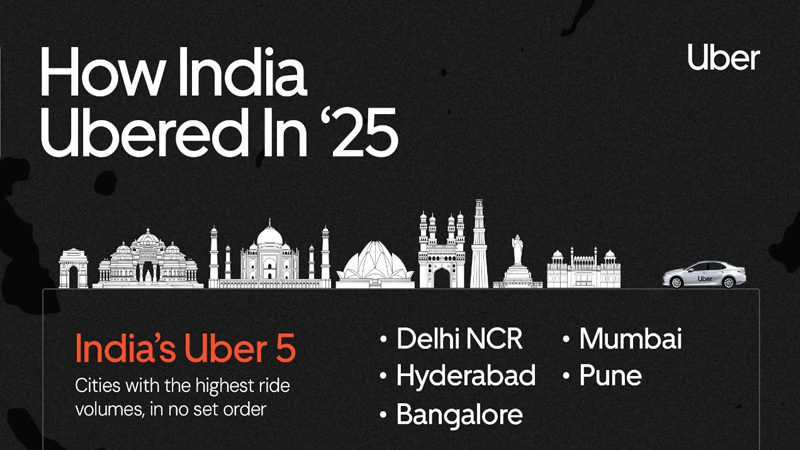
Delhi NCR, Hyderabad, Bangalore, Mumbai and Pune formed India’s top five cities by total Uber rides, while Bhubaneswar and Thiruvananthapuram led the country in average road speeds. The Mumbai–Pune corridor remained India’s busiest intercity route, and the longest journeys stretched beyond 1,800 kilometres on round trips.
Taken together, the data points to a year where ride-hailing was no longer just about getting from A to B, but about how India is reshaping everyday mobility, one trip at a time.