Connect with us

Brands

Maruti charges ahead with electric ambitions

Published

on

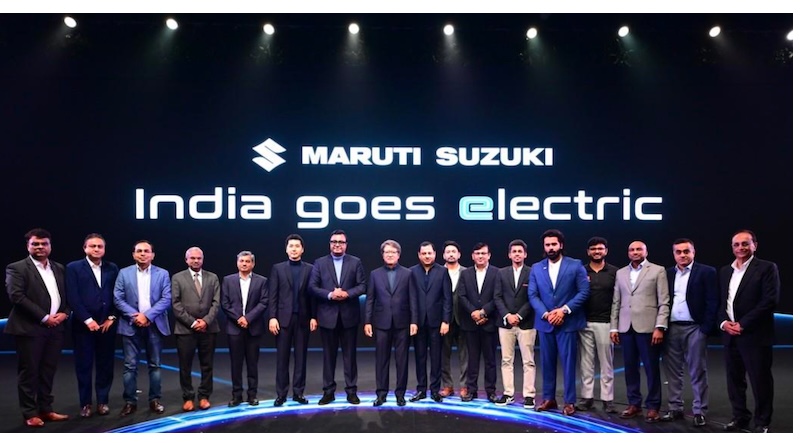
NEW DELHI: The elephant in India’s automotive room is finally dancing. Maruti Suzuki, the lumbering giant that’s sold more cars to Indians than anyone else, has decided it’s time to go electric—and it’s doing so with the subtlety of a Hindi cinema production number.

On 2 December  the company announced it had cosied up to 13 charging-point operators and aggregators, promising to transform India’s patchy EV infrastructure into something resembling a proper network. The ambition? Enable access to 100,000 public charging points by 2030. That’s a lot of juice.

For now, Maruti is rolling out 2,000 of its own charging stations across its dealer network, spanning more than 1,100 cities. Hisashi Takeuchi, the firm’s managing director and chief executive, called it a “historic step” into electric mobility. He’s not wrong—Maruti has been notoriously late to the EV party, watching rivals like Tata Motors gobble up market share whilst it dithered.

Advertisement

The company’s weapon of choice is the e Vitara, a made-in-India electric SUV that’s been tested from “sand to snow” across temperatures ranging from -30°C to 60°C. It promises a driving range of 543 kilometres on a full charge. Whether Indian roads will be quite so accommodating remains to be seen.

To prove the charging network isn’t vaporware, Maruti staged what it calls an “e drive”—four e Vitaras flagged off from Gurugram towards India’s four corners: Srinagar up north, Kanyakumari down south, Bhuj out west, and Dibrugarh in the east. It’s part publicity stunt, part stress test.

The centrepiece is an app called “e for me” (someone in marketing clearly had fun). It promises to locate charging points, handle payments through UPI or “Maruti Suzuki Money” (powered by Razorpay), and even let owners remotely manage their home chargers. One card does it all—”tap n charge” functionality that might actually work.

Advertisement

Senior executive officer for marketing and sales Partho Banerjee was positively buzzing. “Today is the dawn of a new era for electric mobility in India,” he declared. The company has trained 150,000 workers specifically for EVs and converted 1,500 service workshops across 1,100 cities to handle electric vehicles. In the top 100 cities, charging points will sit every 5-10 kilometres. DC fast chargers are being planted along major highways like motorway service stations.

Whether this charging offensive will be enough to convince India’s notoriously price-conscious buyers to go electric is the billion-rupee question. Maruti’s petrol-sipping hatchbacks have ruled Indian roads for decades precisely because they’re cheap to buy and run. EVs remain considerably pricier, even with government subsidies.

But Maruti clearly reckons the current is shifting. And when India’s car colossus finally plugs in, the entire market pays attention. Charge on.


Advertisement
Click to comment

Leave a Reply

Your email address will not be published. Required fields are marked *

Brands

Godrej clarifies ‘GI’ identifier after logo similarity debate

Says GI is not a logo, will not replace Godrej signature across products.

Published

on

MUMBAI: In a branding storm where shapes did the talking, Godrej is now spelling things out. Godrej Industries Group (GIG) has issued a clarification on its newly introduced ‘GI’ identifier, addressing questions around its purpose and design following a wave of online criticism. At the centre of the debate were two concerns: whether the new mark replaces the long-standing Godrej logo, and whether its geometric design mirrors other corporate identities.

The company has drawn a clear line. The Godrej signature logo, it said, remains unchanged and continues to be the sole logo across all consumer-facing products and services. The ‘GI’ mark, by contrast, is not a logo but a corporate group identifier intended for use alongside the Godrej signature or company name, and aimed at stakeholders such as investors, media and talent rather than consumers.

The need for such a distinction stems from the 2024 restructuring of the broader Godrej Group into two separate business entities. With both continuing to operate under the same Godrej name and signature, the identifier is positioned as a way to differentiate the Godrej Industries Group at a corporate level.

Advertisement

The rollout, however, triggered a broader conversation on design originality. Critics pointed to similarities between the GI mark’s geometric composition and logos used by companies globally, raising questions about distinctiveness.

Responding to this, GIG said its intellectual property and legal review found that such overlaps are common in minimalist, geometry-led design systems. Basic forms such as circles and rectangles appear across dozens of brand identities worldwide, the company noted.

It added that the identifier emerged from an extensive design process and was chosen for its simplicity, allowing it to sit alongside the Godrej signature without competing visually. While acknowledging that elemental shapes may appear less distinctive in isolation, the group emphasised that the mark is part of a broader identity system that includes a custom typeface, sonic branding and other proprietary elements.

Advertisement

Following legal and ethical assessments, the company said it found no impediment to using the identifier, reiterating that the GI mark is a corporate tool not a consumer-facing symbol.

In short, the logo isn’t changing but the conversation around it certainly has.

Advertisement
Continue Reading

Advertisement News18
Advertisement
Advertisement
Advertisement
Advertisement Whtasapp
Advertisement Year Enders

Indian Television Dot Com Pvt Ltd

Signup for news and special offers!

Copyright © 2026 Indian Television Dot Com PVT LTD

This will close in 10 seconds