MAM
India fastest-growing market globally at 14.6%: dentsu Global Ad Spend Forecast report

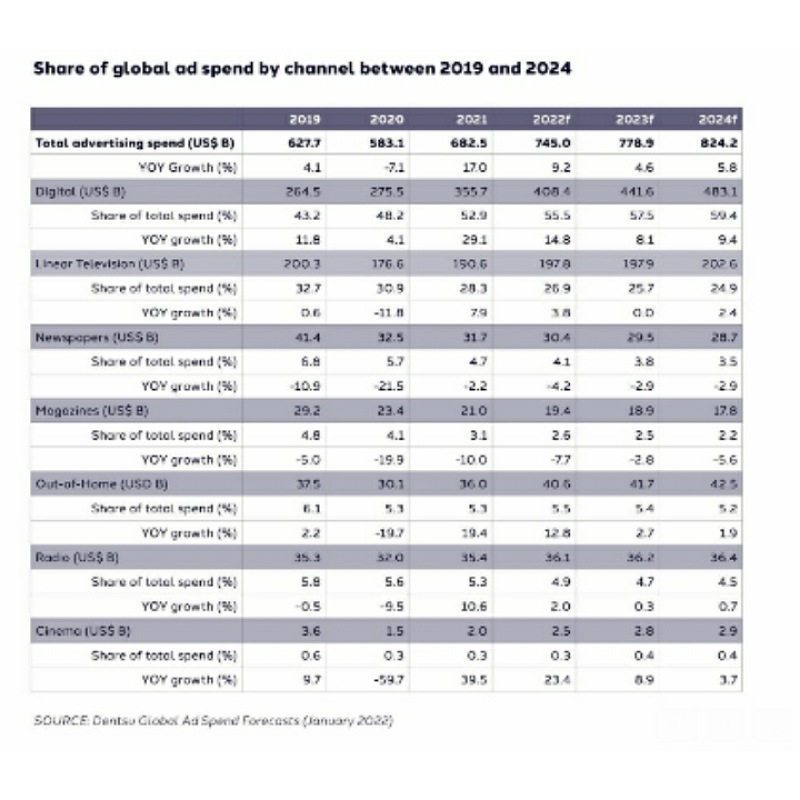
Mumbai: Advertising expenditure in the Asia Pacific is expected to grow by 5.9 per cent, with India being the fastest-growing market globally at 14.6 per cent, followed by the US, Russia and Canada, according to dentsu’s Global Ad Spend Forecast report. Digital forecast is expected to increase 9.6 per cent to a share of 61.1 per cent of total APAC advertising spend, even as advertising investment overall is forecast to grow by 9.2 per cent globally in 2022, as per the report.
In APAC, overall ad spend growth is boosted by key sporting events such as the Indian Premier League, FIFA World Cup, Winter Olympics, and country elections in Australia and India.
Moving towards a second consecutive year of growth following the five per cent market dip in 2020, 2022 is projected to build on a stronger than expected recovery in 2021 which itself saw a record-high 14.4 per cent growth in APAC, totalling $241 billion. The twice-yearly report which combines data from over 50 markets globally, anticipates $745 billion will be spent globally.

Digital and television continue to be the two powerhouses driving global and APAC ad spend, yet with opposite dynamics. Following a 24.8 per cent increase in 2021 (vs 29.1 per cent globally), dentsu forecast digital investment to grow by 9.6 per cent (vs 14.8 per cent globally) in 2022, fuelled by Social and Programmatic in APAC. This will result in the digital share of spend increasing to 61.1 per cent ($150 billion) of the total ad spend in APAC, over twice as big as the television share of spend (24.5 per cent) in 2022.
Linear TV ad spend increased by 5.1 per cent in 2021, the highest rate since 2013. In 2022, dentsu forecast linear TV ad spend to grow by 1.4 per cent to reach $60 billion in APAC. Unlike digital and despite staying in high demand, dentsu is seeing linear TV share of spend on the decline – both globally and in the region – as connected TV and video on demand (VOD) grow.
Out-of-home (OOH) and cinema will both see encouraging growth in 2022, respectively 12.8 per cent and 23.4 per cent globally (vs 2.8 per cent and 30.0 per cent in APAC). Radio too is forecast to grow, yet at a slower pace of 1.5 per cent in APAC (vs 2.0 per cent globally). As with previous predictions, ad spend in newspapers and magazines will continue to decline globally and in APAC.
Globally, the industries that will see growth in ad spend this year will include the beleaguered travel industry which is forecast to see a 10.3 per cent rise. There is also confidence the automotive advertising spend will grow by 7.6 per cent in 2022. Growth follows an 11.5 per cent increase in 2021 and steep declines in 2020 of -15.9 per cent. With pent-up demand and a trend towards personal vehicles in how people want to travel post-pandemic, there is confidence in the recovery of the automotive industry.
Looking further ahead, APAC ad spend is predicted to grow by 5.6 per cent (vs 4.6 per cent globally) in 2023 and 4.9 per cent (vs 5.8 per cent globally) in 2024 – exceeding growth before the pandemic (4.1 per cent in 2019). Digital is forecast to increase its share of spend domination to 64.6 per cent in APAC (vs 59.4 per cent globally) in 2024. Of course, many factors contributing to the uncertain economic outlook could influence the predictions, from the evolution of the pandemic to supply chain issues, and dentsu recommends the industry keep a close eye on key economic indicators.
“APAC region is expected to post robust growth in ad spend in 2022. India, Hong Kong and Vietnam will drive double-digit growth with the rest of the region showing strong growth,” said dentsu International CEO Media APAC Prerna Mehrotra. ” The share of digital spends in APAC is set to increase to 61.1 per cent up from 50.1 per cent in 2019 (pre-covid), driven by Greater China and ANZ. TV as a platform will continue to play a key role especially in Southeast Asia and South Asia.”
“Marketers will need to be nimble, leaning on technology and maximizing opportunities in video, social, connected TV and e-commerce. The use of data to drive business outcomes without compromising privacy or security will continue and we expect data collaboration to be a big focus for 2022. In light of the ongoing global turbulence and recovery, we will continue to work with brands to accelerate efforts to engage consumers and drive attentive reach,” she further added.
When compared to previous global financial and advertising crises, notably the financial crash of 2008, this rebound is almost three times greater, said the report. In 2022 the growth forecast at 9.2 per cent is nearly three times the 3.4 per cent growth in 2011 – the second-year post-global financial crisis. In 2022 the global ad market exceeded the 2019 pre-pandemic level of spend by 18.7 per cent, whereas in 2011 the global ad market continued to be one per cent lower than in 2008.
“The bounce back from the early pandemic impact continues to be strong, especially in digital,” remarked dentsu International Global CEO media and global clients Peter Huijboom. “As we spend more time consuming digital media, brands have the opportunity to tap into the increased flexibility in which consumers engage through multiple touchpoints. Businesses who truly understand these developed human behaviours have the best opportunity to build lasting relationships with them.”
“It also comes as no surprise of the increased popularity in gaming. Dentsu launched its global gaming proposition in 2021. Along with the burgeoning Metaverse, there has never been a more exciting time for brands to experiment, innovate and engage with their customers – as all forms of media are increasingly more central to daily life and routine,” he further said.






MAM
India’s financial sector spent less on TV ads in 2025 but flooded the internet
Banks, insurers and lenders cut tv ads as digital jumps, LIC and Muthoot lead tv and Axis Bank tops online
MUMBAI: India’s banking, financial services and insurance sector, one of the most prolific advertisers in the country, delivered a split verdict on media in 2025. It spent less on television, held its nerve in print, turned up the volume on radio and deluged the internet with a ferocity that left every other medium looking pedestrian. The picture that emerges from TAM AdEx’s cross-media report for the BFSI sector is of an industry in transition, still wedded to the news bulletin but increasingly seduced by the algorithm.
Television: a retreat with caveats
TV ad volumes for the BFSI sector fell 16 per cent in 2025 compared with 2024, a sharp reversal after two years of consistent growth that had pushed volumes 16 per cent above 2021 levels by 2023 and a further 7 per cent higher by 2024. Within 2025 itself, the drop was concentrated in the middle of the year: the second and third quarters saw ad volumes slide 35 per cent each against the first quarter, with a partial recovery of 13 per cent in the fourth.
The retreat did not reshuffle the deck. Life insurance retained first place among TV categories with 19 per cent of ad volumes, mortgage loans held second with 16 per cent, and the top ten categories together accounted for 82 per cent of all BFSI television advertising. The dominance of news channels was equally pronounced: news claimed 68 per cent of ad volumes, general entertainment channels a distant 14 per cent and movies 12 per cent. Together, news and GEC captured 82 per cent of the sector’s television spend. News bulletins alone took 48 per cent of programme-genre volumes, with feature films second at 12 per cent. Prime time, between 6pm and 11pm, drew 34 per cent of ad volumes, followed by afternoon at 22 per cent and morning at 20 per cent. A full 82 per cent of all ads ran between 20 and 40 seconds.
Life Insurance Corporation of India was the sector’s biggest TV spender with 11 per cent of ad volumes. Muthoot Financial Enterprises came second with 9 per cent, followed by National Payments Corporation of India at 6 per cent, Tata AIG General Insurance at 5 per cent and State Bank of India at 5 per cent. The top ten advertisers together accounted for 51 per cent of total TV volumes. Three names were new to the top ten in 2025: Tata AIG General Insurance, IIFL Finance and Tata Capital. At brand level, Muthoot Finance Loan Against Gold led with 9 per cent share, Tata AIG Health Insurance entered the top ten for the first time, and the top ten brands together contributed 35 per cent of ad volumes.
Print: the long climb continues
Print told a different story. Ad space for the BFSI sector has grown every year since 2021, rising 16 per cent in 2022, 30 per cent in 2023, 51 per cent in 2024 and 64 per cent in 2025, all measured against a 2021 baseline. Within 2025, ad space was flat in the second quarter but surged 46 per cent in the third and 33 per cent in the fourth compared with the first. Life insurance led print categories with 21 per cent of ad space, followed by mutual funds and banking services and products at 13 per cent each, and corporate financial institutes at 11 per cent. The top ten categories together took 82 per cent of print ad space. LIC led print advertisers with 6 per cent share, and the top ten together covered just 19 per cent of ad space, a reflection of how fragmented print spending remains. Three new entrants joined the top ten in 2025, with Billion Brains Garage Ventures the only exclusive presence not seen in 2024’s list. In the top ten brands, LIC dominated with a 2 per cent share, while Nippon India Mutual Fund rose to third position from fourth in 2024. English accounted for 62 per cent of print ad space, Hindi for 20 per cent. Business and finance publications took 59 per cent of the genre split. The south zone led regional spending with 33 per cent of print ad space, Bangalore topping that zone, while New Delhi and Mumbai were the leading cities nationally.
Radio: louder than ever
Radio ad volumes for the BFSI sector have climbed steadily, rising 12 per cent above 2021 levels in 2023, 36 per cent in 2024 and 45 per cent in 2025. The quarterly pattern within 2025 was volatile: a sharp drop of 43 per cent in the second quarter and 42 per cent in the third, followed by a near-full recovery in the fourth. Life insurance led radio categories with 22 per cent of volumes, banking services and products second at 14 per cent and corporate NBFCs third at 11 per cent. LIC of India held its position as the leading radio advertiser with 20 per cent of ad volumes; the top ten radio advertisers together covered 69 per cent. Muthoot Financial Enterprises led radio brands with 10 per cent share, five of the top ten brands belonged to LIC alone, and SBI Mutual Fund made a remarkable leap to fifth position from 272nd in 2024. Evening and morning time-bands together captured 84 per cent of radio ad volumes, with evenings at 44 per cent and mornings at 40 per cent. Maharashtra was the leading state for radio BFSI advertising with 18 per cent share; Maharashtra, Gujarat and Uttar Pradesh together accounted for 43 per cent.
Digital: the five-times surge
If one number defines the 2025 BFSI advertising story, it is five. Digital ad impressions for the sector multiplied fivefold between 2021 and 2025, having already doubled in 2023 and doubled again in 2024 before the 2025 leap. Within the year, impressions dipped 19 per cent in the second quarter and 12 per cent in the third before recovering 8 per cent above the first quarter by the fourth. Banking services and products led digital categories with 27 per cent of impressions, life insurance and credit cards tied at 19 per cent each, and securities and sharebroking organisations fell from first place in 2024 to fourth in 2025. Axis Bank was the runaway leader among digital advertisers with 12 per cent of impressions, followed by ICICI Bank at 9 per cent, IDFC First Bank at 7 per cent and Kotak Mahindra Bank at 6 per cent. The top ten digital advertisers covered 59 per cent of impressions, and seven of them were new entrants compared with 2024, signalling rapid churn in the digital spending hierarchy. At brand level, Axis Bank led with 9 per cent, ICICI HPCL Super Saver Credit Card vaulted to third place from 921st in 2024, and six of the top ten digital brands were new to the list. Programmatic buying accounted for 91 per cent of all digital BFSI transactions; combined with ad networks, it captured 96 per cent.
The data from TAM AdEx paints the portrait of a sector that still believes in the power of the television news bulletin to sell insurance to the masses, but increasingly knows that the next generation of borrowers, investors and cardholders is scrolling, not watching. The race is now on to reach them before the algorithm serves up someone else’s loan offer first.






