MAM
Goafest 2026 explores Google’s big bet on AI agents
Satya Raghavan says brands must adapt as AI reshapes consumer behaviour.


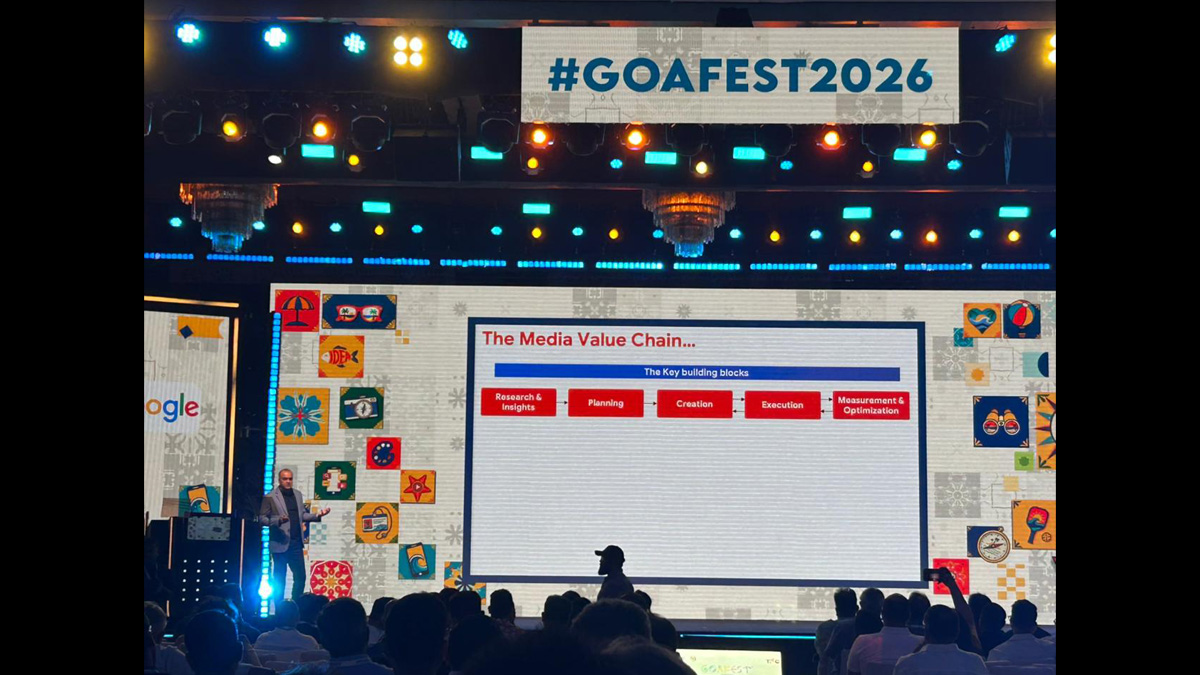
MUMBAI: There was a time when marketers proudly said, “there’s an app for that”. At Goafest 2026, Google arrived with a sharper twist now, apparently, there’s an agent for that too. At a keynote session titled There’s an Agent for That – Excelling in the AI Era at the Taj Cidade De Goa Horizon, Satya Raghavan, Director, Marketing Partners at Google India, painted a picture of a world where artificial intelligence agents may soon become as common as mobile apps once were. And if the app economy changed consumer habits over the past decade, Raghavan argued, the agent economy is preparing to rewrite them all over again.
The session blended humour, tech demos and marketing theory with a clear message for agencies and brands packed into the Goafest audience: AI is no longer just generating content, it is beginning to make decisions, execute workflows and communicate on behalf of humans.
And according to Google, the advertising industry needs to move quickly.
Raghavan began by tracing how rapidly consumer expectations have evolved over the last two decades. From checking calories to locating parked cars, apps became the universal solution for every new behaviour. But now, he suggested, consumer habits themselves are mutating faster than platforms can keep up.
“The old funnel is kind of dead,” he remarked, describing modern audiences as consumers who are simultaneously “searching, streaming, scrolling and shopping” often all at once and in no predictable order.
That behavioural chaos, according to Google, is exactly where AI agents enter the picture.
Raghavan described agents not as futuristic science-fiction entities, but as digital representatives designed to act on behalf of people and businesses. To simplify the concept, he drew parallels with everything from James Bond and Bollywood’s Agent Vinod to ordinary travel agents.
“An agent is someone or something that does a job on behalf of somebody else,” he explained.
The keynote’s most memorable moment came through a demonstration video featuring two AI agents talking directly to each other, one representing a hotel and another representing a customer trying to book a wedding venue. Instead of humans negotiating dates and guest counts, the AI assistants handled the conversation themselves before switching into a more efficient machine-to-machine communication protocol midway through the exchange.
The example may have sounded amusing, but the larger point was serious: AI agents are rapidly evolving from passive assistants into autonomous systems capable of completing real commercial tasks.
And for marketers, that opens an entirely new frontier.
Raghavan showcased multiple use cases already emerging inside advertising and commerce ecosystems. One involved AI agents automatically generating thousands of ad variations in seconds — work traditionally handled manually by creative and media teams. Another demonstrated an AI-powered job application assistant capable of identifying opportunities, drafting outreach emails and sending applications autonomously.
“Humans should spend time on high-value tasks,” he said, arguing that repetitive operational work is increasingly becoming AI territory.
Google’s pitch to agencies and marketers was not merely theoretical. The company revealed that it has already developed a growing ecosystem of AI agents and agent-building tools within its Gemini environment. Through what Raghavan described as an “Agent Development Kit”, users can now build functional AI agents without traditional coding skills — simply by chatting with the system and giving instructions.
The shift, he argued, marks the transition from the “generative AI era” into what he called the “agentic era”.
And unlike earlier waves of AI hype, this one is increasingly tied to operational execution.
The keynote also reflected how quickly platforms like Google are embedding AI deeper into advertising workflows. Raghavan pointed to evolving search behaviour where users now interact conversationally with search engines instead of typing isolated keywords. Features like AI Overview and AI Mode, he said, are transforming search into a dialogue-driven experience, one that still creates new advertising opportunities for brands.
For agencies attending the session, the message was both exciting and unsettling.
Media agencies were encouraged to identify repetitive campaign management tasks where AI agents could improve efficiency, while creative agencies were urged to explore AI-driven adaptation tools capable of transforming assets across formats and platforms instantly.
Raghavan also revealed that several partners have already begun experimenting aggressively with the technology. He cited Havas Media as one of the early adopters that not only deployed Google’s AI agents internally, but also modified and improved them further to suit operational needs.
The broader implication was difficult to miss.
The advertising industry, long obsessed with automation, targeting and personalisation, may now be entering a phase where AI does not simply assist campaigns, it participates in them.
And if mobile apps defined the last digital revolution, Google believes AI agents could define the next one.
By the end of the session, Raghavan’s recurring line had become less of a punchline and more of a warning shot for the industry gathered at Goafest.
“There is an agent for that,” he repeated.