Brands
Ganesh Chaturthi 2025: Brands pull out all stops for the festive season

MUMBAI: Ganesh Chaturthi, the festival that brings Mumbai to a standstill and fills Indian homes with chants, modaks and the heady sound of dhols, has long been more than just a religious celebration. For brands, it is a marketing carnival. The ten-day festival celebrates Lord Ganesha, remover of obstacles and patron of new beginnings. It also signals a consumer mood of optimism and indulgence.
Companies from FMCG giants to real estate firms time campaigns to coincide with this wave of sentiment. Families repaint homes, stock up on groceries, splurge on new clothes, buy sweets in bulk, and even consider big-ticket purchases such as cars and property. This year, marketers approached the festival with unusual zeal. The result was a crop of campaigns that combined technology, nostalgia and product innovation—some deft, some daring, but all designed to link brands to the emotional core of Ganesh Chaturthi.
Instamart: Groceries become art
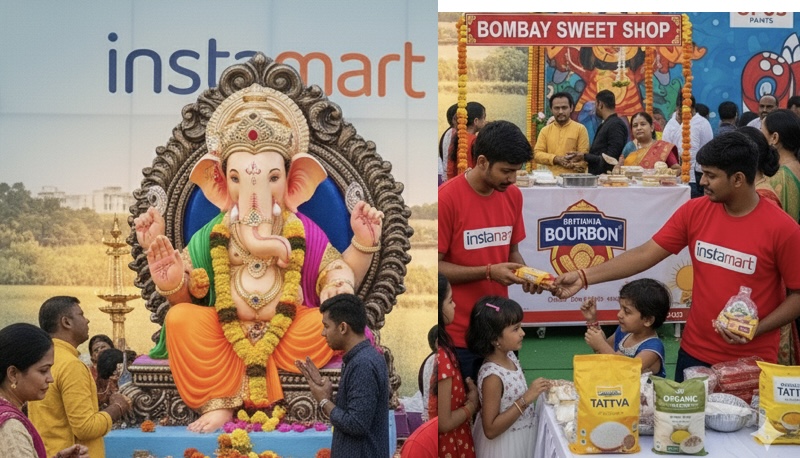
Quick-commerce platforms usually shout about speed: delivery in ten minutes, essentials at the tap of an app. But Instamart chose subtlety. Teaming up with Arthat Studio, it erected a striking installation in Mumbai’s Inorbit Mall. At first glance it appeared to be nothing more than a chaotic heap of coconuts, diyas, flowers and puja thalis. But scan it through a smartphone, and the pieces aligned into a three-dimensional idol of Ganesha.
The symbolism was neat. Just as the scattered objects formed a whole only when viewed through the right lens, Instamart promises to assemble the seemingly random pieces of a festive shopping list into one convenient order. Beyond the art, the campaign also functioned as a product catalogue: eco-friendly idols, temple prasad, modaks, decorations, and other essentials featured prominently on the platform. For Instamart, the festival was not only about spectacle but also about asserting itself as the indispensable partner for India’s season of plenty.
Britannia Bourbon X Bombay Sweet Shop: Tradition with a twist
If Ganesh Chaturthi has one culinary icon, it is the modak. Sweet shops across Maharashtra line their shelves with hundreds of varieties, from the classic steamed ukadiche modak to innovative chocolate and mango-flavoured versions. Into this crowded space stepped Britannia Bourbon, a mass-market biscuit brand, in collaboration with the boutique Bombay Sweet Shop.
Their creation—the Bourbon chocolate modak—was a clever cultural remix: a peda made of crushed Bourbon biscuits and choco crème, topped with edible gold leaf. It hit stores and delivery platforms across Mumbai just in time for the festive rush. For Britannia, this was not merely a seasonal gimmick but a signal that even humble biscuits can aspire to festive luxury. For Bombay Sweet Shop, it was another instance of blending old traditions with urban tastebuds. The tie-up underscored a wider marketing trend: heritage foods reinvented for Instagram and the urban millennial palate.
Organic Tattva: Purity as positioning
Amidst the sugary excess, one brand chose restraint. Organic Tattva’s campaign was centred on “authenticity”, linking pure, chemical-free food to the sanctity of religious rituals. In a short film featuring Reshma More, a modak specialist, the brand emphasised that offerings made with organic jaggery and flour are more than just healthy—they are spiritually appropriate.
The move taps into a growing consumer anxiety: are today’s foods safe? By associating itself with puja rituals, Organic Tattva positioned its products as the morally correct choice, not just the nutritious one. In a world of fusion modaks and instant mixes, the brand argued for a return to roots. It was less about modaks themselves than about staking ownership of the values underpinning festivals—purity, health, and continuity of tradition.
 Birla Opus Paints: The colour of devotion
For paint companies, the festival season is peak season. Homeowners rushing to refresh walls ahead of Diwali and Ganesh Chaturthi make for a lucrative market. Birla Opus Paints approached the festival with a story rather than a sales pitch. Its digital film showed a boy yearning to bring Ganesha home for the first time. His parents, hesitant because repainting seemed a hassle, eventually relented, understanding that devotion outweighs logistics.
The metaphor was simple: painting is not just about colour, but about emotional renewal. The act of giving one’s home a fresh coat becomes part of the ritual of inviting joy in. The campaign, closing with the line “Rangon Ko Khushiyan Phailane Do, Duniya Ko Rang Do”, elevated paint from commodity to symbol. By focusing on the child’s perspective, Birla Opus sidestepped the hard sell and instead wrapped its product in emotional resonance.
Sunny Cooking Oil: A journey home
Cooking oil is hardly the stuff of cinematic storytelling. Yet Sunny Cooking Oil’s “Letter to Bappa” managed to turn it into one. The film followed a young girl travelling from her city home back to her ancestral village. Along the way she witnessed varied forms of celebration: modest pujas in small homes, elaborate pandals in city streets, and community feasts.
Her reflections coalesced in a letter to Lord Ganesha, reminding viewers that while rituals differ, the essence—devotion, family, and food—remains constant. Sunny’s long-standing tagline, “Life Aapki, Recipe Aapki”, slotted neatly into this narrative. The implicit message: whether frying festive snacks or preparing a simple family meal, Sunny is a quiet enabler of togetherness. It was an attempt to take an everyday staple and imbue it with festival emotion.
JSW MG Motor India: Practicality with panache
In the crowded car market, features such as touchscreen displays, panoramic sunroofs and safety ratings usually dominate. MG Motor took a different tack. Its digital film set in a showroom depicted a family shopping for a car, with a son oddly obsessed with inspecting the boot. Only in the final scene did the reason emerge: he was making sure their new car could carry Lord Ganesha home.
The reveal was both heartwarming and slyly strategic. For Indian families, festivals are a prime moment to justify big-ticket purchases. By linking boot space—a mundane but practical feature—to a cultural ritual, MG embedded itself into the festive decision-making process. The campaign exemplified how even a rational purchase can be reframed through the lens of emotion.
Homesfy: A roof for Bappa, a dream fulfilled
If Ganesh Chaturthi is about beginnings, then few beginnings are as momentous as owning a home. Homesfy, a digital-first real estate brokerage, tapped into this with an ad film tracing a boyhood memory. A group of children marvelled at Ganesha idols in a workshop. One remarked wistfully: “To bring Bappa home, you need a home of your own.” Decades later, the same boy, now a man, finally achieved that dream—with help from his Homesfy advisor.
The film struck at a deep cultural truth: festivals, especially Ganesh Chaturthi, are intertwined with aspirations of stability and progress. By aligning itself with the emotional climax of home ownership, Homesfy elevated its service from transaction to life milestone.
The wider lesson
What unites these disparate campaigns is the way brands sought to move beyond surface-level festivity. Some relied on spectacle and technology (Instamart), others on culinary innovation (Britannia Bourbon), while still others leaned on emotion and memory (Birla Opus, Homesfy). All tried to embed themselves in the rituals, values and aspirations that define Ganesh Chaturthi.
There is always a risk of over-commercialisation—of sacred traditions reduced to product placements. But when handled deftly, as many of these examples show, brands can do more than sell: they can become part of the collective experience of celebration. In a festival devoted to the remover of obstacles, perhaps it is only fitting that marketers too find creative ways to enter Indian homes, hearts—and shopping baskets.