MAM
Digital may kill journalism before print, warns Shekhar Gupta at CII Summit ’25

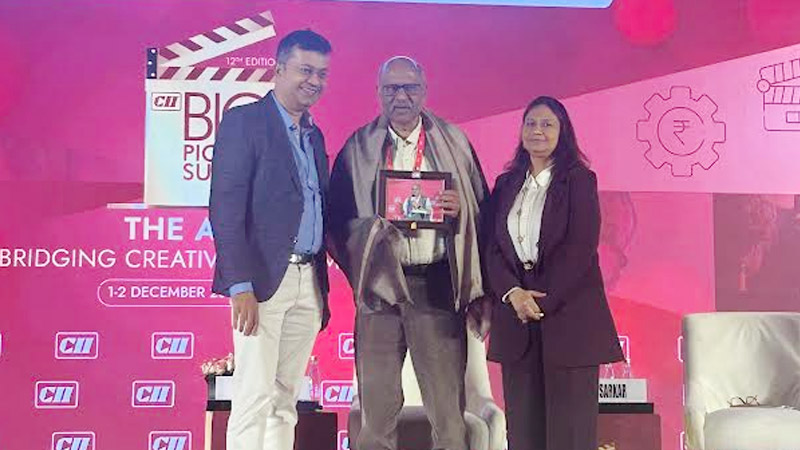
MUMBAI: “Print will die someday, but not this Friday,” Gupta quipped. This is how veteran journalist and founder of The Print Shekhar Gupta opened his sharp, historically grounded critique of the media industry’s evolution at the CII Big Picture Summit 2025, arguing that while the long-predicted death of print remains distant, the death of journalism itself may be dangerously near.
He dismissed the question “Is digital the future?” as two decades out of date, recalling the World Editors Forum in Zurich in June 1999, when global publishers spent three days forecasting print’s imminent demise. “If predictions were right, there should be no New York Times, no The Indian Express, no The Hindu today,” he said. “Yet print remains the only consistently profitable news model in India.”
Gupta argued that digital disruption hasn’t destroyed print, it has created something far more insidious: the erosion of journalistic nuance and trust.
He flagged three structural threats:
. Nuance has vanished. Digital incentives reward outrage, binaries and instant reactions. “News is not a football match. It has nuance. That nuance is gone.”
. Algorithms now curate reality: once readers tilt toward one ideology online, algorithms feed them only reinforcing content, turning journalism into echo chambers. “You end up preaching to the converted.”
. The rise of a ‘mutant species’: news curators. Gupta described digital newsrooms increasingly staffed by young “content writers” on short-term contracts, hired to repackage social media into 200-word posts. “This has sucked the soul out of journalism.” Many job applications he receives are AI-generated – some incomplete, with target fields left blank.
Gupta described digital newsrooms increasingly staffed by young underpaid “content writers” on short-term contracts, hired to repackage social media into 200-word posts. “This has sucked the soul out of journalism.” Many job applications he receives are AI-generated, some incomplete.
Despite decades of decline forecasts, India’s print sector is “prospering”, adding journalists, pages and advertising. Government ads, IPO notices and statutory disclosures continue to anchor revenue. Print remains a trusted format with deep regional penetration.
“Change comes through messy negotiation, not linear disruption,” Gupta said.
Gupta also touched upon the story behind The Print’s origin.
At Sharad Pawar’s 75th birthday event in Delhi, he read an online column speculating that Pawar might become India’s next President simply because major leaders attended the celebration. “I wondered: how could a serious editor write this?”
Former minister of state for external affairs MJ Akbar, sitting beside him, responded, “That’s the problem when serious people go online. They lower the entry barriers.”
The moment crystallised The Print’s philosophy: bring the diligence, verification and patience of old-school print journalism to digital.
“We did not publish rumours during Kargil without confirmation,” Gupta said. “Those values — slowness, verification, responsibility – are what we wanted to carry forward.”
That’s how The Print got its name: a digital platform built on print values.
The Print plans to expand into business, finance, technology and sports, but with the same slow, rigorous ethos. “Digital lowered entry barriers for organisations like ours,” Gupta said. “It cut two zeros out of investment, people and generations required. Why should I fight that? We must ride it, without sacrificing quality.”
He noted that press freedom is not explicitly guaranteed in the Constitution; instead, it survives through a social contract shaped after the Emergency imposed by late and then prime minister Indira Gandhi. “That social contract,” Gupta argued, “still protects credible journalism today.”
During the 1975–1977 Emergency, press freedom was severely curtailed. The government enforced pre-censorship orders, compelled newspapers to obtain official approval before printing political content, and used administrative pressure to silence dissenting outlets. Several journalists were detained, and independent media was effectively throttled through a mix of legal restrictions, intimidation and direct state control.
Gupta repeatedly emphasised that technology is easy to acquire, but trust takes years to build. “India does not need more news. It needs more trust. And trust is earned with conventions, discipline and time.”
“The challenge,” he concluded, “is to embrace what must change – and insist on what must not.”






