MAM
Capital crunch: India’s media and entertainment sector battles for investor attention

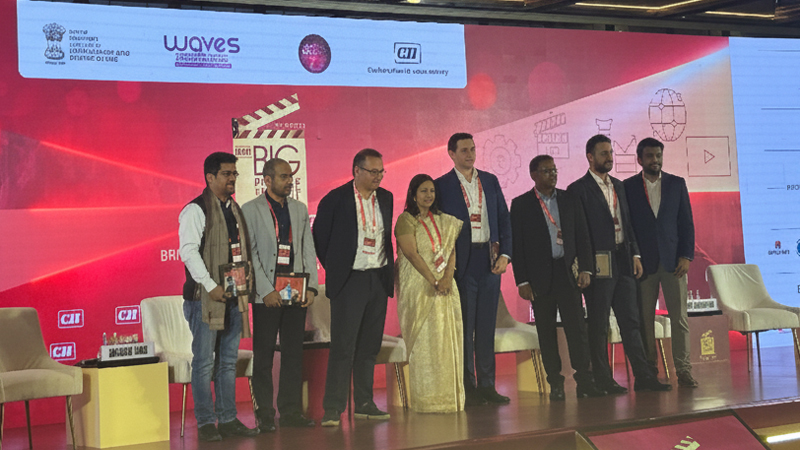
MUMBAI: India’s media and entertainment sector is trapped in a paradox. High growth, high opportunity, but persistently low institutional capital. At the CII Big Picture Summit, a panel titled “Bridging the Funding Gap: Unlocking Investment for India’s M&E Sector” brought together industry veterans and investors to dissect why a sector contributing Rs 3.5 trillion struggles to attract serious money, and what needs fixing.
Shibashish Sarkar of Reliance Entertainment, chairing the session, framed the challenge starkly: a century-old industry built on private passion and private purses now needs institutional heft to scale. But the money isn’t flowing. Atul Phadnis of Vitrina AI pointed to a brutal cocktail of recent shocks: Covid’s production surge followed by a stock market hammering of media companies, Netflix’s subscriber wobbles, Hollywood strikes, and the slow-motion collapse of linear TV. Global production financing, tracked daily by Vitrina across 100 countries, shows volumes slumping to near pre-pandemic levels, with the United States weakened and government-backed markets like Germany, Japan and Brazil surging ahead.
Nicolas Granatino, president of Stem AI and backer of India’s first triple-A console game based on Indian mythology, sees untapped goldmines. “The talent here is incredible,” he said, pointing to India’s epics, the Ramayana, the Mahabharata, as story worlds with global reach that remain criminally underexploited. His bet on Age of Vipara, involving Amish Tripathi and Abhita Bachchan, backs Indian IP at Hollywood quality, targeting both eastern authenticity and western novelty.
Joachim Laqueur, founding partner of 432 Legacy Ventures, argued that the real bottleneck isn’t creativity but infrastructure: rights management, audience discovery, transparent distribution. “You can create a great film with great stars, but distributing it through normal agency channels just doesn’t work anymore,” he said. His fund targets the plumbing: tools that let creators find audiences in Japan, partner with South Korea, price content intelligently and deliver returns to backers.
Anup Chandrasekhar, chief operating officer for regional content at The Epic Company, made the strongest pitch for regional markets, where 60 per cent of theatrical revenue originates. Regional cinema, he insisted, is investor-friendly if you avoid cherry-picking single films and commit to slates. Returns of 20 to 40 per cent are achievable, he claimed, but institutional funding remains scarce. Instead, producers rely on loan sharks charging 3 to 4 per cent monthly interest. “India is not Hindi. India is a constellation of regional languages,” Chandrasekhar said, urging investors to back vernacular franchises like Pushpa and niche OTT platforms catering to hyperlocal dialects and genres: Marathi theatre, micro-dramas, community-specific content.
The panel, which also featured Karan Taurani, executive vice president at Elara Capital, and Aneesh Dev, managing director of WAMIndia, agreed: the old revenue models are dead. Linear TV is a bonus, not a base. Content must be platform-agnostic, multi-revenue, multi-format. The sector isn’t dying, it’s shape-shifting.
The message to investors? Stop treating India’s media sector as a Bombay monolith. Think regional, think IP, think infrastructure. The opportunities are there. The capital, for now, is not.