Brands
Can Ranveer Singh breathe life into the Swiss tourism industry?

MUMBAI: Everyone loves a little vacation once a year. They say, Travel makes one modest, you see what a tiny place you occupy in the world. The tourism industry today is booming with the number of people travelling to foreign destinations witnessing a three-fold rise.
Travel and tourism is one of the world’s fastest-growing sectors today, with close to $1.6 trillion clocked in bookings in 2017. A strengthening global economy lies at the heart of industry growth. Each year, the global traveler pool is flooded with millions of new consumers from both emerging and developed markets, many with rising disposable incomes and a newfound ability to experience the world.
According to 2017 report by TripAdvisor, for globetrotting Indians preferred traveling to Dubai, Singapore, Bangkok and Pattaya, while the evolved and well-heeled Indians sought relatively unexplored destinations such as Genoa in Italy, Corsica in France, Bora Bora and Iceland.
As many as 2.8 crore Indians travel to international destinations every year. Places like Dubai, Switzerland, Maldives, Maccau, Bali, Singapore, Thailand among few others, have always been popular among Indians.
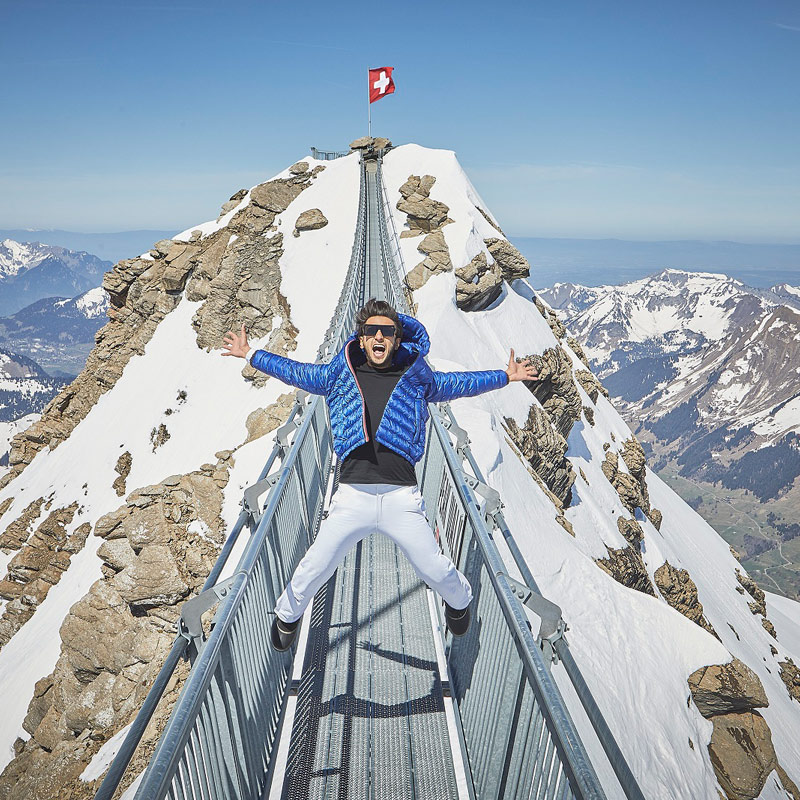
At a time when the travel industry is booming with tourists pouring in from all parts of the world, Switzerland, a destination once every Indian wanted to travel to (thanks to Yash Raj and Bollywood movies), now seems to have lost its appeal. The situation was dire that the revenue from tourism remained stagnant at 15.7 billion CHF between 2013-15. To increase the footfall of Indian travelers, Switzerland appointed Bollywood actor Ranveer Singh as its brand ambassador with a hope to attract Indians and Bollywood fans from across the globe.
Earlier this month, Switzerland tourism launched its second campaign with Ranveer. The tourism board this time, wants to promote Switzerland as a destination for everyone, especially those who are single. Switzerland Tourism India Director Claudio Zemp said, “We wanted to promote Switzerland as a year long destination rather than the preconceived image that everyone has about the place that its only a romantic destination. Hence, we decided to target the younger generation in the campaign to come and explore the place for its adventures.”
According to Zemp, ever since they’ve signed Ranveer as the brand ambassador, Switzerland tourism has seen an increase of 23.4 per cent Indians staying over night.
Overall, the tourism industry has grown by 119 per cent in the last 10 years with an average of 8 per cent per year.
The second campaign with Ranveer was also not created by any ad agency and was instead executed in-house by the tourism board along with the actor’s team.
Although the campaign was launched in the first half of June, most of the schools and colleges start by this time of the year in India. Therefore, it would have made much more sense for the tourism board to launch the campaign between November-February, as that is when most Indians decide on their summer travel plans. Since the final product of the campaign became ready quite late, Zemp said that they are targeting the next peak season with this campaign.
Travel ads are usually targeted at those with enough funds to spare for travel. Hence, it makes more sense for them to advertise on lifestyle and infotainment channels along with B2B marketing. And that’s exactly what most tourism companies imply. However, Zemp mentioned that they had no plan of launching the campaign on television due to budget constraints and it will only be digital led.
“We don’t have enough budget to do television advertising as we are not the Coca-Colas of the world. Our advertising budget on mainstream media In India is limited.”
For Switzerland, 5 per cent of its visitors come from India, 71 per cent of whom travel between April-August. To promote the tourism, Switzerland has various offers on its rail passes and other tickets. For this, Zemp mentioned that 45 per cent their annual budget goes into digital marketing as it is cheap, efficient and quick.
Ever since the brand signed Singh, in 2017, the total of overnights spent in Switzerland grew by +5.2% to 37’392’740. The source market India, along with South Korea, South East Asia, Brazil, and Taiwan, reported record results highlighting the big allure of Switzerland in Asia.
Though Switzerland tourism is now spending big bucks to promote its agenda, the country continues to face stiff competition from other emerging travel destinations that have become a favorite with the Indian travelers of late. The challenge for Switzerland now is not just to market itself better than others but also regenerate interest among Indians.