Brands
AKAI India launches flagship 100 and 75 inch Google TV range
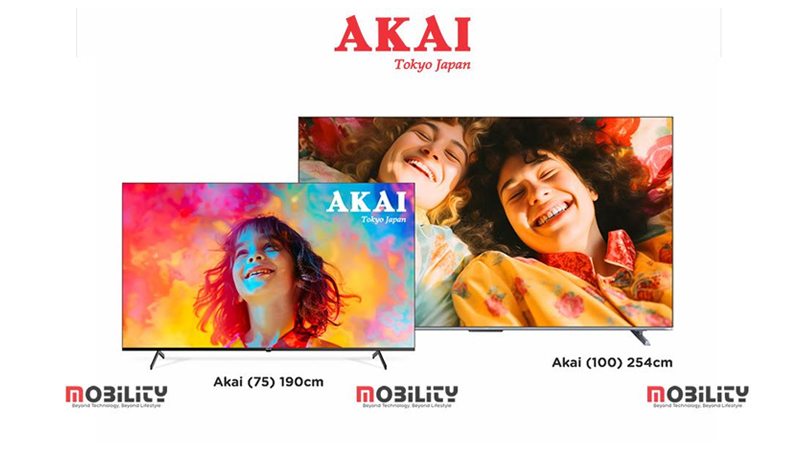
Mumbai: AKAI India has launched its new big-size TVs, featuring advanced 4K QLED display technology, Dolby Vision, and Dolby Atmos Sound. Running on Android 11, the series includes MEMC technology for smoother motion and QLED+ display for enhanced picture clarity.
Available in two sizes— 75-inch (190 cm) and 100-inch (254 cm)—the TVs offer a cinematic viewing experience. The 100-inch model features a 120 Hz refresh rate, HDR 10+, HLG, 178-degree wide-angle viewing, and 400 nits brightness. The 75-inch model comes with a 60 Hz refresh rate, HDR 10, HLG, and 350 nits brightness. Both models have a colour gamut of up to 90 per cent NTSC 1931.
The range includes a bezel-less design, 3840×2160 resolution, built-in Chromecast, Miracast, Google Play, and Google Assistant. The 100-inch variant also offers hands-free voice control through Google Far Field voice control. Connectivity options include three HDMI ports, two USB ports, and a LAN port.
Starting at Rs 99,990 for the 75-inch model and Rs 3,99,990 for the 100-inch, the TVs come with a two-year warranty and flexible EMI options through various financial partners. Available at Electronics Mart India and authorized dealers across India.
Speaking about the launch, AKAI India MD Anurag Sharma said, “This series represents a new frontier in television technology, combining exceptional display performance with powerful sound and the smart capabilities of Google TV. In our endeavor to deliver a ‘Better Up’ experience the personalised cinema, which we call signature cinema is the first step. These big sized TVs signify Akai’s commitment to pushing the boundaries of innovation, ensuring our customers have access to the best that television technology has to offer.”

Brands
Wipro hires 7,500 freshers, withholds FY27 hiring outlook
Profit rises to Rs 3,522 crore, Rs 15,000 crore buyback announced.
MUMBAI- Hiring may be on, but visibility is off, Wipro is adding talent even as it pauses the crystal ball. The company hired 7,500 freshers in FY26 but stopped short of offering any hiring outlook for FY27, underscoring the uncertainty gripping the IT services sector as it pivots towards an AI-led operating model.
The disclosure came alongside its fourth-quarter earnings, where management flagged volatile demand conditions and refrained from committing to future workforce expansion. Chief human resources officer Saurabh Govil noted that over 3,000 of the total hires were onboarded in the March quarter alone, signalling continued intake despite a lack of clarity on deployment pipelines.
This divergence active hiring without forward guidance reflects a broader industry pattern where talent acquisition continues even as deal conversions remain uneven and client spending cycles stretch. Wipro expects its IT services revenue for the June quarter to range between a decline of 2 per cent and flat growth sequentially in constant currency terms, reinforcing near-term caution.
Chief executive officer Srini Pallia pointed to artificial intelligence as both a disruptor and an opportunity. He said evolving client priorities are pushing the company towards outcome-driven engagements, with Wipro increasingly focusing on a services-as-software model through its AI Native Business and Platforms unit. The shift marks a structural change from traditional headcount-led growth to AI-enabled delivery frameworks.
The company has already committed over $1 billion to its AI ecosystem, with investors closely watching how these investments translate into revenue. For now, the numbers present a mixed picture. Net profit rose sequentially to Rs 3,522 crore, while revenue grew 3 per cent to Rs 24,236 crore. However, core IT services performance remained under pressure, with full-year revenue declining 0.3 per cent in dollar terms and 1.6 per cent in constant currency.
Large deal bookings offered a counterpoint, rising 45.4 per cent year-on-year to $7.8 billion, highlighting a widening gap between deal wins and actual revenue realisation. On a quarterly basis, IT services revenue slipped 1.2 per cent sequentially, signalling continued softness in execution.
Margins, however, told a more optimistic story. Operating margins expanded to 17.3 per cent in the fourth quarter, up from 14.8 per cent in the previous quarter, reflecting improved cost discipline. That said, the company cautioned that upcoming wage hikes and the ramp-up of large deals could exert pressure going forward.
Attrition stood at 13.8 per cent in the March quarter, indicating stabilisation after periods of elevated churn. Alongside its earnings, Wipro also announced a Rs 15,000 crore share buyback, reinforcing its focus on shareholder returns, with a payout ratio of 88 per cent over the past three years.
Taken together, the numbers capture a company in transition investing in AI, maintaining hiring momentum, but navigating a demand environment where growth is uneven and visibility remains limited.