AD Agencies
Aidem Ventures: A comeback tale

Filling someone‘s shoes is never easy and especially when that someone is the person you‘ve always looked up to. Vikas Khanchandani, director of media outsourcing firm Aidem Ventures, who was part of the founding team humbly acknowledges the fact.
 |
“We all know Raj Nayak the man who started it and had the vision to look at an opportunity keeping in mind the fragmentation that the industry was witnessing. He has left very large shoes for me to fill and I don‘t think it‘s going to be easy doing that. After working with him for 14 years I am glad to make an attempt at fulfilling a dream and I know he is extremely proud of what we have done and continue to do.”
Aidem Ventures was carved out of NDTV Media which ad veteran Raj had set up as a 26:74 joint venture in 2003 with major TV news network NDTV. NDTV Media‘s role was to do ad sales for NDTV (and any other channels it would launch), Mi Marathi and Sahara‘s TV channels. All was well for a few years.
But then NDTV launched a Hindi GEC NDTV Imagine in 2008 and did not hand over ad sales to Raj and his team. He waited and watched for a couple of years for things to change, but nothing did.

 |
|
Vikas Khanchandani believes obstacles are the best path to take
|
Hence, in 2010, Raj decided to quit NDTV Media and with the supposed blessings of both Prannoy and Radhika Roy he set up Aidem Ventures taking its entire sales team and business to the new firm in an effort to build a standalone enterprise. Things were hunky-dory, and Raj roped in some senior industry professionals such as Kaushal Dalal, M. Suku to strengthen the organisation. The venture was cruising until a year later when NDTV decided not to renew its contract. It was almost as if the entire floor collapsed under Aidem as NDTV accounted almost 80 per cent of the new fledgling‘s business.
Many of the founding senior management team headed for the exits. Around this time, Raj moved to Viacom18 as the CEO of Colors after finding an investor and well wisher, leaving with the belief that Vikas and team would successfully run with the baton.
Raj also took the efforts to reassure everyone that the company will continue to keep its stakeholders‘ benefit in mind and will work forward to fulfilling its motto.
“But those were tough times,” recollects Vikas. “We scaled down our operations and had to calm clients apart from making sure that our colleagues were absorbed in other companies. We did not lay off anyone.”
 |
|
The Aidem dream team: Alok Rakshit (regional entertainment & news head), Joydeep Ghosh (eBUS business head, India), Lama Choudhury (business development head)
|
The investor that came in was none other than a client in his personal capacity: Ashok Gupta of the HDIL group, who was involved in a channel Live India. His entry and financial injection proved to be the proverbial turning point.
From being a near basket case then, the firm has come back very strongly. And how. Today, Aidem has 100 plus employees and 30 clients across broadcasters and publishers nationally and claims to be more experienced in the outsourced model compared to any of its peers. The reason behind this is nothing but years of experience and practice that has built a whole host of services and IT enabled infrastructure that has given it an edge over some of the larger networks.
“We spent two years to create extensive resources to have a robust platform which is web enabled giving people opportunity to feed, view and retrieve information on the go. We have experience across platforms and across genres from news – national and regional, regional entertainment, Hindi entertainment and niche and hence have build extensive knowledge and on pricing and strategy which have immensely helped our partners to improve their yields,” explains Vikas.
He further adds, “We have the finest operations process and teams, something that keeps revenue based errors to negligible levels thereby bringing efficiencies in our service. Aidem also has one of the finest digital sales and operations team offering solutions to our digital publishers. Lastly, we are go-to-market experts, something that we have proven to our technology partners by creating the business model and then executing it as per plan and strategy to create one of the largest service providers in digital delivery of ad commercials within the country.”
Madison Media COO Karthik Lakshminarayan agrees that there is a need-gap in the market and that is when such media-sales organisations have a huge potential to flourish. “Niche and regional channels don‘t have enough revenues to have a specified sales team and hence, such organisations come to their rescue unlike the large networks which have their own set ups.”
 |
|
The Aidem dream team contd: Neena Dasgupta (digital & international business head), Nikhil Sheth (Hindi entertainment & niche channels head) , Shailendra Shetty (systems head)
|
Vikas has built a solid team, which is responsible for the Rs 200 plus crore business, Aidem generates across platforms for its clients. Alok Rakshit is the business head across regional entertainment and news. Neena Dasgupta looks after the digital & international businesses as business head. Joydeep Ghosh leads the eBUS Business for India. Nikhil Sheth is business head across Hindi entertainment & niche channels while Shailendra Shetty has been instrumental in devising and developing work flow and system for traffic and sales operations. Lama Choudhury heads the business development team and is actively involved with all commercial negotiations and deal evaluations. He has been with Aidem right from its incorporation.
“Our hierarchy is simple, each business head has people under them looking after different regions,” explains Vikas.
Tamil television broadcaster Jaya Network which has been with Aidem for more than an year is not only content but also thanks it for bringing in more clients (read: revenues). “We started with one channel but now Aidem handles the whole bouquet and within a year we have seen a 30 per cent increase in revenue,” proudly proclaims Jaya TV marketing head S Senthil Velavan.
Similarly, The Economist which is in its second year of association with Aidem never anticipated the results it has got so far. “I knew Neena Dasgupta and when she came with a proposal for our online business, we were open to it. And all I can say is that revenues are now substantial while it was negligible when they came to us,” says The Economist India MD Supriyo Guha Thakurta.
One venture which the organisation feels was a god-send was that of eBus, a digitial delivery and distribution platform for short form TV commercials, which it set up as a joint venture with a Singapore based company (headed by its CEO Carmine Masiello) of the same name in 2010. eBus is arguably one of the largest providers of this service to the advertising and broadcasting industries and was acquired by media logistics company IMD this year. “The acquisition gave us some good cash which has helped us retire all debt,” says Vikas. “But Aidem has the contract to manage it for the next five years. eBus is one of the finest cloud based delivery service and industry swears by it. We have around 300 clients using it.”
 |
|
Karthik Laxminarayan says outfits such as Aidem Ventures help the smaller players
|
Like for any other, the journey for Aidem so far has been challenging, trying and exciting at the same breath. Not every client stays and it has had its fair share of losses. For instance, Radiowalla‘s co-founder Anil Srivatsa feels that though they had partnered with Aidem for only six months, the expectations and capabilities didn‘t match. He blames the timing for it, but however hasn‘t struck it off completely and wouldn‘t mind considering it in the future.
Ups and down are a part and parcel of life and keeping that in mind Aidem sees itself as a platform that will create opportunities for many of its partners to grow and in the process grow with them. It has shortlisted some of the growth areas that it needs to put its energies in to and build them into substantial and valuable business over the next three to five years.
“Right now, Aidem 1.0 is about trading while Aidem 2.0 will be about building platforms offering solutions across channels using technology as a tool to scale. We will also be building new business/services verticals using technology as a tool/differentiator that will help bridge some need gap within our industry,” says Vikas optimistically.
He hopes to reduce the revenue dependence on channels too. “We are far better off from the days of the 80 per cent dependency on NDTV for revenues. But I would like it to come down from the 14 per cent to 20 per cent which it is currently. What that means is getting in more channels,” says Vikas.
What was it that kept him going when everything else around him seemed to be falling apart? “It has been touch and go on several occasions,” he confesses. “But for all of us at Aidem: obstacles are the best path to take.”
Maybe the quote by Marcel Proust “We don‘t receive wisdom; we must discover it for ourselves after a journey that no one can take for us or spare us” can sum up Aidem‘s journey.






AD Agencies
Advertising Rocks Season 4 returns to Goafest 2026 with musical flair
Industry talent takes centre stage as music meets creativity at Goafest
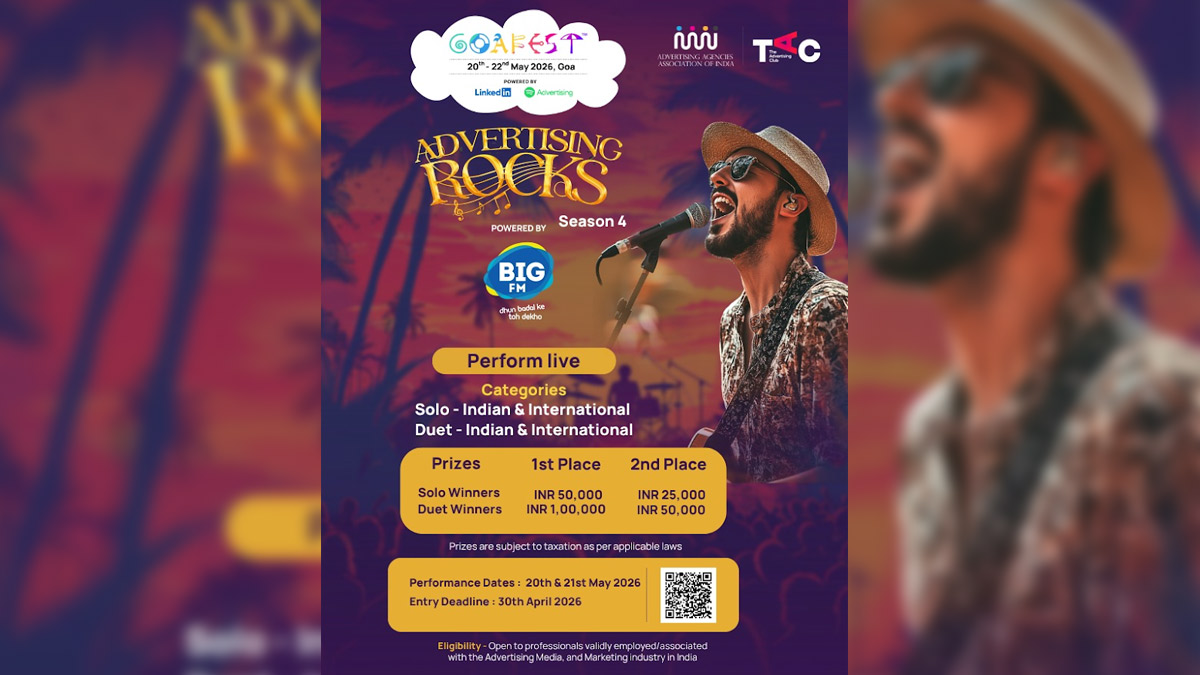
MUMBAI: The spotlight is back on music and marketing as Advertising Rocks Season 4 gears up for a high-energy return at Goafest 2026, promising a louder and more vibrant celebration of creative talent within the industry.
Now in its fourth edition, the platform continues to carve a niche as a space where professionals from advertising, media and marketing step beyond boardrooms to showcase their musical side. Open to solo and duet performers, the competition will unfold across multiple rounds before culminating in a live finale at the festival. Shortlisted participants will also receive complimentary access to Goafest, adding to the appeal.
Each category will feature four finalists, with winners decided through a mix of jury evaluation and audience votes, making the experience interactive as well as competitive. The stakes are equally compelling, with cash prizes ranging from Rs 25,000 to Rs 1,00,000 across categories.
Reflecting on the journey so far, BBH former CEO Subhash Kamath said, “This will be the 4th edition of Advertising Rocks and every year, it’s become better and better. We have some amazing musical talent in our industry and what better stage to perform than at Goafest. I hope we get more entries this time and I’m really looking forward to hearing some fabulous talent.”
Echoing the sentiment, Havas Media Network India chief executive officer Mohit Joshi said, “Season 4 of Advertising Rocks perfectly captures the spirit of our industry, where creativity doesn’t end at the workplace, it finds expression in many forms. At Goafest 2026, we are excited to bring back Season 4, bigger and more vibrant, giving professionals a platform to showcase their musical talent.”
Registrations for the competition are currently open, with entries accepted until April 30. Participants are invited to submit their performances and take a shot at the stage.
Co-hosted by the Advertising Agencies Association of India and The Advertising Club, Goafest 2026 will be held from May 20 to 22 in Goa. With Advertising Rocks returning to the lineup, the festival is set to strike a chord that goes well beyond advertising, blending ideas with rhythm and a touch of showmanship.






