Connect with us

iWorld

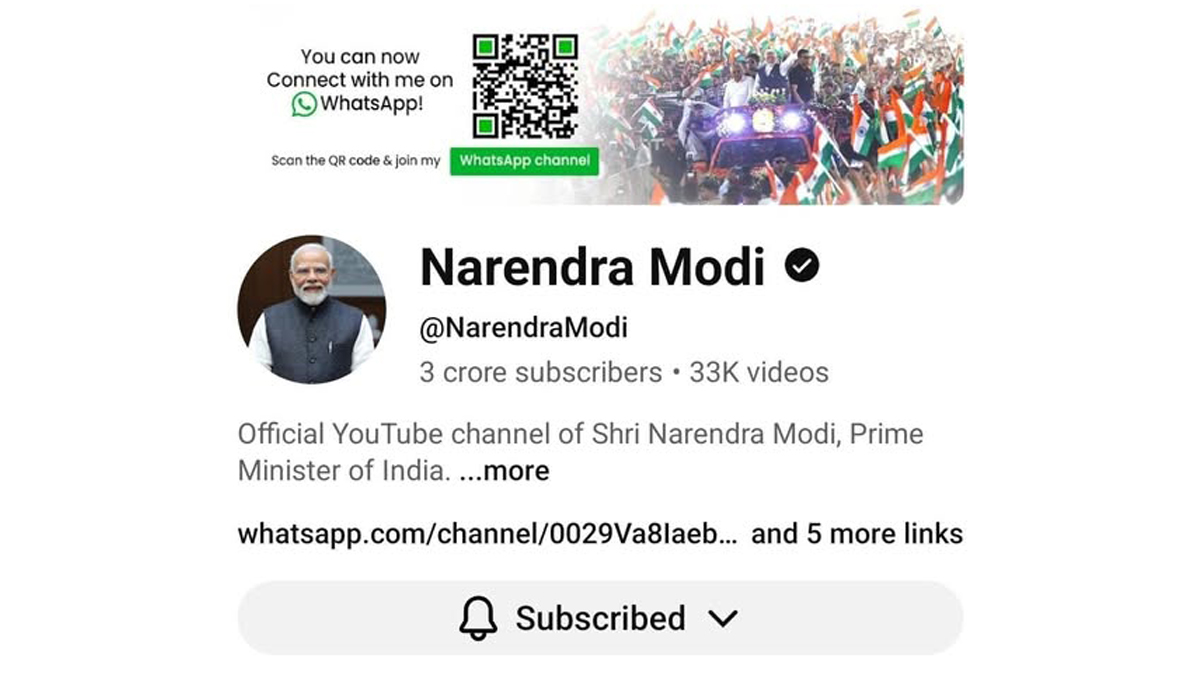
PM Modi hits 30M subscribers on Youtube

World’s most-followed leader adds to 100M Instagram milestone last month.

Published

on

MUMBAI: PM Narendra Modi just clicked ‘subscribe’ on digital dominance because when your YouTube channel outpaces world leaders like a viral cat video, even politics gets binge-worthy. Prime Minister Narendra Modi’s Youtube channel has surged past 30 million subscribers, solidifying his status as the most-followed world leader on the platform, officials announced on 24 February 2026. This milestone leaves former Brazilian President Jair Bolsonaro second with about one-fourth of Modi’s count in the dust, while US President Donald Trump trails with roughly one-seventh the subscribers.

The achievement builds on Modi’s Instagram triumph last month, where he became the first global leader to cross 100 million followers. On Instagram, Modi towers over peers, Trump at 43 million, Prabowo Subianto at 15 million, Luiz Inácio Lula da Silva at 14 million, Recep Tayyip Erdoğan at 11 million, and Javier Milei at 6 million their combined totals still fall short of Modi’s solo mark.

Domestically, the gap is equally stark. Modi’s subscriber base is three times that of Congress leader Rahul Gandhi, and over four times the channels of the Aam Aadmi Party and Indian National Congress. On Instagram, Uttar Pradesh chief minister Yogi Adityanath has 16 million followers, while Gandhi counts 12 million.

Advertisement

Modi joined YouTube and Instagram in 2014, evolving both into powerhouses of digital outreach with governance highlights, cultural moments, and direct citizen engagement. In a world where likes and shares shape narratives, Modi isn’t just leading polls, he’s leading the scroll, turning policy into playlist gold.

Click to comment

Leave a Reply

Your email address will not be published. Required fields are marked *

iWorld

Tech firms tweak office operations amid LPG shortage concerns

Infosys, HCLTech and Cognizant adjust cafeteria services and work policies.

Published

on

MUMBAI: When geopolitics turns up the heat, even office cafeterias start feeling the burn. Several technology companies in India are adjusting workplace operations and food services as concerns over a nationwide shortage of liquefied petroleum gas (LPG) grow following escalating tensions in West Asia. Major IT firms including Cognizant, Infosys and HCLTech have begun rolling out contingency measures to reduce dependence on office cafeterias that rely heavily on commercial LPG.

The disruption stems from rising geopolitical tensions involving Iran after military action by the United States and Israel reportedly led to the closure of the Strait of Hormuz, a critical global shipping route for oil and gas supplies. The closure has disrupted the movement of LPG and liquefied natural gas across international markets, triggering concerns about supply constraints and price volatility.

According to a report by The Times of India, Cognizant has advised employees to bring their own meals to office where possible to reduce reliance on office cafeterias dependent on LPG based cooking.

Advertisement

The company has reportedly told staff that it is preparing for potential disruptions driven by supply prioritisation, price fluctuations and pressure on vendor networks.

As part of contingency planning, Cognizant is identifying alternative food vendors that do not rely on LPG. These include kitchens using induction based or solar powered cooking systems.

The company is also exploring partnerships with cloud kitchens that operate on electric or solar power to ensure uninterrupted food supply in case conventional cooking gas availability worsens.

Advertisement

Additionally, Cognizant is evaluating the possibility of expanding work from home or hybrid arrangements for non critical roles, partly to reduce commuting exposure if fuel prices rise sharply due to global energy disruptions.

Meanwhile, HCLTech allowed employees at its Chennai office to work from home on March 12 and March 13 after cafeteria vendors were unable to operate because of the LPG shortage.

Several food service vendors at the campus reportedly suspended operations as they struggled to secure cooking gas supplies, prompting the company to permit staff to work remotely for the two days.

Advertisement

Infosys has also issued internal advisories across multiple locations, including its campuses in Bengaluru and Chennai.

The company informed employees in Bengaluru that cafeteria services would continue but with reduced menu options due to concerns around commercial LPG availability.

As part of the temporary adjustments, live food counters have been suspended, and employees have been encouraged to bring home cooked food while the situation evolves.

Advertisement

While LPG shortages in India remain a developing situation, the measures taken by these technology firms highlight how global geopolitical disruptions can ripple through unexpected corners of the economy, even the humble office lunch.

For companies with large campuses and thousands of employees relying on daily cafeteria services, cooking fuel shortages can quickly turn into an operational challenge. Until global supply chains stabilise, many workplaces may find themselves rethinking everything from food sourcing to flexible work policies.

Advertisement
Continue Reading

Advertisement News18
Advertisement All three Media
Advertisement Whtasapp
Advertisement Year Enders

Copyright © 2026 Indian Television Dot Com PVT LTD

This will close in 10 seconds

×