Brands
Dabur Red brushes up awareness on fluoride-free oral care
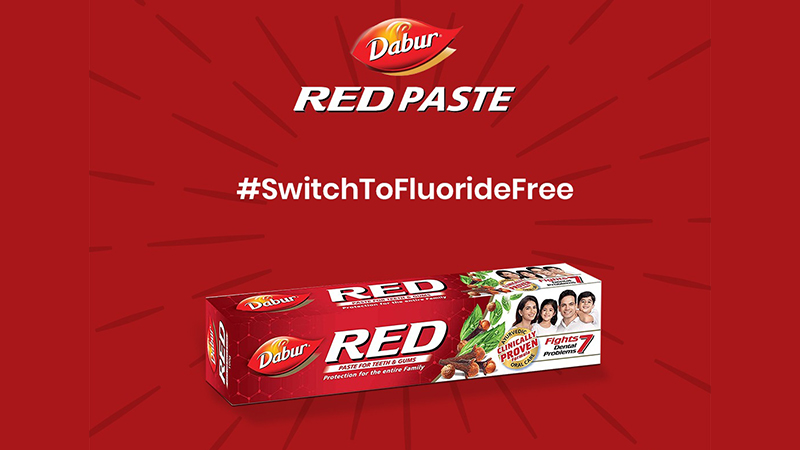
MUMBAI: In a bold move to redefine oral health conversations, Dabur Red Paste has launched the ‘Switch to fluoride free’ campaign, questioning the long-standing presence of fluoride in toothpaste. The month-long initiative aims to spark a nationwide dialogue on the potential risks of fluoride, especially in regions where its overconsumption is already a concern.
Taking the conversation beyond the toothbrush, the campaign will travel across multiple cities, educating consumers about oral care ingredients that are often overlooked. It aims to debunk myths surrounding fluoride’s role in oral hygiene and highlight the need for more natural alternatives.
Dabur India has partnered with Mixed Route Juice, a Delhi- and Bangalore-based marketing agency, to execute the campaign through on-ground activations, influencer collaborations, and digital storytelling.
Dabur India Ltd executive vice president for marketing Abhishek Jugran said, “With this campaign we aim to drive awareness towards a crucial but often times concealed issue. Our goal is to ensure that consumers make informed choices for themselves that will automatically lead to a healthy population. We are also aiming to shake up traditional marketing beliefs with this campaign. Everything that works for the international market isn’t in the best interest of Indian Markets. Our products are centered around effortlessly plugging in the need gaps in Indian markets with Natural Ingredients that have been tried and tested over years. Our call out to our consumers is simple. Read up, research and make independent informed choices.”
Speaking about the campaign, Mixed Route Juice founder & creative director Amrita Sharma said, “At MRJ, we are all for meaningful, purpose driven communications. We are grateful that this opportunity came our way and we could add Dabur and the product Red toothpaste in particular to our portfolio. We’ve used a mixed media touch-points approach where digital becomes a central pillar, on-ground activations driven in priority markets to spread awareness and influencers as media vehicles for driving conversations.”
For decades, fluoride has been positioned as a cavity-fighting hero in toothpaste. However, emerging research suggests that excessive fluoride exposure can lead to skeletal fluorosis, thyroid dysfunction, brittle bones, and cognitive issues in children. Studies indicate that fluoride levels exceeding 1.5 mg/L in drinking water could be linked to lower IQ levels in children.
Despite its widespread use, fluoride can accumulate in the body over time, raising concerns about long-term health effects on bones, the liver, kidneys, and mental well-being. Given these risks, fluoride-free oral care is gaining global traction, with many experts advocating for a shift to safer, natural alternatives.
With ‘Switch to fluoride free’, Dabur Red is challenging conventional wisdom and urging consumers to take a closer look at their toothpaste choices. As the movement gains momentum, one thing is clear, oral health conversations are getting a much-needed refresh.

Brands
Kwality Wall’s reports standalone losses following strategic HUL demerger
Ice cream major faces Rs 64 crore Ebitda loss amid commodity inflation and muted Q3 sales
MUMBAI: Kwality Wall’s (India) Limited (KWIL) has released its first set of financial results as a standalone entity, revealing a challenging start to its independent journey. Following its successful demerger from Hindustan Unilever Limited (HUL) on 1st December 2025 and its subsequent listing on 16th February 2026, the company is navigating a transition period marked by structural changes and high input costs.
For the quarter ended 31st December 2025, the company reported revenue of Rs 222 crores. Despite the revenue base, the bottom line was impacted by several factors, resulting in an Ebitda loss of Rs 64.2 crores. When calculated on a Pre-IND AS 116 basis, the Ebitda loss stood at Rs 83.8 crores.
Organic Sales Growth (OSG) declined by 6.5 per cent year-on-year during the quarter. Volume growth, however, saw a marginal increase of 1.2 per cent. The company reported a gross margin of 41.5 per cent. Additionally, exceptional expenses amounting to Rs 94 crores were recorded, primarily linked to non-recurring costs during the transition phase.
Performance across portfolios and channels was mixed. Within the impulse portfolio, brands such as Magnum and Cornetto recorded mid-single digit volume growth, indicating steady demand in on-the-go consumption. However, the in-home portfolio, which includes take-home packs, experienced muted consumption. The company is planning a relaunch of this category with improved offerings ahead of the 2026 season.
Quick commerce (Q-Com) continued to emerge as a strong growth driver, delivering robust double-digit growth during the quarter. Meanwhile, the company also expanded its physical distribution network by increasing the number of company-owned cabinets across markets.
Margin pressure during the quarter was driven by a combination of one-off factors and broader cost inflation. Gross margins were impacted by around 600 basis points due to trade investments made for stock liquidation. Additionally, cocoa price inflation contributed to another 400 basis points of pressure on margins.
Deputy managing director Chitrank Goel attributed the muted performance partly to prolonged monsoons and transitional challenges linked to the GST framework. Operating expenses also increased as the company invested in establishing its standalone supply chain, operational systems and corporate infrastructure following the demerger.
Looking ahead, the management remains focused on a volume-driven growth strategy. To restore profitability, the company has initiated a cost productivity programme aimed at reducing non-consumer-facing costs. It is also working on building regional manufacturing networks to optimise logistics expenses and improve operational efficiency.
The commodity outlook for the near term remains mixed. Dairy prices are expected to remain firm due to tight supply conditions and rising fodder costs. Sugar prices may also move higher following increases in the Minimum Selling Price (MSP). While cocoa prices have moderated recently, currency depreciation has offset some of the potential cost relief for the company.