Brands
Dabur Red brushes up awareness on fluoride-free oral care
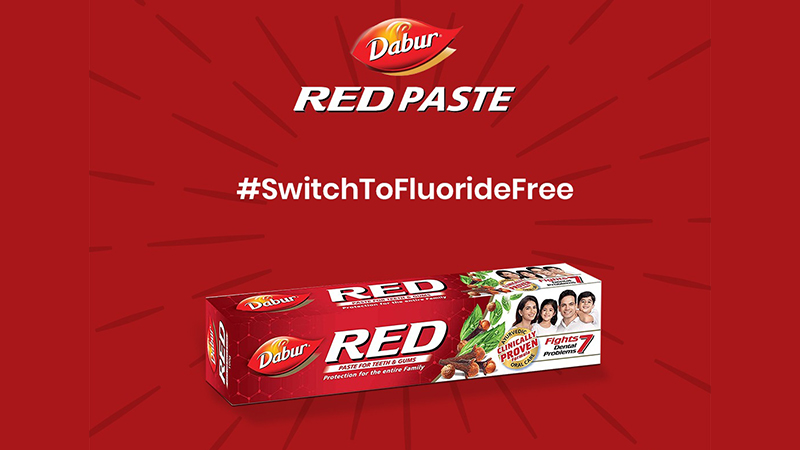
MUMBAI: In a bold move to redefine oral health conversations, Dabur Red Paste has launched the ‘Switch to fluoride free’ campaign, questioning the long-standing presence of fluoride in toothpaste. The month-long initiative aims to spark a nationwide dialogue on the potential risks of fluoride, especially in regions where its overconsumption is already a concern.
Taking the conversation beyond the toothbrush, the campaign will travel across multiple cities, educating consumers about oral care ingredients that are often overlooked. It aims to debunk myths surrounding fluoride’s role in oral hygiene and highlight the need for more natural alternatives.
Dabur India has partnered with Mixed Route Juice, a Delhi- and Bangalore-based marketing agency, to execute the campaign through on-ground activations, influencer collaborations, and digital storytelling.
Dabur India Ltd executive vice president for marketing Abhishek Jugran said, “With this campaign we aim to drive awareness towards a crucial but often times concealed issue. Our goal is to ensure that consumers make informed choices for themselves that will automatically lead to a healthy population. We are also aiming to shake up traditional marketing beliefs with this campaign. Everything that works for the international market isn’t in the best interest of Indian Markets. Our products are centered around effortlessly plugging in the need gaps in Indian markets with Natural Ingredients that have been tried and tested over years. Our call out to our consumers is simple. Read up, research and make independent informed choices.”
Speaking about the campaign, Mixed Route Juice founder & creative director Amrita Sharma said, “At MRJ, we are all for meaningful, purpose driven communications. We are grateful that this opportunity came our way and we could add Dabur and the product Red toothpaste in particular to our portfolio. We’ve used a mixed media touch-points approach where digital becomes a central pillar, on-ground activations driven in priority markets to spread awareness and influencers as media vehicles for driving conversations.”
For decades, fluoride has been positioned as a cavity-fighting hero in toothpaste. However, emerging research suggests that excessive fluoride exposure can lead to skeletal fluorosis, thyroid dysfunction, brittle bones, and cognitive issues in children. Studies indicate that fluoride levels exceeding 1.5 mg/L in drinking water could be linked to lower IQ levels in children.
Despite its widespread use, fluoride can accumulate in the body over time, raising concerns about long-term health effects on bones, the liver, kidneys, and mental well-being. Given these risks, fluoride-free oral care is gaining global traction, with many experts advocating for a shift to safer, natural alternatives.
With ‘Switch to fluoride free’, Dabur Red is challenging conventional wisdom and urging consumers to take a closer look at their toothpaste choices. As the movement gains momentum, one thing is clear, oral health conversations are getting a much-needed refresh.

Brands
Wipro hires 7,500 freshers, withholds FY27 hiring outlook
Profit rises to Rs 3,522 crore, Rs 15,000 crore buyback announced.
MUMBAI- Hiring may be on, but visibility is off, Wipro is adding talent even as it pauses the crystal ball. The company hired 7,500 freshers in FY26 but stopped short of offering any hiring outlook for FY27, underscoring the uncertainty gripping the IT services sector as it pivots towards an AI-led operating model.
The disclosure came alongside its fourth-quarter earnings, where management flagged volatile demand conditions and refrained from committing to future workforce expansion. Chief human resources officer Saurabh Govil noted that over 3,000 of the total hires were onboarded in the March quarter alone, signalling continued intake despite a lack of clarity on deployment pipelines.
This divergence active hiring without forward guidance reflects a broader industry pattern where talent acquisition continues even as deal conversions remain uneven and client spending cycles stretch. Wipro expects its IT services revenue for the June quarter to range between a decline of 2 per cent and flat growth sequentially in constant currency terms, reinforcing near-term caution.
Chief executive officer Srini Pallia pointed to artificial intelligence as both a disruptor and an opportunity. He said evolving client priorities are pushing the company towards outcome-driven engagements, with Wipro increasingly focusing on a services-as-software model through its AI Native Business and Platforms unit. The shift marks a structural change from traditional headcount-led growth to AI-enabled delivery frameworks.
The company has already committed over $1 billion to its AI ecosystem, with investors closely watching how these investments translate into revenue. For now, the numbers present a mixed picture. Net profit rose sequentially to Rs 3,522 crore, while revenue grew 3 per cent to Rs 24,236 crore. However, core IT services performance remained under pressure, with full-year revenue declining 0.3 per cent in dollar terms and 1.6 per cent in constant currency.
Large deal bookings offered a counterpoint, rising 45.4 per cent year-on-year to $7.8 billion, highlighting a widening gap between deal wins and actual revenue realisation. On a quarterly basis, IT services revenue slipped 1.2 per cent sequentially, signalling continued softness in execution.
Margins, however, told a more optimistic story. Operating margins expanded to 17.3 per cent in the fourth quarter, up from 14.8 per cent in the previous quarter, reflecting improved cost discipline. That said, the company cautioned that upcoming wage hikes and the ramp-up of large deals could exert pressure going forward.
Attrition stood at 13.8 per cent in the March quarter, indicating stabilisation after periods of elevated churn. Alongside its earnings, Wipro also announced a Rs 15,000 crore share buyback, reinforcing its focus on shareholder returns, with a payout ratio of 88 per cent over the past three years.
Taken together, the numbers capture a company in transition investing in AI, maintaining hiring momentum, but navigating a demand environment where growth is uneven and visibility remains limited.