Cable TV
Indian pay TV ecosystem yet to optimise HD viewing opportunity

KOLKATA: Industry leaders have emphasised over and over again that despite recent developments and change in consumer preferences, pay TV will continue to coexist with over-the-top (OTT) platforms. On the other hand, the need for a sustainable business model is also undeniable amid the rapid flux in the media and entertainment industry. In the coming future, the conversion from standard definition (SD) to high definition (HD) can be a key growth driver, the experts said in a panel discussion at the Video and Broadband Summit (VBS) 2021. Moreover, the broadband segment will be another crucial factor, which has seen higher uptake in the last few quarters.
‘The leaders speak laying out a profitable future’ moderated by Indiantelevision.com founder, CEO and editor-in-chief Anil Wanvari included Indiacast Media Distribution president Amit Arora, Siti Networks CEO Anil Malhotra, Star & Disney India- India & International TV distribution president Gurjeev Singh Kapoor, Travelxp 4K founder & CEO Prashant Chothani, Fastway Transmission & Netplus Broadband group CEO Prem Ojha, and NXTDigital MD & CEO Vynsley Fernandes as panelists.
Arora said broadcasters will always remain focused on telling new, exciting stories. But the mediums of broadcasting, distributing content will include a range of devices, TV, screens. DPOs have to look at how they can assimilate all the content assets and determine the best way of marketing those.

“The pot of gold I see for the industry is how you can make a dollar more from the customer giving him more and more content. India will stay in a broad spectrum of free TV to $10 in the next 10 years, which segment you want to operate in is going to be your choice,” he quipped.
Fernandes agreed to the need of looking at a wider spectrum rather than having a singular kind of telescopic lens for the distribution platform operators (DPOs) as well. In addition to that, DPOs need to bear down costs like infrastructure sharing. The important thing is how they drive out a better value for each dollar, he added.
“Our offtake of HD in the country is very low. We have not been able to achieve a strong HD push. There is that much runaway available to us. So, can we make the transition from SD to HD as one of the key drivers going forward as there is so much runway available? The second thing we have to focus on is if we can take the second runway of a whole bunch of customers who are watching FTA content and look at them converting them to basic pay bundles, maybe from one dollar,” he stated further.
Arora highlighted another important aspect; while HD consuming subscribers are hovering around 14-15 million, a large section of the population buys HD boxes but watches SD channels. Hence, marketing the HD proposition is very important to raise awareness.
“We are a market of 200 million TV homes and we have 15 million homes who are watching HD channels. We have closer to 40-45 million homes that have HD TV set. The communication piece is a big issue. People don’t know when they buy an HDTV set, they also have to buy an HD set top box, along with that they have to buy a subscription for HD channels. What they think is if they have a TV set, they would get brilliant quality of channels regardless,” Kapoor detailed.
Broadcasters and DPOs have not taken HD expansion as an agenda but it is more important than ever as OTT platforms are offering high-quality video, experts concurred. However, Travelxp’s Chothani thinks the industry needs to look beyond HD and start focusing on 4K too.
“Five years from now, there will be 40 million 4K homes in India. MSOs and DPOs have to look at the 4K opportunity. India has a great opportunity because of the infrastructure in the cable system. If a consistent effort by MSOs, DTH platforms is taken, people will realise SD quality is not good enough,” he noted.
On the other side, broadband looms as a highly promising prospect on top of everything, Fernandes added. Siti Network’s Malhotra is also optimistic that there is an opportunity for everyone despite the presence of players like Jio, Airtel as there are 22 million wired broadband customers compared to 650 million internet users in the country. Even if Jio subsidises as it did for wireless broadband, they might have maximum market share but would not be able to acquire all consumers, he opined. However, the home broadband rollout is slow in the country because it is physically extensive work.
Ojha said that his organisation has already penetrated the urban consumers in its strongholds and will reach rural areas faster than Jio. “Evolution is happening in the ecosystem. There can be imperfection at every level, even at the regulation level. But we will have to look at the longest horizon where the growth engine has to be broadband driven,” Ojha commented.







Cable TV
Hathway Cable appoints Gurjeev Singh Kapoor as CEO
Leadership change comes as cable TV faces shrinking subscriber base and modest earnings pressure
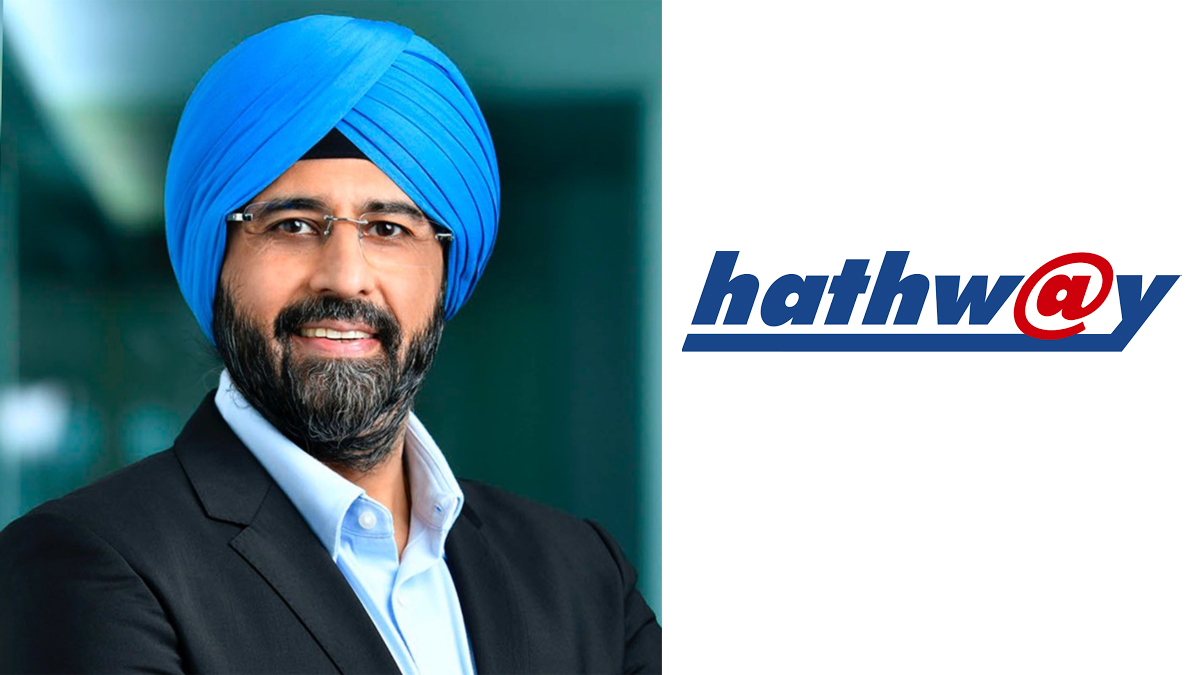
MUMBAI: Hathway Cable and Datacom has tapped industry veteran Gurjeev Singh Kapoor as chief executive officer, marking a leadership pivot at a time when India’s cable television business is under mounting strain.
Kapoor will take over from Tavinderjit Singh Panesar, who is set to retire in August after a long innings with the company. Panesar, chief executive since 2023, has held multiple leadership roles at Hathway, including his latest stint beginning in 2022.
Kapoor brings more than three decades of experience in media and entertainment. He most recently led distribution at The Walt Disney Company’s Star India business, now part of JioStar. His career spans television distribution and affiliate partnerships, with stints at Sony Pictures Networks India, Discovery Communications and Zee Entertainment.
Panesar, with over three decades in the industry, has worked across strategic planning, distribution and business development in media, broadcasting and manufacturing. His past associations include ESPN Star Sports, Star India, Apollo Tyres and JK Industries.
The transition lands as the cable sector grapples with structural disruption. Traditional operators are losing ground to streaming platforms, while telecom and broadband players tighten the squeeze with bundled offerings.
An EY report estimates India’s pay-TV base could shrink by a further 30 to 40 million households by 2030, taking the total down to 71 to 81 million. The slide follows a loss of nearly 40 million homes between 2018 and 2024, a contraction that has already wiped out more than 37,000 jobs in the local cable operator ecosystem.
Hathway’s numbers reflect the strain. The company reported a consolidated net profit of Rs 93 crore for FY25, down from Rs 99 crore a year earlier. Revenue inched up to Rs 2,040 crore from Rs 1,981 crore. As of December 2025, it had about 4.7 million cable TV subscribers and roughly 1.02 million broadband users.
Kapoor steps in with a familiar brief but a shrinking playbook. In a market where viewers are cutting cords faster than companies can reinvent them, the new chief executive inherits a business fighting to stay plugged in.