AD Agencies
Havas Media Group India launches Havas Content
Mumbai: Havas Media Group India has launched its specialized content division called Havas Content. With the launch, the media agency conglomerate will focus on leveraging dynamic content to help brands create meaningful media experiences and make a meaningful difference in consumers’ lives.
Havas Content aims to bridge the gap by offering meaningful content solutions that not only entertain but also educate, inspire, and help consumers, map the brand’s performance to its content effectiveness and boost business returns.
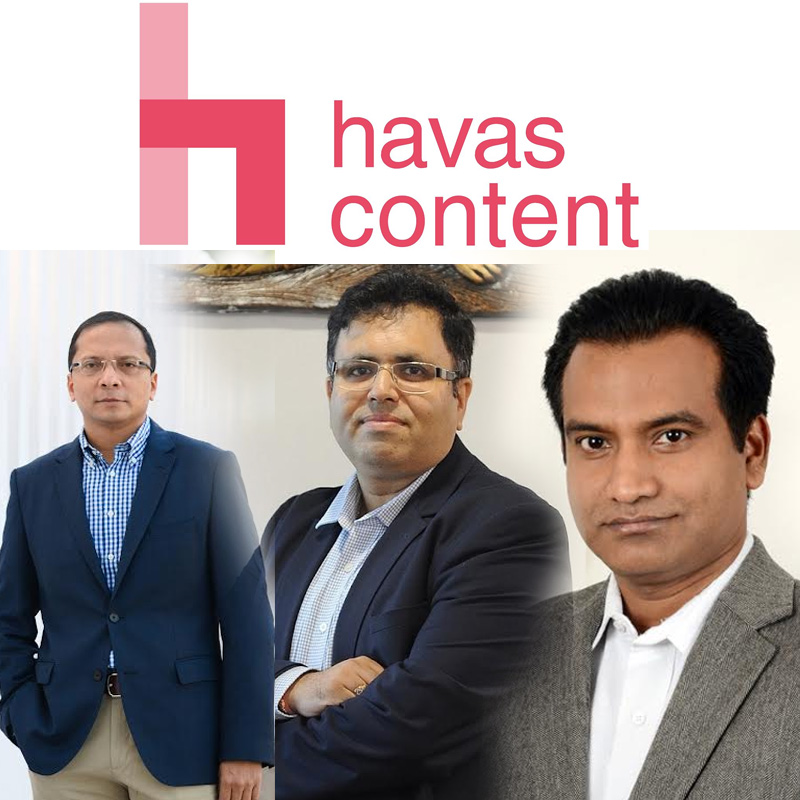
Havas Content will be led by Uday Mohan, President and Chief Client Officer, Havas Media Group India. To further strengthen the division, the agency has made two key hires. Prachi Narayan has joined as Vice President, Content and Shivani Kaushik as Content Manager, who will support Uday in scaling this offering across Havas Media Group India’s client portfolio.
With the division’s in-house capabilities of analysing data and driving insights, Havas Content is armed with a scientific approach to developing meaningful content which in turn resonates with the Group’s core philosophy of building meaningful brands.
Over the last few years, Havas Media Group India has witnessed a 5x growth in the content space, with some clutter-breaking content created for prominent brands like Hyundai, OYO, Swarovski, Swiggy and Tata Motors (CVBU).
Havas Content has also adopted a future-first approach and is helping brands navigate today’s dynamic content ecosystem that is constantly evolving with new trends like AR, VR, NFTs, and Metaverse, which has led to its sweeping success in India.
Speaking about the launch, Havas Group India Group CEO Rana Barua, said, “We understand the power of good content and the launch of Havas Content couldn’t have come at a better time. The wide range of work that the team has done for a varied set of clients in the content space, and the impact it has made to our client’s business made it a logical step to launch this as a separate vertical and further scale it up. It’s another step towards further empowering the brands that partner with us, and help them craft more meaningful stories.”
Havas Media Group India’s CEO Mohit Joshi said, “Content has been an integral part of Havas Group’s Meaningful Brands proprietary study each year. In the past, the study has revealed that Content is falling massively short of consumer expectations. With the current content overload, misinformation, fake news and the pandemic-driven shifts in consumer behaviour, it has become more imperative than ever to create differentiated content that not just grabs the consumer’s attention but also helps & rewards them, making the brand a seamless part of the consumer’s journey. I am confident that Uday, along with Prachi and Shivani will make the content division the best in the business in India.”
Uday Mohan further added, “In this new world order, consumers are constantly on the lookout for brands with a greater purpose, brands that can impact their lives positively. Content has proved to be an important tool in making consumers see that purpose. Havas’s reputation globally in the content space is unparalleled. With Indian brands becoming content-conscious, we believe this was the perfect time for us to officially launch our content division in India. Bringing together the combined expertise of Havas Village, and the content powerhouse within the Vivendi network, we are confident Havas Content will become a one-stop-shop for all our client’s content needs.”

AD Agencies
Kevin Vaz opens FICCI-EY report with a declaration: India’s M&E industry set to breach Rs 3 trillion mark by 2027
In a keynote address at the FICCI-EY report launch, Kevin Vaz says sport, AI and the connected TV boom are driving a multi-screen revolution with no signs of slowing
MUMBAI: India’s media and entertainment industry is growing faster than the economy, reshaping global benchmarks and is on course to blow past Rs 3 trillion by 2027. That was the headline message from Kevin Vaz, chairman of the FICCI Media and Entertainment Committee and chief executive of entertainment at JioStar, who delivered the opening keynote at the launch of the FICCI-EY Media and Entertainment Report 2026 in Mumbai on Monday. He did not waste much time on caveats.
The industry hit Rs 2.78 trillion in 2025, outpacing GDP per capita growth and surpassing even last year’s bullish forecasts. Vaz described the year in three words: scale, convergence, transformation. The numbers, he suggested, were only half the story. The other half was how that growth was happening.
Digital has become the industry’s largest segment, driven by advertising, subscriptions and commerce. But Vaz was quick to puncture the familiar narrative of digital killing everything else. India, he argued, is not an either-or market. It is an AND market. Connected TV is surging. Linear television, mobile, films and print are all still expanding. AVGC, the animation, visual effects, gaming and comics sector, is emerging as a serious growth engine, opening new storytelling formats and new global revenue streams. Nothing, he said, is replacing anything. Everything is reinforcing everything else.
Nowhere is that more vivid than in sport. In an on-demand world where audiences can watch anything, anytime, Indians still show up live. “Sports don’t fragment audiences,” Vaz said. “They unite them, just on different screens.” The ICC Men’s T20 World Cup 2026 made the point emphatically. During the final, JioHotstar delivered 72.5 million concurrent streams, a global record. Group chats exploded. Families renegotiated control of the television. Advertisers, Vaz noted with undisguised relish, stopped asking where audiences were and started asking how fast they could get in.
Cinema had its own landmark year. More than 1,900 films were released, with several crossing the Rs 1 billion mark. Dhurandhar was singled out as proof that Indian audiences will still turn up in large numbers for content that grips them. Live experiences, too, are getting bigger and more immersive, though Vaz suggested the surface has barely been scratched.
Then there is artificial intelligence, which he described as quietly, and sometimes not so quietly, reshaping everything. AI is enabling personalisation, efficiency and scale, but Vaz argued its deeper significance lies in what it is doing to creativity itself. He pointed to Mahabharat: Ek Dharmayudh, billed as the world’s first AI-produced show, as evidence that the technology can amplify creative ambition rather than hollow it out. He also used the platform to call on Indian policymakers to engage seriously with the creative industry on AI and copyright, ensuring that creators are fairly compensated as the technology spreads.
The picture that emerges from the report, and from Vaz’s keynote, is of an industry that has stopped thinking of itself as a fast-growing emerging market and started thinking of itself as a global template. Scale, diversity and innovation, he said, are no longer in tension in India. They are coexisting, and the rest of the world is taking notes.
The Rs 3 trillion milestone is two years away. As the man who chairs the committee that shapes the industry’s policy agenda and runs the country’s most powerful entertainment platform, Vaz set the tone for the day with characteristic directness: India’s media business is not just chasing growth. It is deciding what the country talks about at dinner. That is a different kind of power altogether.