Brands
Your old clothes are becoming India’s next big environmental crisis, says ReFiber’s Manoj Wanvari
The fashion industry’s waste crisis is growing rapidly, and a new circular economy model aims to tackle it

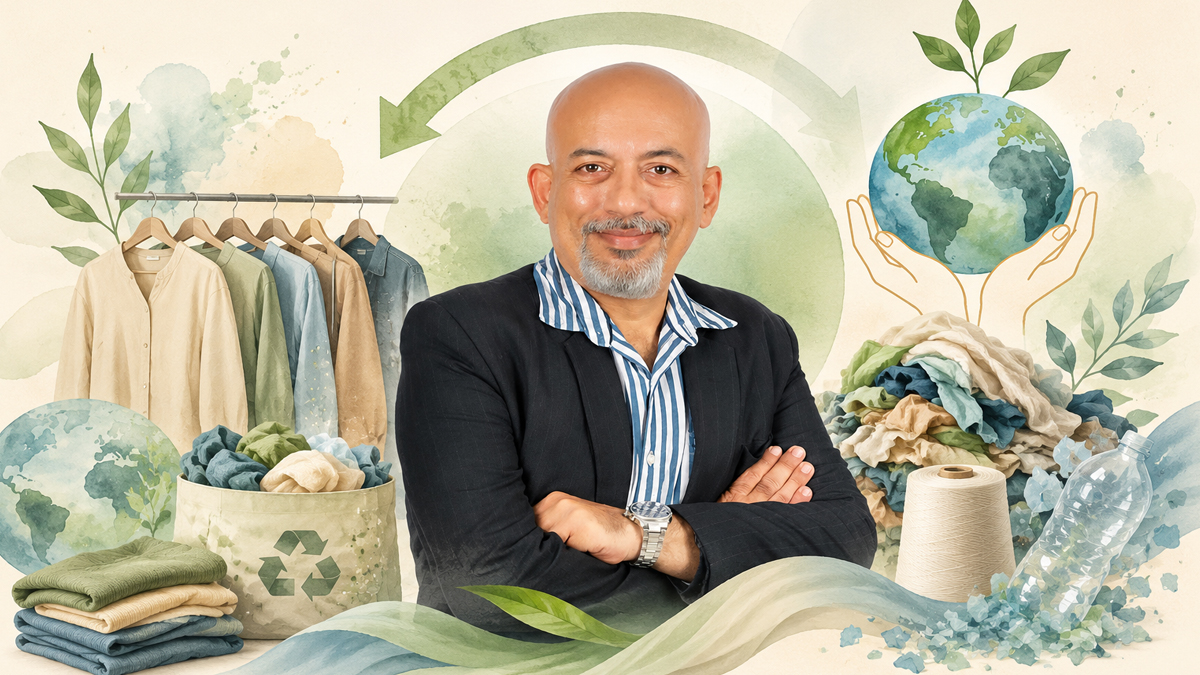
MUMBAI: There is a mountain of old clothes in India. Not a metaphorical one. Actual mountains, growing taller by the day in landfills, drains, and the backs of wardrobes, quietly ignored by an industry that has spent decades treating its own leftovers as someone else’s problem. Manoj Wanvari, chief operating officer at ReFiber, would like a word about that.
ReFiber is not your typical sustainability start-up with a bamboo logo and a lofty mission statement. It is a technology platform that tracks post-consumer textile waste, which is the industry’s rather long-winded way of saying clothes people have finished wearing, from the moment a household tosses them out to the moment they are sorted, processed, and reborn as something useful. Every step is logged, traced, and documented. Think of it as giving your old salwar kameez a passport.
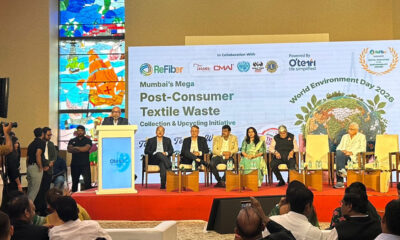
Speaking to Indiantelevision.com at the launch of the Mega Post-Consumer Textile Waste Collection and Upcycling Initiative by ReFiber, powered by OterRi, on World Environment Day, Wanvari did not mince words about where things stand. “Circularity at this point of time,” he said, “is just a myth.” For a man working in the sustainability sector, it is a remarkably honest place to start. So what does he think will actually move the needle? Not technology, as it turns out. Not investment. Not another industry conference. His answer was simpler and rather more humbling: school.
“In a country like Japan, sustainability as a subject is taught to students, children from Class 3 onwards,” Wanvari noted, referencing a point raised by fellow panellists at the event. “Education is the biggest key. At a young age, if people are taught about responsible civic behaviour and responsible usage, automatically sustainability will become a reality.”
It is the kind of argument that sounds obvious until you realise how rarely anyone actually acts on it. Teaching children to think carefully about what they buy, use, and throw away is not glamorous work. There are no press releases. There is no funding round. But Wanvari is convinced it is where the chain has to begin. And yet, while education is the long game, there is a short cut that India has so far refused to take, and it sits squarely in the hands of policymakers.
Wanvari points to plastic PET bottles as the model the textile industry desperately needs to replicate. “There is something known as an EPR,” he explained, referring to Extended Producer Responsibility, a policy framework that makes manufacturers financially and legally accountable for the end-of-life of their products. “It is mandatory for every PET manufacturer to at least use 50 per cent of the raw material from recycled plastic. Something like that is non-existing in the textile industry.”
The results of that policy in the plastics world, he argued, have been transformative. “Earlier, PET waste was treated like an untouchable child. Today, PET bottles have become like gold. Every PET bottle manufacturer today is hunting and looking around for PET because it’s mandatory.” The lesson is not subtle. Tell an industry it must use recycled materials, and suddenly recycled materials become precious. Leave it to goodwill and voluntary pledges, and the mountain keeps growing.
“The minute you have got some mandates from the government — that in textiles it is mandatory to use 20 per cent of recycled fibre — it will be a big game changer,” Wanvari said. The EPR policy for textiles, however, remains conspicuously absent. “There are different government departments which are involved and the EPR policy is not being announced,” he added.
Of course, policy alone does not change what happens inside a flat in Andheri or a house in Jaipur on a Sunday afternoon when someone is clearing out their wardrobe. For that, you need to make the right choice feel like a reward rather than a chore. ReFiber launched in Mumbai in January this year and has been offering laundry discounts to consumers who hand over their old clothes through the platform. It is a decent start, but Wanvari has bigger plans.
“Moving forward, we will be offering recycled products from Tisser,” he said. “We will be getting in a lot more recycled products, and not just Tisser. There are many more brands who are there to recycle and upcycle products. Once that awareness is created and instead of old clothes, we give people products that they actually desire, it will make life much easier for platforms like ReFiber.” The idea is elegantly transactional. Stop asking people to donate out of the goodness of their hearts. Give them something they want in return. It is the oldest trick in commerce, only this time the currency is a pile of old t-shirts.
Scaling that idea beyond Mumbai, however, brings its own set of headaches. Wanvari described the rather absurd economics of trying to run a textile collection drive in a residential society. “Each society is, say, charging us Rs. 20,000, Rs. 30,000 for a day to put up a kiosk,” he said. When the kiosk exists to collect waste that would otherwise end up in a landfill, the charging of a fee to do so is, to put it generously, counterproductive. His ask of the government is straightforward: treat textile waste collection the way you treat other public goods. “If a message is given by the government that this is something which is going towards saving the ecosystem and saving the environment, and they give us periodic opportunities to participate in social drives and educate people, it will help in a very big way.” The municipal corporations and urban local bodies, he argued, need to actively empower private organisations rather than treating them as event vendors seeking a spot on the premises.
Zoom out from the policy debates and the society gate fees, and the potential picture is rather extraordinary. ReFiber’s recycling partner Tisser already employs close to 20,000 women for upcycling work across the country. That is from one partnership, at an early stage, without a supportive regulatory framework. “It’s not just collection of post-consumer textile waste,” Wanvari said. “It will give employment to the logistics people. There will be technology developers who will have to develop effective technology. In the middle layer, there will be people who will be required for sorting and clearing. Once the sorting part is done, there would be employment creation. The minute it’s going to an organisation like Tisser and other upcyclers, there would be employment created. Once the finished product is ready, platforms like ReFiber selling it, employment there. And again, the last mile delivery, again an employment. It’s unending. It’s massive.” He is describing a full supply chain conjured almost entirely from discarded clothing. Waste, in this framing, is not a problem to be managed. It is an economy waiting to be built.
Wanvari is refreshingly clear-eyed, though, about just how far that economy still has to travel. When asked what it would take to shift consumer behaviour, he did not point to his own platform as the answer. “You need at least 10 ReFibers,” he said, “to make sure that people are educated and understand how to use post-consumer textile waste.” Not many COOs will tell you their industry needs ten of them to succeed, but then again, not many COOs are thinking at this scale. One platform cannot shift a country of 1.4 billion people. The infrastructure for change, both cultural and logistical, needs to be built at a scale that no single company can manage alone.
Which brings it back, in the end, to the person standing in front of a wardrobe on a Sunday afternoon, holding a shirt they have not worn in three years and wondering whether to bin it. On World Environment Day, Wanvari had one message for that person. “Before you throw away any clothes, please remember: the clothes can be re-upcycled, they can be recycled, they can be donated, they can be used for a very good cause. Please think twice before you throw your clothes into a dustbin.”
It is not a revolutionary idea. It is, in fact, something your grandmother probably said. But perhaps that is the point. The clothes crisis in India is not a technology problem or even, at its heart, a policy problem. It is a habit problem, and habits, as anyone who has ever tried to change one knows, are the hardest thing of all to shift. Manoj Wanvari and ReFiber are betting that with the right mix of education, incentives, regulation, and just enough nudging from the government, the habit can change. The old shirt at the back of your wardrobe would seem to agree.