Brands
India’s textile waste challenge finds a circular path to a $9 billion opportunity
Industry leaders call for smarter sorting, stronger policy and scalable recycling to unlock textile circularity


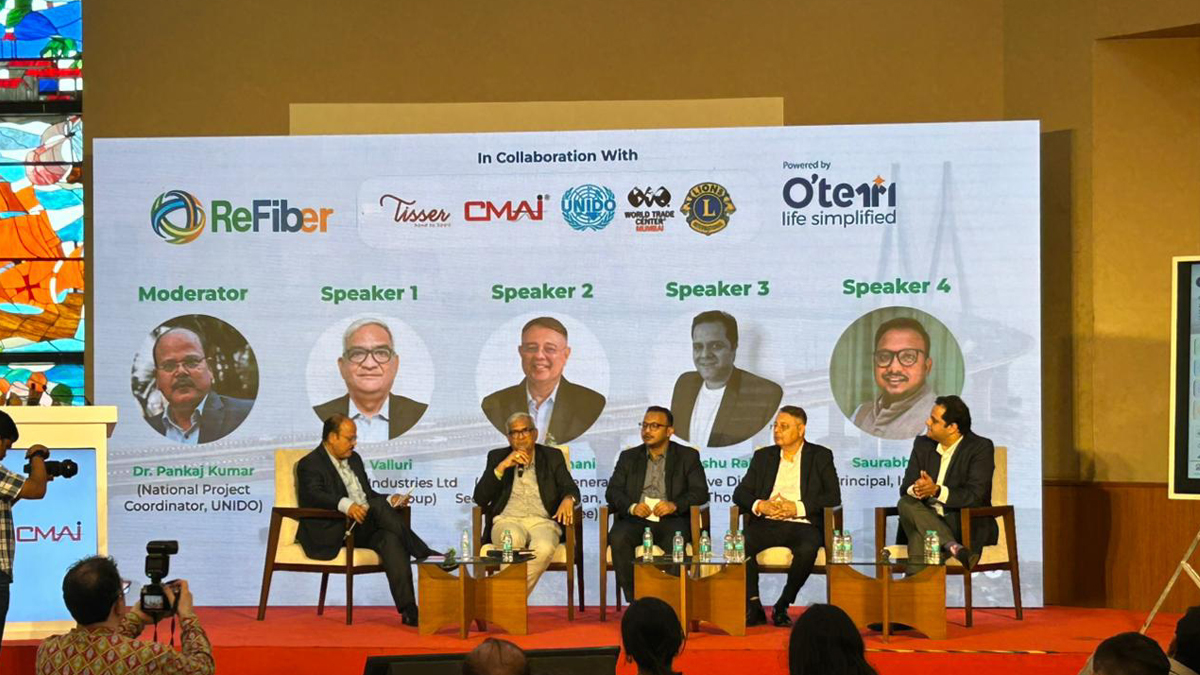
MUMBAI: If waste is the new wealth, India’s textile industry may be sitting on a goldmine stitched together from discarded garments. On World Environment Day, Mumbai witnessed the launch of the Mega Post-Consumer Textile Waste Collection & Upcycling Initiative by ReFiber, powered by OterRi. The initiative aims to build a large-scale ecosystem for collecting, recovering and upcycling textile waste while creating environmental, social and economic value. Supported by partners including UNIDO, CMAI, Tisser, Lions Clubs International and the World Trade Centre Mumbai, the programme seeks to transform textile waste from an environmental challenge into a valuable resource for India’s growing circular economy.
The launch was followed by a panel discussion titled Accelerating Circularity in India’s Textile Sector: Policy, Innovation, and Industry Action. Moderated by UNIDO, national project coordinator, Pankaj Kumar, and featuring Aditya Birla Group- Grasim Industries, chief sustainability officer, Surya Valluri; CMAI, hon. general secretary and chairman of the ESG sub-committee, Naveen Sainani; Grant Thornton, executive director, Devanshu Ralhan, and Intellecap, principal, Saurabh Dey. Together, they explored how policy, innovation, financing and industry collaboration can help India turn its growing textile waste challenge into a significant economic opportunity.
A common thread running through the discussion was the idea that textile circularity is no longer simply a waste-management issue. Instead, it is increasingly becoming a matter of industrial competitiveness, supply chain resilience and future trade readiness. Participants highlighted that as global markets tighten sustainability requirements, circularity will play an increasingly important role in determining which countries and businesses remain competitive.
The conversation also underscored the scale of the opportunity. Studies and industry assessments suggest that textile waste circularity could unlock nearly $9 billion in economic value annually for India if the right ecosystem is put in place. That opportunity, panellists noted, extends well beyond environmental benefits and could create new jobs, strengthen domestic manufacturing and improve resource efficiency across the textile value chain.
Technology was identified as a key enabler of this transition. Significant progress is being made in developing lower-impact fibres, fibre-to-fibre recycling technologies and circular material solutions. Advances in chemical recycling and fibre recovery are helping bring valuable materials back into production cycles, reducing dependence on virgin resources. However, participants stressed that innovation must move beyond successful pilot projects and into large-scale commercial deployment if meaningful impact is to be achieved.
One challenge repeatedly highlighted was the lack of robust sorting infrastructure. Textile waste often consists of blended materials that are difficult to separate and process. Without efficient sorting systems, recyclers struggle to recover fibres at the quality required for high-value applications. Better sorting technologies and infrastructure were described as fundamental to unlocking the true value of textile waste and enabling large-scale recycling.
The panel also focused on financing, particularly for micro, small and medium enterprises. While interest in textile recycling and circular business models is growing, many enterprises continue to face barriers in accessing affordable capital. Discussions centred on the need for innovative financing mechanisms, including blended finance, concessional lending and outcome-based funding models that can reduce risks and help businesses scale.
MSMEs were repeatedly identified as central to India’s circularity ambitions. As the backbone of the country’s textile manufacturing ecosystem, smaller enterprises will play a crucial role in improving resource efficiency, reducing emissions and adopting circular practices. Participants emphasised the need for policies and financial instruments that make it easier for these businesses to invest in new technologies and sustainable operations.
Policy support emerged as another critical ingredient. Speakers outlined the need for decentralised recovery centres, improved collection systems and expanded recycling infrastructure across the country. Creating multiple recovery and sorting hubs closer to waste generation centres could significantly improve the economics of textile recycling while reducing transportation costs and increasing recovery rates.
Beyond recycling, the discussion highlighted opportunities in upcycling, repair and extending garment life cycles. Repair services, in particular, were identified as an underutilised but potentially powerful tool for reducing waste and lowering carbon footprints. Encouraging consumers to keep products in use for longer could help reduce pressure on resources while creating new business opportunities for brands and manufacturers.
The issue of traceability and data management also featured prominently. With global buyers increasingly demanding transparency across supply chains, Indian manufacturers, particularly SMEs, will need stronger systems to track materials and verify sustainability claims. Better access to digital infrastructure and data storage solutions could help businesses meet international compliance requirements while improving operational efficiency.
Participants also pointed to the growing ecosystem of Indian startups working on textile recycling, waste recovery and circularity technologies. While innovation is abundant, many of these solutions require greater industry adoption, investment support and policy backing to move from pilot stages to industrial-scale implementation.
As the discussion concluded, there was broad agreement that India’s path to textile circularity will depend on a combination of technology, infrastructure, financing, policy support and collaboration across the value chain. With millions of tonnes of textile waste generated annually and significant volumes still ending up in landfills or low-value applications, the challenge is substantial.
Yet, as the launch of Mumbai’s textile waste initiative demonstrated, the industry’s focus is increasingly shifting from simply managing waste to unlocking its value. For a sector woven deeply into India’s economic fabric, the future may well be defined not by how much it produces, but by how effectively it reuses, recovers and reinvents what it already has.