Sports
Will Zee’s entry shake up India’s sports market?
The expectations are there, but it has to pass the FIFA telecast test first.

MUMBAI: The timing, for once, is impeccable. Just as India’s sports broadcasting establishment finds itself battered by financial losses, a regulatory shock, and the creeping realisation that paying eye-watering sums for cricket rights is a game only the reckless can afford, Zee Entertainment has quietly walked through the unlocked door.
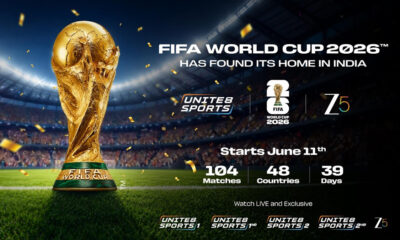
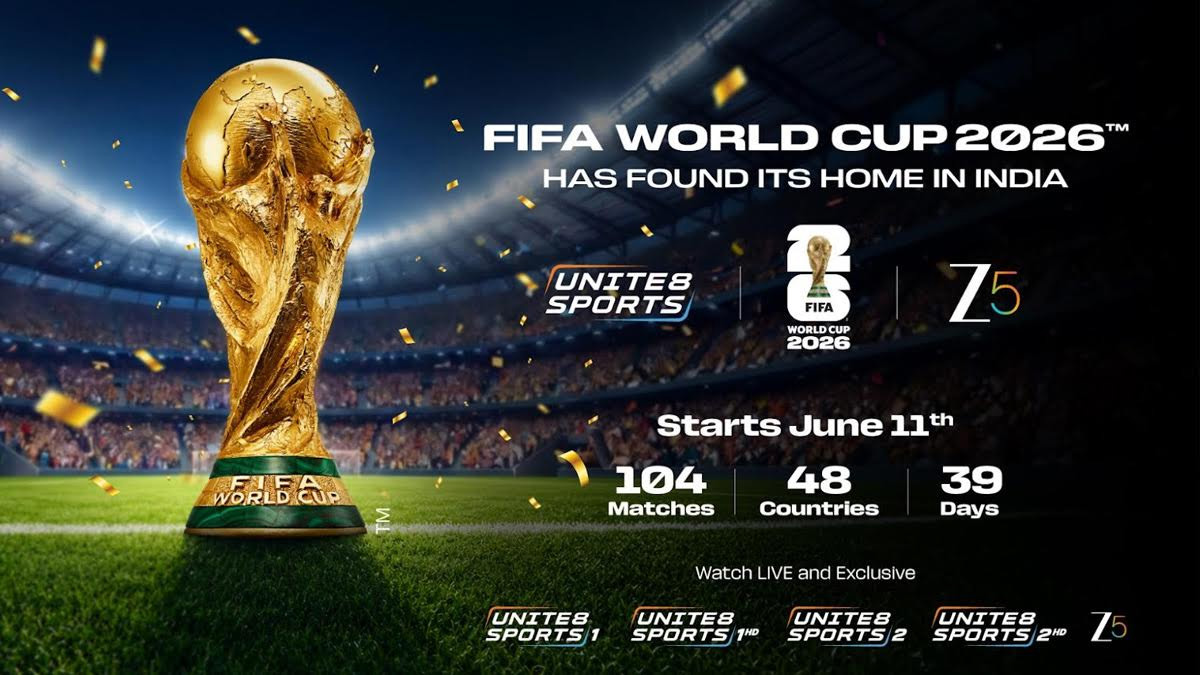
Zee’s Unite8 Sports launched four channels Unite8 Sports 1, Unite8 Sports 1 HD, Unite8 Sports 2, and Unite8 Sports 2 HD going live across more than 500 cable and distribution platforms nationwide, covering sports from football and cricket to kabaddi, boxing, and combat disciplines. But the truly consequential detail is not the four channels. It is what sits behind them. Zee has acquired Indian broadcast and streaming rights for 39 FIFA events from 2026 to 2034, including three World Cups and every match will be available not just on Unite8’s linear channels but on Zee’s streaming platform, ZEE5.
That pairing linear and digital, channel and app, new brand and established platform is the spine of Zee’s entire strategy. And it changes the nature of what this launch actually is.
To understand the significance, one must first appreciate how troubled the incumbent is. JioStar, the colossus created by the ₹70,352-crore merger of Reliance’s Viacom18 and Disney’s Star India has for years been the undisputed overlord of Indian sports broadcasting. For the 2023–27 IPL cycle, digital rights were valued higher than linear TV for the first time, with JioStar controlling both. Over the past decade and a half, the company invested more than $500 million in growing sports properties through marketing, production, and technology separate from rights fees entirely. The ambition was total dominance. For a while, it had it.
Then came the reckoning. The ban on real-money gaming previously the single biggest category of cricket advertisers has created an estimated $840 million annual advertising gap that no other sector has managed to fill. The structural challenges compound it: a subdued advertising sector, linear television facing pressure from a shrinking pay-TV subscriber base, and streaming businesses continuing to operate at a loss. JioStar more than doubled its provisions for expected losses on onerous sports contracts in 2024–25 to ₹25,760 crore, up from ₹12,319 crore a year earlier.
The pièce de résistance? JioStar formally notified the ICC of its intention to exit its four-year India media rights agreement, a deal originally valued at nearly $3 billion. The ICC has already begun a fresh sale process for 2026–29, reportedly targeting about $2.4 billion and sounding out Sony Pictures Networks India, Netflix, and Amazon Prime Video, none of whom have shown appetite. The castle, it turns out, has termites.
The narrative of a two-horse race, JioStar versus Zee is dangerously simplistic. Sony Pictures Networks India is no bit-player shuffling at the margins. It is a coherent, disciplined broadcaster that has survived two decades of Indian sports’ convulsive economics by doing something the others have largely failed to do: exercise restraint.
Sony’s portfolio would be the envy of most broadcasters globally. It holds exclusive television and digital rights for all men’s and women’s international cricket played in England, including county competitions, until 2028. On Sony Liv, the sports slate spans the UEFA Champions League, UEFA Europa League, the Australian Open, the Pro Wrestling League, and bilateral cricket series across multiple formats. Sony has secured exclusive broadcast and streaming rights for the 2026 Asian Games in Aichi-Nagoya carrying the event for the third time, with India riding momentum from a record 107-medal haul. The Asia Cup sits with Sony too, broadcast across multiple language feeds on Sony Sports 1, 3, 4, and 5.
That is not a side player’s portfolio. It is a curated, financially considered collection premium, global, and deliberately non-cricket-centric in a way that looks prescient now that the cricket rights bubble is visibly deflating. Sony has also pioneered a new model of sub-licensing: retaining television rights while licensing digital streaming to JioHotstar, as it did with India’s England tours turning a rival into a revenue partner while reducing its own financial exposure. Sony, in short, is playing a longer, smarter game than it is typically credited for.
Its weakness is not its rights portfolio. It is scale and integration. Sony’s own financial reports show FY25 revenue down over 4 per cent and net profit down nearly 46 per cent, partly due to advertising budget pressures and shifting consumer preferences towards digital platforms. Sony is fighting the right battles but with fewer soldiers than it needs, and a streaming platform SonyLiv that, for all its merits, lacks the regional linguistic depth of its coming rivals.
And then there is Doordarshan’s DD Sports dismissed in media industry conversations, chronically underestimated, and yet possessed of something no private broadcaster in India can buy: universal reach at zero cost to the viewer.
DD Sports reaches 38 countries via the INSAT-4B satellite and has been broadcasting continuously since the New Delhi Commonwealth Games. It is free-to-air, accessible to the hundreds of millions of Indians who will never pay a subscription fee for sport. Beyond international events, DD Sports gives pride of place to Indian sports like kabaddi and kho-kho, and showcases local sporting culture from events such as the Kila Raipur Sports Festival Punjab’s rural Olympics. This is not sports broadcasting as a commodity. It is sports broadcasting as a public service and in a country with India’s income distribution, that distinction matters enormously.
Doordarshan secured broadcast rights for the Indian Football League 2025–26, ensuring India’s domestic football reaches its widest possible audience. Its free-to-air simulcast mandate enshrined in the Sports Broadcasting Signals (Mandatory Sharing with Prasar Bharati) Act means Doordarshan will carry portions of major events regardless of who holds the primary rights. Zee wins the FIFA commercial rights; India’s poorest viewers still watch it free, courtesy of DD.
That is DD Sports’ peculiar power. It cannot compete on production values, commentary panels, or app features. But it reaches the watcher in the village with a television, a dish, and no appetite for yet another monthly subscription. That viewer shapes national sporting culture in ways advertisers undervalue and policymakers cannot ignore.
Which brings us to Unite8’s most underappreciated advantage, one that has nothing to do with linear television at all. The critical phrase in Zee’s FIFA announcement was not about the four new channels. It was the confirmation that all matches would stream live on Z5.
Z5 is not a start-up scrambling for subscribers. By 2024, the platform had achieved 48 million paid subscribers, reflecting its resilience in an intensely competitive market. More importantly, it is a platform built for India’s linguistic and geographic diversity in a way that JioHotstar vast as it is has not always prioritised. Fully 40 per cent of ZEE5’s viewership comes from tier-2 and tier-3 markets, with non-Hindi languages accounting for 50 per cent of total consumption. This reflects a structural shift, the share of regional languages in OTT content rose from 27 per cent in 2020 to 54 per cent by 2024, while rural internet users at 442 million overtook the urban base for the first time.
Zee formalised this direction in June 2025, repositioning ZEE5 as a language-first, hyper-personalised platform. ZEE5 Global now offers content across 18 Indian languages, including Hindi, Punjabi, Gujarati, Telugu, Kannada, Tamil, Bengali, Malayalam, Marathi, Odia, and Bhojpuri, as well as six international languages. That is the infrastructure of a genuinely national streaming service not one designed for the English-speaking urban professional, but one built for the Telugu viewer in Vijayawada, the Punjabi viewer in Ludhiana, the Bhojpuri viewer in Patna.
Now attach live football to that infrastructure. The FIFA World Cup streamed in regional languages, with localised commentary, on a platform already embedded in the heartlands? That is a proposition JioHotstar cricket-first, metropolitan-tilted does not easily replicate. SonyLIV, for all its strengths, lacks the regional linguistic depth to match it.
The scale of Zee’s FIFA commitment underlines the ambition: 39 events from 2026 to 2034, covering not just the men’s senior World Cups but the Women’s World Cup 2027, U-17 and U-20 tournaments for both men and women, futsal competitions, and the Intercontinental Cup. This is not a one-tournament punt. It is a decade-long bet that football, streamed in every Indian language to every Indian town, can become the cornerstone of a new kind of sports media platform.
Into this layered market, Zee’s entry changes the rights calculus materially. A credible third bidder alongside JioStar and Sony raises the floor on non-cricket properties across the board. Rights holders for football leagues, combat sports, and emerging formats will find genuine competition for the first time. The FIFA deal signals that Zee is prepared to go where others will not and go there at scale, across both linear and digital, with a streaming platform already trusted in the markets that matter most for growth.
For advertisers, the arithmetic is equally significant. The RMG ban threatens to wipe out roughly Rs 10,000 crore from India’s advertising expenditure, with forecasts of a 25 per cent plunge in IPL advertising revenues. Unite8 on television and Z5 in the heartlands represent new inventory and, crucially, new audiences. Brands that found themselves priced out of cricket’s increasingly expensive ecosystem will see in Unite8 and Z5 a route to aspirational, sports-watching India at a sustainable cost.
The FIFA World Cup is the first test. It is mass-market, aspirational, youth-facing, and pan-regional precisely the profile for which ZEE5’s regional architecture was built. If Zee delivers strong numbers across both linear and digital, it validates not just the FIFA deal but the entire integrated model. If it does not, the sceptics — and in Indian media, there is no shortage will be merciless.
What is happening in Indian sports broadcasting is structural rebalancing, long overdue, in which the single-platform model of JioStar’s dominance gives way to a more competitive, more diversified ecosystem. Sony provides premium global sports at disciplined cost, with a digital strategy that turns rivals into revenue partners. DD Sports provides unmatched reach to the bottom of the market, where no subscription can compete with free. Zee, at its best, can fill the middle and the regional margins simultaneously, the Unite8 channels for the living room, Z5 for the small town, the local language, the first-generation football fan watching on a Rs 8,000 Android phone.
That is a genuinely different model from anything the Indian market has seen. It is also, given the RMG-driven collapse in cricket advertising and the growing impossibility of sustaining Rs 25,000-crore loss provisions, an arguably more sustainable one.
Global sports media spending is projected to grow from $65 billion in 2025 to more than $78 billion by 2030, but the era of winner-takes-all rights acquisition in India is over. What replaces it is a market where content quality, distribution intelligence, linguistic reach, and financial discipline matter as much as the size of the cheque written to a rights holder.
India’s billion-plus sports fans, those paying subscriptions in Mumbai, watching free on DD FreeDish in Meerut, streaming in Tamil in Madurai are not loyal to platforms. They are loyal to the sport. Whoever gives them the best seat, in their own language, at the fairest price, across the most screens, will win.
Zee, with Z5 in its corner, has more seats to offer than anyone yet realises.
Aurelian is a sports industry analyst based in Goa