News Headline
Game on again as 2025 powers up a record year and sets the stage for 2030

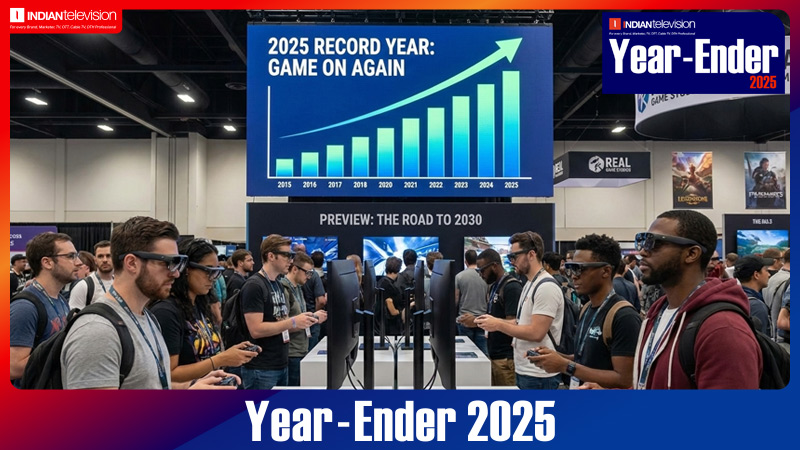
MUMBAI: Some industries slow down gaming hit respawn. In a year when entertainment options multiplied and attention became gold dust, the global gaming sector didn’t merely keep pace, it accelerated, expanded and rewrote its own high scores.
The figures tell the tale. Industry analysts forecast that total global gaming revenue could hit $268.5 billion in 2025 and grow at a 12.8 per cent compound annual rate through 2034, signalling long-term strength across platforms and markets. Even more conservative estimates put 2025’s actual market size at $188.8 billion, up about 3.4 per cent on 2024 as players continued to invest time and money on digital play.
This isn’t a niche pastime anymore, it’s a global pastime. In 2025, around 3.6 billion people were actively playing video games, roughly 61.5 per cent of the world’s online population. Of those, 3 billion were mobile gamers, while 936 million played on PC and 645 million on consoles.
That player base dwarfs traditional audience figures for other forms of entertainment and has been steadily rising. Global gaming has gone from about 2.03 billion gamers in 2015 to an estimated 3.5–3.6 billion in 2025, marking a decade of huge digital adoption.
Mobile remains the industry’s powerhouse, accounting for roughly 55 per cent of overall gaming revenues with about $103 billion in 2025. The ubiquity of smartphones with nearly 7.5 billion global connections projected by 2025 has made gaming easier to access than ever, reinforcing mobile’s dominant role.
“2025 felt like the year India’s gaming landscape stepped into the centre of cultural conversation, and being part of that journey with our players has meant a great deal to us. Our collaboration with Rolling Loud was one of those rare moments where gaming sat shoulder to shoulder with music and felt completely at home. V5 brought creators, pros, and long-time fans together to celebrate five years of clutch plays and unforgettable moments, while looking ahead to a more competitive future. Grassroots events also came alive, from watch parties that turned malls and cafés into pop-up arenas, to local organisers building hubs of competition that felt distinctly homegrown. As we move forward, we’re excited to keep building this journey together, crafting experiences that grow not just in scale, but in cultural impact,” commented Riot Games publishing lead for India & South Asia Anushka Bhatnagar.
2025 delivered plenty of headline-grabbing success stories. Casual and competitive titles alike have kept consoles and PCs humming, while Battlefield 6 sold an estimated more than seven million copies within three days of launch, showcasing that big-budget games still draw huge crowds.
On player participation fronts, massively popular games continue to break records, Roblox’s Grow a Garden saw peaks of over 16.4 million concurrent players, significantly outpacing older stalwarts and illustrating the rise of community-driven experiences.
Gaming and music converged in new ways this year as Riot Games’ Valorant partnered Rolling Loud India 2025, marking India’s first collaboration between a major game publisher and a global hip-hop festival. The move reinforced Riot’s leadership at the intersection of gaming and entertainment, coming in a year when the publisher won Esports Publisher of the Year at the Esports Awards 2025, League of Legends was named Esports Game of the Year, and Riot secured Variety’s Interactive Music in Media Award. These honours added to a growing legacy built through collaborations with Imagine Dragons, Linkin Park, Twenty One Pilots and Lil Nas X, alongside the global success of Arcane.
In India, Riot’s cultural footprint has continued to deepen. The 2022 launch of Raja, the country’s first Valorant Agent, became a defining moment for local representation, with its anthem crossing 2.8 million Youtube views. That momentum carried into grassroots engagement through Bunker, a community event powered by ‘Gotcha Back’ by Mumbai rapper Tienas, which captured the energy and identity of India’s VALORANT scene. The Rolling Loud partnership signalled that this fusion of gaming, music and culture is still at an early, expansive stage.
Alongside these shifts, India’s game development ecosystem gained fresh momentum. Indie Game Utsav at Mumbai Comic Con attracted unprecedented interest, while Indian-made titles appeared on the front page of Steam’s global sale for the first time. Further impetus came with the launch of LVL Zero, an incubator led by MIXI Global Investments, Nazara Technologies and ChimeraVC, offering an equity-free USD 100,000 grant pool and a 100-day acceleration programme designed to support early-stage Indian gaming startups across the ecosystem.
“2025 marks the year India’s gaming industry truly scaled from enthusiasm to structure. We now have scale, spend, and supply coming together, the three pillars of a sustainable ecosystem. Studios are moving beyond service work and hyper-casuals toward PC, console, and cross-platform titles. Our own pre-registration data at LVL Zero shows a clear increase in teams targeting multi-platform releases with stronger demo and prototype completeness, a sign that India’s creator base is maturing fast. Together, these shifts make 2025 the year India stopped looking outward for validation and started building inward for scale,” highlighted ChimeraVC managing Partner and LVL Zero founding partner Krish Anurag.
Esports, too, remained a vibrant slice of the ecosystem. While precise global revenue figures vary, multiple research estimates show esports revenue approaching or exceeding $3 billion in 2025, with sponsorships and media rights forming significant shares of that pie.
Asia-Pacific remained the dominant revenue engine, contributing an estimated $87.6 billion about 46 per cent of total gaming revenue in 2025. North America and Europe continued solid performance too, bolstered by strong console and PC markets.
India, in particular, is rapidly reshaping the map. With hundreds of millions of gamers and projections estimating the Indian market could be worth $8–10 billion by 2030, the subcontinent’s influence is intensifying. AFFiNCO Cheap smartphones, inexpensive data and a cultural affinity for mobile titles have all fuelled this surge.
Technology was a key story in 2025. AI-assisted game design, procedural generation and rapid prototyping enabled faster development cycles and empowered smaller studios to punch above their weight effectively flattening some traditional barriers to entry.
Cloud gaming, propelled by wider 5G adoption, brought console-quality play to mid-range mobile devices, a shift analysts believe will further drive global engagement. Beyond pure play, user-generated content platforms like Fortnite Creative and Roblox created thriving creative economies inside games, blurring lines between players and creators.
It wasn’t all bonus points. Venture funding for gaming start-ups stumbled in 2025, dipping to decade-low levels compared with the tens of billions seen earlier in the decade, a reminder that capital flows are still sensitive to macroeconomic shifts.
Regulation, especially around real-money gaming and in-app monetisation, continued to evolve, complicating planning and compliance for companies operating in multiple regions. The delayed launch of Grand Theft Auto VI, now expected in 2026, underscores how one high-profile title can swing both financial projections and industry buzz analysts estimate its absence may cost the sector around $2.7 billion in 2025 alone.
Looking forward, the narrative remains strong. With player numbers still climbing, platforms converging and monetisation models evolving, gaming is set to become an even larger pillar of global entertainment. Trends pointing ahead include:
. Projected market growth beyond $300 billion by 2026, continuing longer-term expansion.
. Mobile gaming revenues expected to push toward $173 billion by 2026, reflecting ongoing smartphone-led engagement.
. Console and PC innovation alongside cloud services that lower entry barriers for new players.
. Hybrid monetisation strategies blending subscriptions, microtransactions and ad-supported models for diversified revenue.
As 2025 levels out with billions of players, blockbuster sales and a broadening digital footprint, one thing is clear: gaming hasn’t just entered the mainstream, it’s shaping the future of entertainment, culture and connectivity on a planetary scale.