MAM
Tata Motors looks to score on football’s popularity with Messi

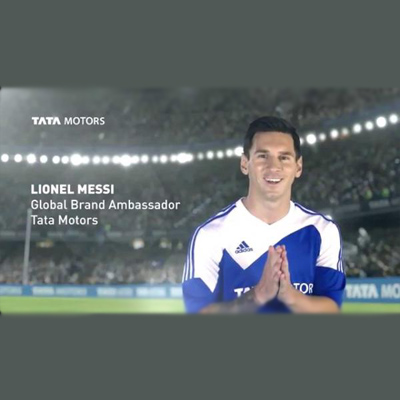
MUMBAI: Football fanatics in the country were overjoyed to hear the words “Namaste India” from their idol and one of the biggest names from the world of soccer Lionel Messi, as he made his maiden campaign address to the nation. After ruling over the hearts of millions of soccer fans across the globe, the champion has now set his eyes on India as the brand ambassador for Tata Motors for the brand’s #madeofgreat campaign.
This is also the football star’s first ever association with an Indian brand.
“I am very excited about my first association with an Indian brand and am extremely thrilled to be part of the Tata Motors family,” said Messi on his association with the brand.
Titled #MadeOfGreat, the campaign that took off few weeks ago created quite a buzz in the industry through powerful TVCs , digital advertising, and experiential marketing initiatives. The campaign’s ground activation organised by Wizcraft across multiple cities at malls and other popular public places were well appreciated.
Keeping all the fanfare aside, one can’t help but ask how relevant is Messi to Tata’s consumer base in India? Can a marketing campaign ride solely on the star player’s popularity without any relativity factor for the consumers? If sports were to be a moving factor, wouldn’t cricket and an Indian player fit the bill better for the brand’s India campaign?
While some may argue that the brand’s’ idea to get Messi onboard was to create a huge stir with their first ever celebrity association, Tata Motors, passenger vehicle business unit, marketing and communications – head, Delna Avari begs to differ.
According to her, the decision wasn’t single-mindedly led by Messi’s far reaching influence on the youth, but a well thought of strategy keeping India’s growing exposure to the game.
“Football is not only a global phenomenon but it is one of the fastest emerging sports in the country in terms of popularity. Currently, India has an approximate viewership of 80 million for football. With various researches conducted across fields to measure the impact of celebrity association on a brand, we realised that Indian celebrities are over exposed and were associated with multiple brands,” shares Avari, hereby nullifying any prospect of brand association with an Indian sporting celebrity.
She further adds, “We as a company wanted to connect with the younger audience (less than 35 years) especially in our domestic market and ‘cool’ is something that this age group loves to associate with. Messi is found cool across all age groups, his iconic stature and values inherent to him were just the perfect kind of amalgamation for us as a brand. He is a winner who is trustworthy, reliable, pioneering, simple and driven by self-belief, which is what is at the core of Tata Motors as well and hence he is the perfect match for us.”
Not to mention, with Indian Super League (ISL) second season going on, the campaign couldn’t have had a better head start.
Avari points out that the campaign has garnered a positive response from both consumers and stakeholders. “Besides trending on Twitter on the day of the campaign launch, we have received approximately 178 million impressions. As part of the campaign, fans were sent around the city through a series of clues, until they arrived at the final destination where the hidden letter stood,” she informs.
Backing the brand’s reason for changing their marketing strategy, Avari adds, “With an overall aggressive marketing strategy, we have always customised our marketing plans as per our products. Sub brands like Nano, Bolt, Zest, Safari and Indigo have their own strong individual identities. However the need to have a common link to bind these sub brands and to create a well-defined brand architecture for the company brought this campaign to life.”
When it comes the mediums used to propagate the brand message, Tata Motors hasn’t left any stone unturned for maximum impact and reach. “All the mediums that we have worked with have a different strategy, be it print, digital or mobile. Experiential marketing is another important leg of our campaign as we believe that on-ground activations create great impressions on people’s mind,” she voices.
Expanding further on their experiential marketing initiative, Avari says, “With Wizcraft on board to execute our BTL plans and DigitasLBi as our digital partners, we are working on a great mix and it will be showcased through this 360 degree campaign. which will comprise a series of innovative and compelling campaigns across mediums. For instance, a part of our BTL activation involves the implementation of augmented reality. With this, we gave our customers an exclusive chance to experience how getting a picture clicked with Lionel Messi would feel.”
Not only that. On 3 November, over 10 million customers of the brand were pleasantly surprised by getting a call from Messi himself, albeit a recorded message. The initiative was an integrated campaign with Truecaller. “We were thrilled to know that out of the 10 million calls made, approximately 9.8 million people received them. While #madeofgreat trended on Twitter on the day of the campaign launch, we also crossed over 300 million impressions across mediums in just two weeks,” shares Avari.
Given the football player’s high brand value, there’s natural curiosity on his signing amount for the campaign. “It is a two year contract. The cost is in line with what international celebrities are paid globally,” answers Avari when asked about the particulars of the contract.
As per Forbes’ list of highest-paid athletes in the world for 2015 Messi ranks 4th with a net earning of $22 million from his endorsements. In the light of this knowledge, it is safe to assume that a large pie of the brand’s marketing spends has gone into getting Messi on board.