iWorld
Seven must-listen, must-watch titles celebrating Ram Navami
Mumbai: Ram Navami marks the birth of Lord Ram, one of the most revered deities in Hindu mythology. This auspicious festival is a way to connect with Lord Ram’s timeless story and his moral and spiritual lessons. For those looking to immerse themselves in his epic journey, there are several outstanding audiobooks, podcasts, and web series available, that you can tune into to learn more! These provide a deep dive into his life, teachings, and the impact he had on the world. Here’s a curated list of seven must-listen and must-watch titles that offer a rich exploration of the Ramayana and its legacy, perfect for rejoicing in the Ram Navami celebrations and beyond.
Platform: Audible
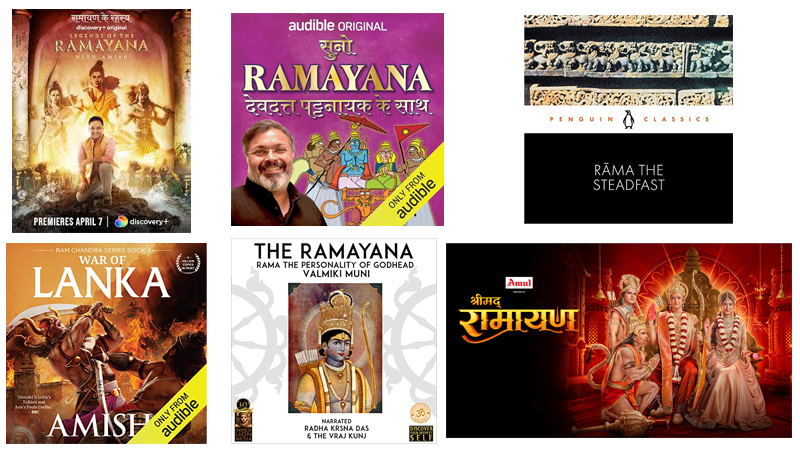
‘Suno Ramayana Devdutt Pattanaik Ke Saath’ is a 12-episode podcast series that brings the timeless tale of the Ramayana to life in a modern audio format. Narrated by acclaimed mythologist Devdutt Pattanaik, the series explores the epic’s complex characters and themes, exploring the birth stories and moral dilemmas of figures like Ram, Sita, and Ravan. Each episode provides fresh perspectives on dharma and karma, making it an engaging and immersive experience for listeners. In celebration of Ram Navami, this series serves as a tribute to the revered deity and his journey, offering a chance to reconnect with the cultural heritage and wisdom of the epic.
Platform: Audible
In War of Lanka, the fourth instalment of the Ram Chandra series by Amish Tripathi, the legendary tale of Lord Ram’s quest to rescue Sita and uphold Dharma. The ancient world of India in 3400 BCE is vividly depicted as the backdrop for a battle between darkness and light, justice and rage. Amish’s skilled storytelling breathes new life into this classic epic, creating a gripping story that honours the divine journey of Lord Ram, blending timeless themes with contemporary sensibilities. As you celebrate Ram Navami, immerse yourself in this story that mirrors the triumph of good over evil and the enduring power of love and faith.
Platform: Audible
‘Rama the Steadfast’ is a classic epic that transports listeners into the world of the ancient Hindu legend. Performed with precision and eloquence by Sid Sagar, this audio adaptation brings to life the saga of the warrior-prince Lord Ram. Set in the kingdom of Ayodhya, Lord Ram’s journey takes him from the heights of being the chosen successor to the throne to the depths of exile in the forest, where he faces the ultimate test of resilience. Joined by his devoted wife Sita and the valiant Hanuman, he embarks on a heroic quest to rescue Sita from the clutches of the wicked Ravana.
Platform: Audible
Written by Maharishi Valmiki, this epic poem explores Lord Ram’s fourteen-year exile in the forest with his wife Sita and brother Lakshmana, his struggles against the demon king Ravana, and his triumphant return to Ayodhya. Through its nearly 24,000 verses, ‘The Ramayana’ showcases the ideal qualities of a father, servant, brother, husband, and king, offering a guide to virtuous living. So, whether you’re seeking spiritual enlightenment or simply captivated by the allure of ancient lore, immerse yourself in this audiobook this Ram Navami and rediscover the essence of devotion, courage, and love.
Legends of the Ramayana with Amish
Platform: Amazon Prime Video
As Amish Tripathi travels 5,000 kilometres tracing the legendary path of Lord Ram, he seamlessly merges myth, geography, and cultural traditions to paint a vivid picture of Lord Ram’s epic journey. Listeners will be drawn into the rich tapestry of India’s spiritual heritage as Tripathi’s deep insights and eloquent storytelling bring the legends of Lord Ram to life. This series is the perfect one to watch this Ram Navami, providing a profound and enriching experience for those seeking to celebrate the birth of Lord Ram.
Platform: Sony LIV
Experience the tale of Lord Ram, in this series that beautifully depicts his life and the trials he faced, serving as a beacon of inspiration for generations to come. His epic journey to rescue his beloved wife, Sita, from the clutches of the rakshasa king Ravana is a story of courage, devotion, and righteousness. The author’s masterful storytelling breathes new life into this ancient legend, bringing the vibrant world of the Ramayana to life with vivid descriptions and emotional depth.
Platform: Disney + Hotstar
It is a gripping narrative that retells the ancient tale of Lord Ram and Sita’s journey through exile, fraught with challenges and tests of faith. Following their marriage, the couple is banished from their kingdom due to Queen Kaikeyi’s desire for her son Bharata to ascend the throne. In the midst of their struggle, Sita is tragically kidnapped by Ravana, pushing Lord Ram to set on a daring quest to rescue his beloved. This immersive retelling brings the epic story to life with compelling character development and deep emotional resonance!

eNews
How short, addictive story videos quietly colonised the Indian smartphone
A landmark Meta-Ormax study of 2,000 viewers reveals a format that is growing fast, paying slowly and consumed almost entirely in secret
CALIFORNIA, MUMBAI: India has a new entertainment habit, and it arrived without anyone really noticing. Micro dramas, those short, cliffhanger-driven episodic stories built for the smartphone screen, have quietly embedded themselves into the daily routines of millions of Indians, discovered not by design but by algorithmic accident, watched not in living rooms but in bedrooms, on commutes and in the five minutes before sleep.
That, in essence, is the finding of a sweeping new audience study released by Meta and media insights firm Ormax Media at Meta’s inaugural Marketing Summit: Micro-Drama Edition. Titled “Micro Dramas: The India Story” and based on 2,000 personal interviews and 50 depth interviews conducted between November 2025 and January 2026 across 14 states, it is the most comprehensive study of the category in India to date, and its findings are striking.
Sixty-five per cent of viewers discovered micro dramas within the last year. Of those, 89 per cent stumbled upon the format through social media feeds, primarily Instagram and Facebook, without ever searching for it. The algorithm did the heavy lifting. Discovery, as the report puts it bluntly, is algorithm-led, not intent-led.
The typical viewer journey begins with accidental exposure while scrolling, moves through a cliffhanger-driven incompletion hook that makes stopping feel unfinished, and is reinforced by algorithmic repetition until habitual consumption sets in. Only then, when a platform asks for an app download or a payment, does the viewer pause. Trust, not content quality, determines what happens next, and many simply return to the free feed rather than pay. It is a funnel with a wide mouth and a narrow neck.
The numbers on consumption tell their own story. Viewers spend a median of 3.5 hours per week watching micro dramas, spread across seven to eight sessions of roughly 30 minutes each, peaking sharply between 8pm and midnight. Daytime viewing is snackable and low-commitment, squeezed into morning commutes, work breaks and coffee pauses. Night-time is where the format truly lives: private, uninterrupted and, for many viewers, socially invisible. Ninety per cent watch alone, compared to just 43 per cent for long-form OTT content. Half the audience watches during their commute, well above the 37 per cent figure for streaming platforms, a direct reflection of the format’s low time investment advantage.
The audience itself breaks into three segments. Incidental viewers, comprising 39 per cent of the total, are passive consumers who stumble in and rarely seek content actively. Intent-building viewers, the largest group at 43 per cent, are beginning to form habits and seek out episodes but remain cautious. High-intent viewers, just 18 per cent, are the ones who download apps, tolerate ads and occasionally pay: skewing male, younger and urban.
What audiences want from the content is revealing. The top three genres are romance at 72 per cent, family drama at 64 per cent and comedy at 63 per cent, precisely the same top three as Hindi general entertainment television. The format rewards emotional familiarity over complexity. Romance in particular thrives because it demands low cognitive investment, needs no elaborate world-building and plays naturally into the private, pre-sleep viewing window where inhibitions lower and emotional intimacy feels safe.
The most-recalled shows, led by Kuku TV titles such as The Lady Boss Returns, The Billionaire Husband and Kiss My Luck, share a common narrative DNA: rich-poor conflict, hidden identities, power imbalances, melodrama and cliffhangers that make stopping feel physically uncomfortable. Predictability, the research warns, is fatal. Each episode must re-earn attention from scratch.
The terminology question is telling. Despite the industry’s embrace of the phrase “micro drama,” viewers have not adopted it. They call the content “short story videos,” “short dramas,” “reels with stories” or simply “serials.” One respondent from Chennai said bluntly that “micro sounds like a scientific word.” The category is at the stage that OTT occupied in 2019 and podcasts in the same year: widely consumed, poorly named and not yet crystallised in the public imagination.
Platform awareness remains alarmingly thin. Only three platforms, Kuku TV at 78 per cent, Story TV at 46 per cent and Quick TV at 28 per cent, have crossed the 20 per cent awareness threshold. The rest languish in single digits. This creates a trust deficit that directly throttles monetisation: viewers who cannot remember which app they used are hardly primed to enter their payment details.
Yet the appetite is clearly there. Sixty-five per cent of viewers watch only Indian content, drawn by the TV-serial familiarity of the storytelling, the comfort of Hindi as a shared language and the sight of actors they half-recognise from decades of television. South languages are rising fast: Tamil, Telugu and Kannada together account for 24 per cent of first-choice viewing. And AI-generated content, still a novelty, has landed better than expected: 47 per cent of viewers call it creative and unique, with only 6 per cent actively rejecting it.
Shweta Bajpai, director, media and entertainment (India) at Meta, called micro drama “a category that is rewriting the rules of Indian entertainment,” adding that the discovery engine being social distinguishes this wave from previous content formats. Shailesh Kapoor, founder and chief executive of Ormax Media, was characteristically measured: the format, he said, is showing “the early signs of becoming a distinct content category” and, given how closely it aligns with natural mobile behaviour, “has the potential to scale very quickly.”
The format’s fundamental mechanics are working. It enters lives quietly, through boredom and a scrolling thumb, and burrows in through incompletion and habit. The challenge now is monetisation: converting a category of highly engaged but deeply anonymous viewers into paying customers who trust the platform enough to hand over their UPI credentials. The story, as any micro-drama writer knows, is only as good as the next cliffhanger. India’s platforms had better have one ready.