
VBS 2026
Linear and OTT will coexist in hybrid future
Industry chiefs bet on satellite, AI and 5G-led fusion


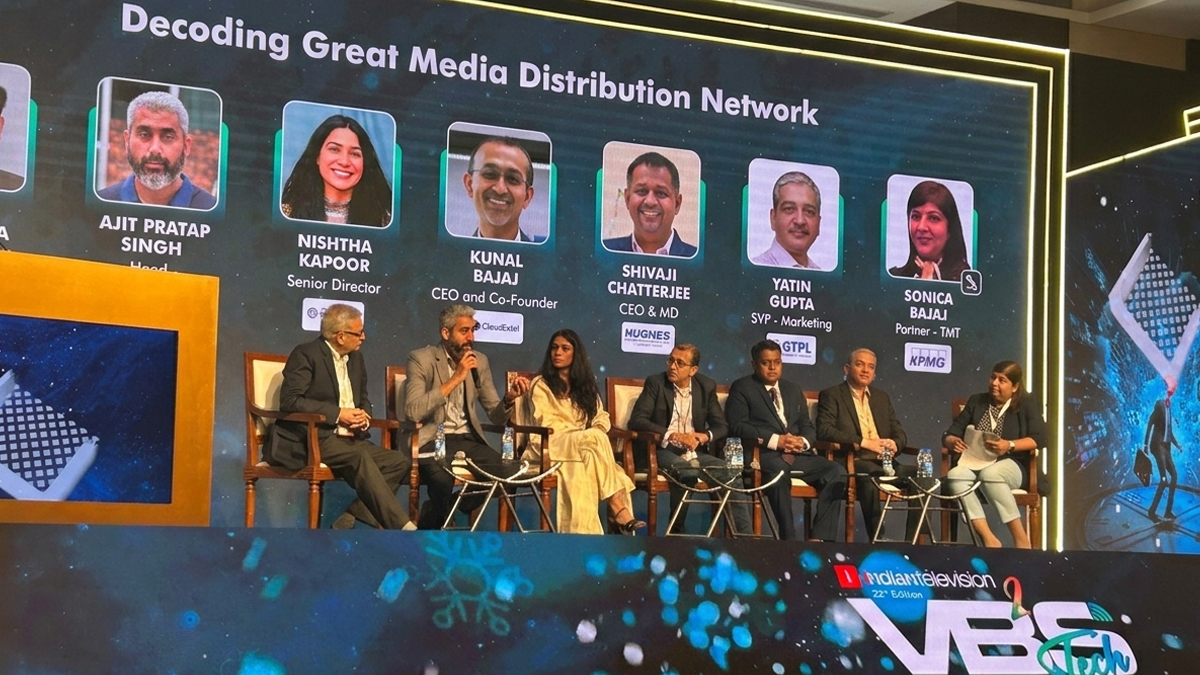
MUMBAI: India’s broadcast industry is not heading towards a linear-versus-OTT showdown. Instead, executives across the value chain argue it is entering an era of convergence: where satellite, cable, IPTV, OTT and AI-powered discovery merge on a single screen.
Industry leaders mapped the architecture of India’s hybrid media future: one built on satellite, IP delivery, 5G, data intelligence and AI, at the 22nd edition of the Video Broadcast and Broadband Tech Summit 2026.
The session, chaired by KPMG partner – TMT Sonica Bajaj, explored how broadcasters, digital platforms and distribution partners are building resilient and scalable networks while audience behaviour shifts toward on-demand, personalised consumption, without abandoning linear viewing.
Z chief revenue officer affiliate sales & head-public & regulatory affairs Anil Malhotra emphasised that linear television remains India’s mass medium. The country has roughly 160 million linear TV households across cable, DTH and free-to-air platforms. With television still a shared family device, its reach remains unmatched for large-scale content delivery.
“The only difference,” he noted, “is that linear is one-way, while OTT rides over telecom networks and allows two-way interaction.”
He pointed to aggregation as a common thread. Linear distributors have long bundled channels into unified offerings. OTT players are replicating that model, with consumers subscribing to 10–15 streaming platforms, often packaged by telecom operators.
However, monetisation remains complex. OTT platforms operate under 18 per cent GST, share up to 30 per cent with app stores, and rely heavily on low CPM digital advertising. “It is a thin-margin business,” he suggested, particularly when competing with user-generated content and short-form platforms amplified by algorithms.
Price sensitivity is another structural constraint. A Rs 40 tariff increase, he observed, can trigger millions of subscriber losses. Around 65 million homes rely on free-to-air platforms funded purely by advertising.
Content, he stressed, remains foundational.
Airtel head – telco engineering Ajit Pratap Singh laid out Airtel’s IPTV strategy, describing a shift from audience cohorting to individual-level curation, which he called “N equal to one.”
Rather than forcing consumers to navigate multiple subscriptions and search fatigue, Airtel is building unified billing and universal search across linear and OTT content. AI and machine learning models analyse personality traits, viewing time, language preference and behavioural signals to surface relevant content automatically.
“The customer may soon stop searching,” he said, predicting that conversational AI interfaces could replace traditional navigation within three to six months.
Crucially, Airtel controls both the network and the platform layer, allowing it to monitor playback quality in granular detail, targeting low latency, zero buffering and minimal errors.
For Singh, the future lies in removing friction from the limited leisure time consumers have: “You may have only 30 minutes. We want to remove the hazard of decision-making.”
Representing the satellite segment, Eutelsat OneWeb senior director Nishitha Kapoor highlighted the potential of low earth orbit (LEO) constellations to address India’s broadband deficit.
India has approximately 314 million households, but only about half own a television. Connectivity gaps remain acute. LEO satellites, she argued, can deliver 150–300 Mbps speeds with latency below 150 milliseconds, significantly lower than traditional geostationary satellites.
Unlike fibre rollouts that require right-of-way approvals and physical infrastructure, LEO terminals can be installed rapidly, even powered via a car battery if required.
Beyond reach, she emphasised redundancy. LEO networks provide genuine independent backup routes, strengthening disaster recovery and resilience for media operations.
The pitch was clear: without affordable high-speed connectivity, immersive AI- and cloud-driven content models risk excluding large swathes of the population.
GTPL SVP-marketing Yatin Gupta said the future of television lies in offering consumers a unified entertainment and connectivity experience.
“The consumer today simply wants access to content and connectivity. As networks, our role is to bring everything together in one place,” Gupta said, adding that operators are increasingly bundling broadband, cable TV and OTT platforms to offer a single, unified billing and viewing experience.
He noted that such integration is particularly critical for expanding television access in underserved markets. “India has around 314 million homes, but only about 160 million currently have a television connection. That leaves nearly 160–170 million households yet to get their first TV experience,” Gupta said.
Gupta added that television remains a uniquely family-centric medium, even as OTT continues to grow on personal devices.
“OTT is largely consumed individually on personal screens. Television, on the other hand, is still a shared family experience on the big screen. That’s why it will remain relevant for a very long time,” he said.
While distribution technologies may evolve, from linear broadcast to IP and IPTV, Gupta argued that the television platform itself will continue to endure.
CloudExtel CEO and co-founder Kunal Bajaj traced OTT’s rapid growth to the transition from 3G to 4G, which enabled mass video streaming and user-generated content. The next leap, powered by 5G, cloud architectures and edge computing, will enable immersive and interactive formats.
“4G drove video. 5G will drive immersion,” he said.
Low-latency networks could drive AR, VR and shared remote viewing experiences, creating communal engagement beyond physical proximity.
“It’s not if, but when,” he suggested, describing 5G as the enabler of the next content revolution.
Hughes Communications CEO & MD Shivaji Chatterjee cautioned against abandoning the efficiency of linear broadcast, especially for live events.
If millions stream identical cricket feeds over OTT, he argued, bandwidth is wasted. Satellite distribution remains cost-effective for mass simultaneous viewing.
He also highlighted IP’s growing backend role, from virtualised playout and encoding in data centres to hybrid satellite-IP last-mile delivery.
Across the panel, one message stood out. India’s future is hybrid: linear for mass reach, OTT for personalisation, satellite for resilience, cloud for intelligence.
Yet the economics remain delicate. In a market where small price changes trigger churn and millions still rely on free content, monetisation models must balance ambition with affordability.
Technology is advancing rapidly. But as multiple speakers stressed, infrastructure alone is not enough. Content must justify the pipeline, and the pipeline must be efficient enough to sustain the content.






