Sports
Rugby Premier League 2026 to be held in Hyderabad
Second edition returns in Rugby 7s format from 16 to 28 June at Gachibowli Stadium.
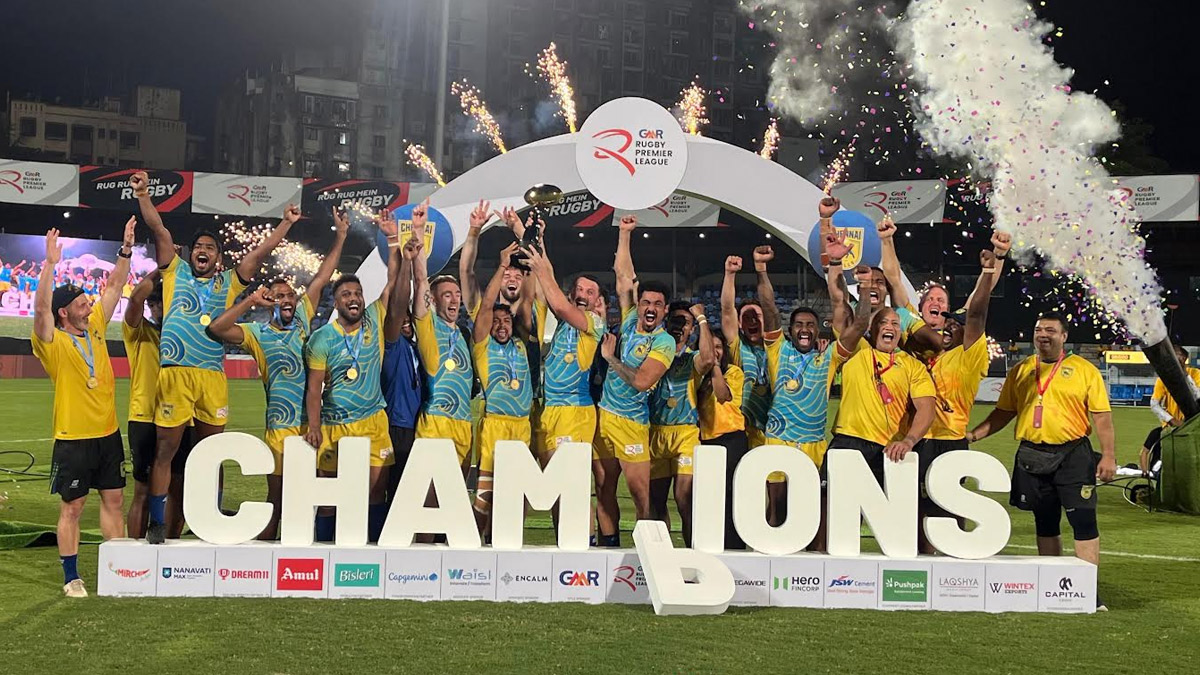
MUMBAI: Hyderabad is all set to tackle a new sporting challenge, the Rugby Premier League is coming to town, and this time it promises even more pace, power and passion. GMR Sports, in partnership with Rugby India, has announced that the second edition of the Rugby Premier League (RPL) will be staged at the Gachibowli Stadium in Hyderabad from 16 to 28 June 2026.
Following a successful debut in Mumbai last year, the league returns in the fast-paced Rugby 7s format. All six franchises from the inaugural season will compete again, bringing together top Indian and international talent to deliver high-quality, action-packed rugby for fans.
The shift to Hyderabad aligns with GMR Sports’ growing commitment to building world-class sporting infrastructure in the city. It also follows the group’s recent MoU with the Government of Telangana to develop a Satellite Sports City within Bharat Future City.
Government of Telangana special chief secretary (Youth Advancement, Tourism & Culture & Sports), IAS Jayesh Ranjan welcomed the league, saying Hyderabad’s emergence as a global sporting destination reflects the state’s long-term vision.
Rugby India President Rahul Bose emphasised the league’s continuous improvement, “With everything one does in life, the quest is to always do better, be better, deliver better.” He promised a superior fan experience, higher quality rugby, and a stronger television and OTT product in 2026.
GMR Sports CEO Satyam Trivedi highlighted Hyderabad’s excellent sports infrastructure, connectivity and passionate fan base as ideal for the league. “One of our franchise partners is rooted in Hyderabad, underscoring the city’s pivotal role in our long-term vision for rugby in India,” he added.
Sports Authority of Telangana, vice chairman & managing director, IFS A. Sonibala Devi noted that hosting the RPL will strengthen the state’s high-performance ecosystem and provide valuable exposure to emerging talent.
With elite competition, a proven format and a new energetic host city, the 2026 Rugby Premier League is shaping up to be a thrilling chapter in the growth of rugby across India. Get ready, Hyderabad rugby is about to touch down in style.

Sports
IPL 2026 shows widening gap between CTV and TV advertising trends
Ecom leads CTV with 39 per cent, 30 plus shared categories, distinct advertiser mix.
MUMBAI: If cricket is the same on every screen, advertising clearly isn’t. A new analysis by TAM Sports reveals a widening gap between Connected TV (CTV) and linear television advertising during IPL 2026, with brands and categories playing very different innings across platforms. On CTV, digital-first categories dominated. E-commerce media, entertainment and social media led with a commanding 39 per cent share, followed by e-commerce services at 11 per cent. Smartphones and cars each accounted for 6 per cent, while air conditioners contributed 4 per cent highlighting a strong tilt towards tech-led and high-consideration categories.
Linear TV, in contrast, leaned heavily into mass-market staples. Mouth fresheners topped the chart with 14 per cent, closely followed by e-commerce services at 13 per cent. Financial institutions held a 6 per cent share, while paints and e-commerce wallets each stood at 5 per cent, reflecting a more traditional advertising mix.
The divergence extends to advertisers as well. On CTV, Star India (JioHotstar) led with a dominant 39 per cent share, followed by Google at 17 per cent. Havells India, Renault India and Reliance Consumer Products rounded out the top five with smaller shares. Linear TV saw Google in the lead at 12 per cent, with Reliance Consumer Products at 10 per cent, followed by Vishnu Packaging and Havells India at 6 per cent each, and K P Pan Foods at 5 per cent.
Despite these differences, there is some overlap. The study identified 30 plus common categories and 25 plus common advertisers across both platforms, based on 22 matches analysed. Shared categories included e-commerce media, e-commerce services, mouth fresheners, paints and cars, while common advertisers featured Star India (JioHotstar), Google and Reliance Consumer Products.
Yet, exclusivity tells the sharper story. CTV saw over 20 exclusive categories and 30 plus unique advertisers, including smartphones, credit cards, fast food outlets and hotels, with brands such as Renault India, Tata Motors and Voltas featuring prominently. Linear TV, meanwhile, had 15 plus exclusive categories and 20 plus advertisers, including chocolates, jewellery, perfumes and mortgage loans, with names like Cadbury India, Skoda Auto and Amul in the mix.
The findings point to a structural shift in how advertisers are approaching big-ticket sporting events. While linear TV continues to deliver scale and familiarity, CTV is emerging as a playground for digital-native categories and more targeted brand storytelling.
In the IPL’s advertising game, it seems the format may be the same but the strategy is anything but uniform.