News Broadcasting
Prasar Bharati’s Gaurav Dwivedi on why news must move beyond the breaking-news race
Prasar Bharati CEO outlines a sharper role for public-service news in the digital age


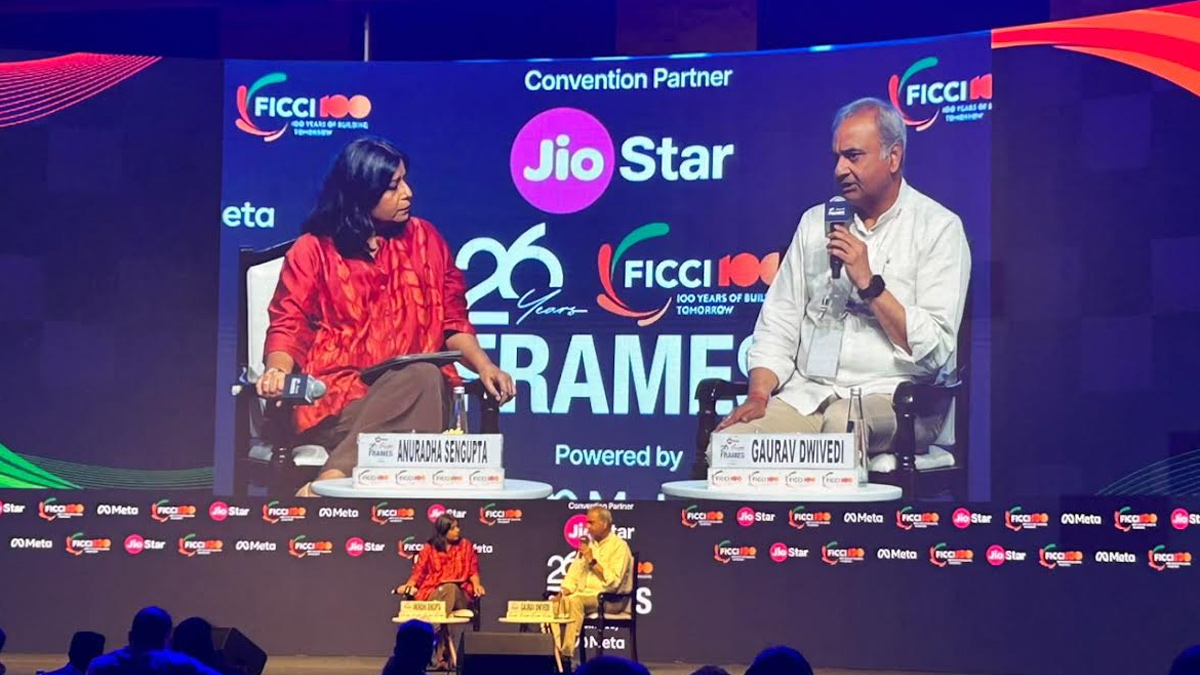
MUMBAI: In the trust game, facts need to stay in the driving seat. That was the central theme as Gaurav Dwivedi, chief executive officer of Prasar Bharati, discussed the future of news, audience trust and public-service broadcasting at FICCI Frames 2026.
The session, titled Who Can We Trust? Preserving the Sanctity of News in the Age of Digital Disruption, examined how news organisations can maintain credibility at a time when the boundaries between reporting, opinion, commentary and misinformation are increasingly difficult for audiences to navigate.
The discussion, moderated by journalist Anuradha Sengupta, centred on a changing news environment where audiences are no longer dependent on television for breaking news. Social media, digital platforms and algorithm-driven feeds have created an always-on information cycle, but also made it easier for audiences to repeatedly encounter the same interpretation of an event.
The resulting echo chambers can influence how people understand even the same set of facts. The discussion highlighted how repeated exposure to similar viewpoints can narrow the range of perspectives audiences encounter, making trust increasingly dependent not only on whether information is factual but also on how it is framed and distributed.
For public-service broadcasting, that creates an opportunity to rethink the role of news. Instead of competing with digital platforms purely on the speed of breaking news, the focus can shift towards bringing together verified facts, context and background and presenting them in concise, accessible formats.
The traditional breaking-news model is under pressure as audiences can receive an event update almost instantly through social platforms and other digital sources. The more relevant role for television and public-service news, therefore, is increasingly about explaining what happened, why it happened and what led to the event.
The challenge is to provide that context without turning every story into a lengthy television monologue. The approach discussed at FICCI Frames was to gather the relevant facts, organise them into a crisp package and allow audiences to form their own conclusions.
That also means adapting the way information is presented. News consumption is increasingly moving towards shorter, bite-sized formats across television, social media and digital platforms. The volume of information available is no longer the main problem. The bigger challenge is ensuring that audiences can actually absorb and understand it.
The evolution of Doordarshan itself illustrates that shift. News presentation has moved from presenters reading scripts from paper to packages, phone-ins, multiple frames and conversations between anchors. The next stage could involve learning from the presentation styles that have gained traction among digital creators while retaining the editorial discipline expected of a news organisation.
The conversation also placed renewed emphasis on reportage and the value of ground-level journalism.
India’s scale means that hundreds of developments can take place across different regions on any given day, even when one major story dominates national attention. A national broadcaster therefore faces the challenge of representing a wider picture rather than allowing the news cycle to revolve around only a handful of major events.
For Prasar Bharati, ground reporting was described as a continuing priority. Its network across states and Union Territories gives Doordarshan and Akashvani access to a broad pool of regional information.
The organisation has also moved towards creating a common news pool between its television and radio news operations, allowing material collected through different parts of the network to be shared more efficiently.
One of the more significant developments discussed was Shabd, the wire service through which Prasar Bharati is making news material available to other media organisations.
The service is being used by around 4,000 media organisations, including local channels, cable networks, newspapers and periodicals, according to the discussion. The material includes news stories as well as video and audio resources that organisations can use to build their own reports.
The initiative is particularly aimed at smaller media organisations that may not have the resources to maintain extensive reporting networks or subscribe to multiple commercial wire services.
The access has also been extended to independent content creators, widening the potential distribution of material collected through Prasar Bharati’s national network.
The underlying idea is that public-service broadcasting is not limited to the screen operated by the broadcaster itself. Information can reach audiences through television, radio, streaming services, digital publications and independent creators, with the emphasis placed on making credible information available across platforms.
The session also touched on Prasar Bharati’s decision to bring Sudhir Chaudhary into its programming mix.
The programme was described as a production engagement rather than a conventional salary arrangement. It runs five days a week and involves a wider production team operating under the editorial oversight of DD News.
Instead of functioning as a conventional news bulletin, the format focuses on capsules and segments built around specific subjects. The approach reflects the broader shift from expecting television to deliver breaking news to using it for deeper explanations and perspectives on selected issues.
The discussion placed the move within the longer evolution of Doordarshan’s programming, pointing to previous changes in presentation style and the involvement of prominent television news personalities and formats over the decades.
Audience measurement was also part of the conversation. The programme’s performance was discussed in the context of combined linear and digital viewership, with BARC data cited as showing DD News among the leading channels in the 9 pm to 10 pm slot.
The wider television industry continues to face uncertainty around audience measurement. BARC’s ratings system has been affected by regulatory and structural issues, with the status of news ratings and the possibility of multiple audience-measurement currencies remaining subjects of industry discussion.
The conversation eventually moved from social-media algorithms to artificial intelligence, raising the question of whether AI-generated audiovisual material should carry clear labels.
The discussion extended beyond news to audiovisual content more broadly. The central concern was that audiences should be able to distinguish between material created or substantially generated by AI and content produced through conventional human-led processes.
That becomes particularly important in news, where synthetic audio, video, images and scripts can make fabricated material appear increasingly convincing. Clear labelling was therefore discussed as an important potential safeguard as AI becomes more deeply embedded in content production and distribution.
The issue also fits into a broader industry conversation around AI and media. At FICCI Frames 2026, AI has emerged across multiple sessions as a force reshaping production, distribution, copyright and audience engagement.
Ultimately, the discussion framed the future of news not as a choice between television and digital, but as a question of how credible information can travel across both. In an environment overflowing with content, the value of journalism increasingly lies in providing facts, context and breadth while giving audiences the space to make up their own minds.