Sports
MPA sounds the alarm: the IPL’s $5.4bn rights party is over and the hangover starts in 2028
A new report finds the 2028-32 media rights cycle will flatline at $5.4bn, franchise losses are mounting and the merger that created JioHotstar has killed the competition that drove prices up

MUMBAI: The party lasted twenty years. Now comes the hangover. The Indian Premier League’s media rights, which grew six-fold since the first auction in 2008 to reach $5.4bn in the current 2023-27 cycle, are hitting a structural ceiling. The next rights auction, for the 2028-32 period, will fetch exactly the same number in total but deliver 13 per cent less per match, as an expanded 94-game format adds volume without adding value. Two decades of compounding growth, in short, are over.
That is the central finding of a report published on Monday by Media Partners Asia (MPA), entitled The IPL: Teams, Rights and Valuations. It is a forensic, and at times uncomfortable, read for anyone with money in the game.
The arithmetic of the current cycle is already painful. Rights holders are staring at cumulative losses of $1.8-2.0bn across the 2023-27 period. Total advertising revenue grew at just 7 per cent compound annual growth over the last three seasons, a sharp deceleration from the 18 per cent of the prior cycle. The culprits are familiar: policy-driven exits by ed-tech and real-money gaming companies, a BCCI ban on crypto advertising and a narrowed advertiser base that new sectors such as AI have not yet come close to replacing. Global macro headwinds are not helping either.

The structural story, though, runs deeper than a bad advertising cycle. The near-threefold jump in rights values seen at the 2023-27 auction was driven by fierce competition between Viacom18 and Disney. That competition no longer exists. The merger that created JioHotstar has eliminated the primary source of bidding tension, and with it, any realistic prospect of another auction war. MPA is blunt about what this means: the dynamic that supercharged rights values cannot be repeated.
“The IPL has created extraordinary value over two decades, but the conditions that drove that growth are now shifting in ways that are structurally consequential,” said Mihir Shah, vice president, India, at Media Partners Asia. “The rights reset in 2028 will not be a correction to be absorbed and forgotten. It marks the beginning of a period in which franchise value creation depends on building the non-media revenue base, focusing on sponsorship, international presence and digital monetisation.”
The warning to investors is pointed. Media rights now account for 75 per cent of total franchise revenues, up from 48 per cent in 2017. EBITDA margins have expanded from an average of 10 per cent in the first cycle to 34 per cent today, but that operating leverage, MPA notes, cuts both ways. When rights values correct, the pain is amplified. Non-media revenues are growing at 22 per cent compound annual growth since the pandemic, but from a low base that offers little cushion in the near term.
Against this backdrop, franchise owners are moving. Stake sales are accelerating, and MPA believes franchises are advancing liquidity plans precisely because they can see what is coming in 2028. Shah’s message to those pricing franchises at current multiples is direct: “Owners and investors who are pricing franchises today on current EBITDA multiples need to factor in both the rights cycle headwind and the concentration risk it implies. The window at current multiples may be shorter than the market assumes.”
MPA’s franchise scorecard, which assesses all ten IPL teams across championship wins, playoff appearances, social media following and international presence, places Mumbai Indians first with 360 out of 400 points and Chennai Super Kings second with 320. Royal Challengers Bengaluru ranks fourth, its enormous social media presence, anchored by Virat Kohli’s 274 million individual following, undermined by a single championship title across 18 seasons, no international franchise presence and dangerous dependence on one icon player. Punjab Kings and Lucknow Super Giants prop up the table at 90 and 100 points respectively.
The digital picture adds a further layer of irony. JioHotstar recently broke 70 million concurrent users during the ICC T20 World Cup final. Audience scale has never been greater. Yet that scale has not translated into the monetisation needed to justify current rights pricing. The structural gap between what streaming costs and what streaming earns remains, MPA says, the single biggest constraint on 2028 valuations.
Seventy million people watching at once and the economics still do not work. That, more than any other number in the report, tells you everything about where the IPL’s next chapter is headed.





Sports
IPL 19 records 96.8 ad index as advertisers and categories decline: TAM Sports report
Fewer categories and advertisers as tech and FMCG brands reshape IPL ad mix
NEW DELHI: The on-field action remains strong, but advertising activity during the Indian Premier League has shown a slight shift this season. A report from TAM Sports, a division of TAM Media Research, indicates that the first 13 matches of IPL 19 have recorded a marginal decline in commercial volumes compared to the same phase last year.
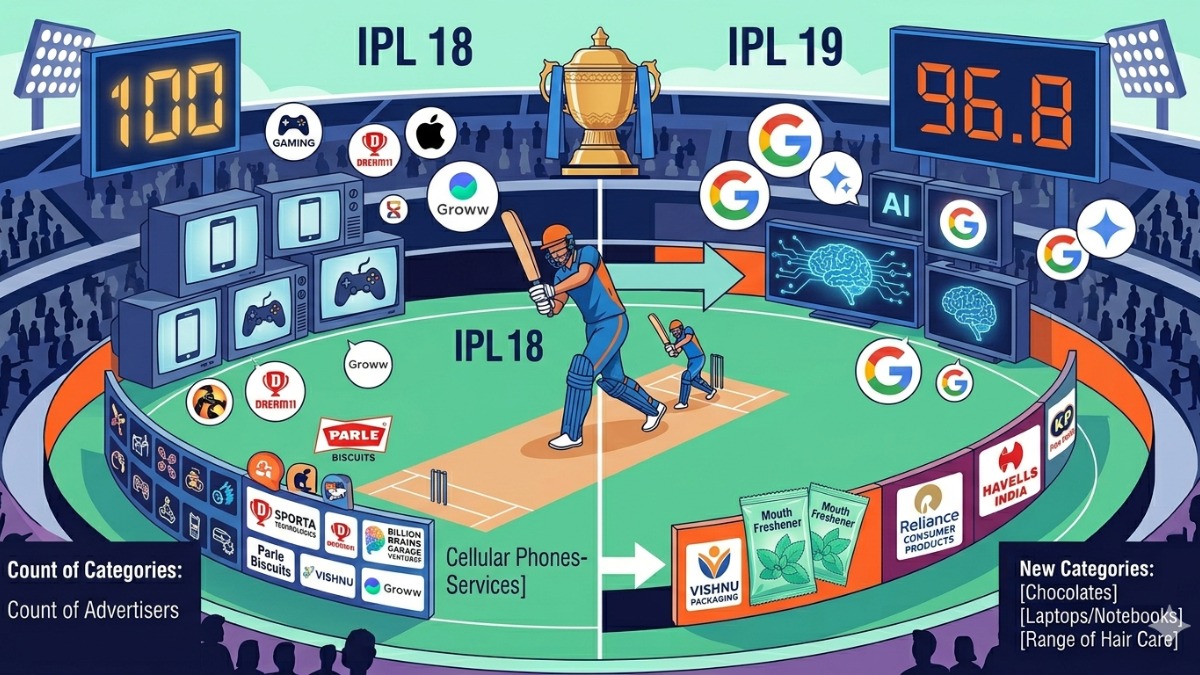
Indexed ad volumes stood at 96.8, down from 100 in IPL 18. The number of advertising categories fell from over 50 to 40, while the advertiser base reduced from 65 to 45. At the same time, the number of channels broadcasting the tournament declined from 28 to 25.
Mouth Fresheners emerged as the leading category, contributing over 14 per cent of total ad volumes. Ecom-Other Services and Ecom-Wallets followed, maintaining a strong presence during the early part of the tournament.
The technology sector has gained prominence this season. Google ranked as the top advertiser, accounting for over 13 per cent of ad share. The company focused on promoting its Google Search Engine and Google Gemini AI platform. In contrast, categories such as Ecom-Gaming and Cellular Phones-Smart Phones did not feature among the leading segments this year.
TAM Sports analyst Arjun Sharma said the decline in volumes reflects a more focused approach by advertisers, with fewer but more prominent players dominating the space.
The report also identified new entrants, with ten additional categories including Chocolates, Laptops/Notebooks, and Hair Care products. Among companies, Vishnu Packaging and Reliance Consumer Products remained key advertisers, while Havells India and K P Pan Foods continued to feature prominently.
Among brands, Vimal Pan Masala and Kamla Pasand Silver Coated Elaichi recorded high visibility, while Cadburys Dairy Milk Chocolate was among the notable new entrants.
With the tournament still underway, advertising activity may increase in the coming weeks as more brands look to capitalise on IPL viewership.







