News Broadcasting
From television to web on the go


CANNES: Day two of Mip Junior put the spotlight on how kids today are increasingly moving from television to the web.
“This year, four trillion gigabytes of social data was generated. In fact, two years down the line, the number will double,” said SuperAwesome CEO Dylan Collins, adding that Netflix and YouTube were two of the biggest platforms for children to watch/upload videos and listen to music.
“There is a re-definition of trend. This year, YouTube has seen 100 hours per minute of video being uploaded. And this has built up from zero, six years back. YouTube could probably kill half a dozen entertainment companies tomorrow, just because of how many children are there,” he said.

SuperAwesome recently asked 2,000 children what presents they’d like to unwrap on Christmas Day only to find out that kids favoured iPhones and iPads over traditional games consoles and handhelds.
Speaking about the shift to multiple screens, Collins said: “A lot of people talk of two screens, but there are actually four – the mobile, laptop, TV, and desktop. If one has to look at China, the usage of mobiles has exceeded that of desktops. This is where every kid is going.”
Again, kids with their own tablets are using more Android than iPad, Collins pointed out. “So when you’re thinking about creating new IPs and new brands, build them for tablets and not necessarily just iPads,” he said.
He stressed on the need for producers to think multi-channel from the very beginning. “Parents today are ready to pay $10-20 for tablets. Everything that interacts with kids involves video and that is the way ahead. Video isn’t going away, in fact, online video is getting bigger and everyone needs to think about it from day one,” he said.
The morning session also concentrated on games, apps, toys and books for kids.
In a session on ‘Borderless IPs’, MakieLab CEO Alice Taylor informed the audience about her creation of physical goods from virtual ones. “MakieLab is a start-up making customisable 3D printed dolls, born out of the trend where children were seen collecting in virtual worlds like Moshi Monsters and Club Penguin to customise avatars. We wanted to turn these avatars into real dolls.”
MakieLab now has a website and an app, and will also launch a game in early 2014. “The app helps children build their own doll through simple slide-bar controls. MakieLab is also working at creating an 11-minute 52-episode animated show aimed at girls, based on the Makies characters and world,” Taylor said.
Compania de Medios Digitales (CMD) COO Marcelo Liberini spoke about his product Gaturro, which started as a comic in 1993, and has now moved to TV and video. “We ended up building a full trans-media property around this character, and this year, we are finishing the work on the TV series,” Liberini said.
In 2010, CMD also launched Mundo Gaturro, a virtual world, which has since spread to online radio, a social network called Picapon, webisodes and a video-on-demand platform. “We are expanding into mobile too. We are now in the process of porting the virtual world, ready to be used on tablets,” Liberini said.







News Broadcasting
Network18 channels lead YouTube news viewership in March 2026
CNN-News18, News18 India and CNBC channels top categories with record views
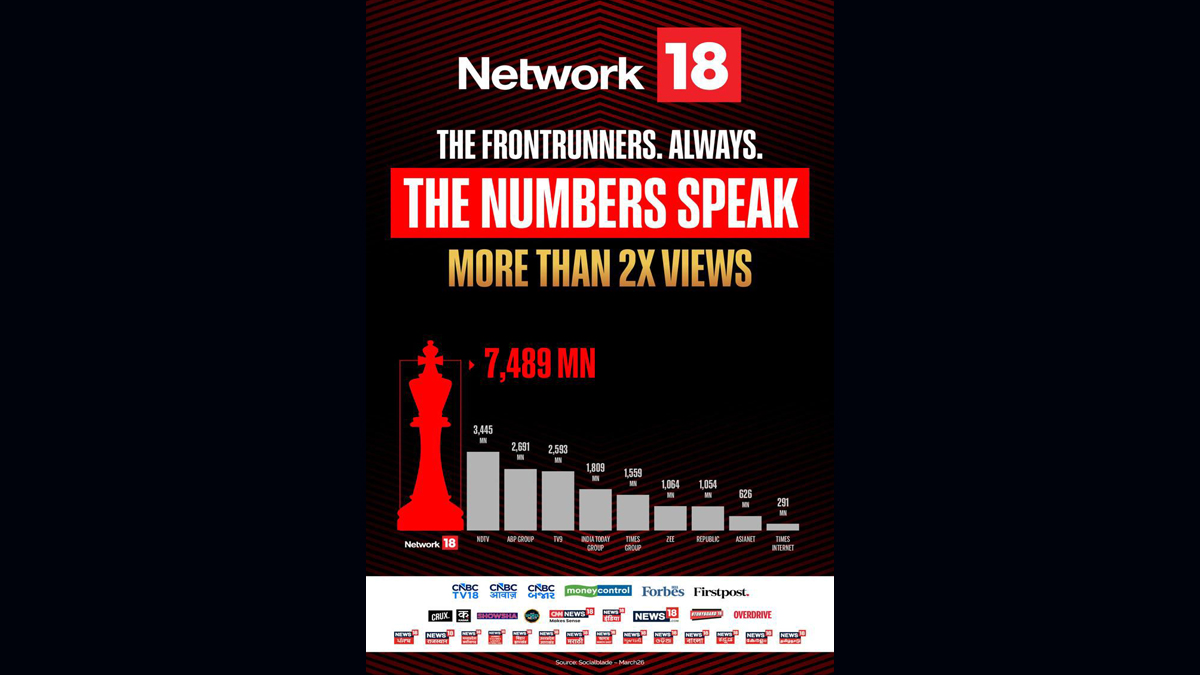
MUMBAI: When the world hit refresh on breaking news, Network18’s channels were already streaming ahead. As geopolitical tensions and war-driven headlines fuelled a surge in global news consumption, the network’s digital playbook delivered big clocking record Youtube viewership across English, Hindi and business news categories in March 2026.
At the forefront was CNN-News18, which emerged as the clear leader in the English news segment with 130 million live and video-on-demand views. The channel edged past competitors such as Times of India (126.5 million), Times Now (101.1 million), India Today (88.2 million) and NDTV (77.5 million), according to Databeings data for March.
In the Hindi news arena, News18 India delivered a commanding performance, racking up a staggering 3,297 million views on YouTube. The channel comfortably outpaced NDTV India, which recorded 3,119 million views, underlining its deep reach and consistent engagement with mass audiences, as per Playboard data.
The network’s dominance wasn’t confined to general news. In the Hindi business segment, CNBC Awaaz topped the charts with 92 million views, narrowly ahead of Zee Business (90 million) and well ahead of ET Now Swadesh (57 million). Meanwhile, its English counterpart CNBC-TV18 posted a strong 58 million views, reinforcing the network’s cross-category strength.
The spike in viewership reflects a broader shift in audience behaviour, with viewers increasingly turning to digital platforms particularly Youtube for real-time updates and in-depth coverage during high-intensity news cycles. For Network18, the numbers signal more than just scale; they underline the effectiveness of a multi-platform strategy that blends speed, credibility and continuous coverage.
In a month where the news never paused, it seems viewers chose to stay tuned where the stream never stopped.






