Comment
Disney’s theatrical production Beauty and the Beast makes an impressive debut
MUMBAI: When the history of Indian theatre is written sometime in the future, historians will make references to the pre- and the post Beauty and the Beast era. The date: 21 October 2015 will be enshrined as the day that changed the Indian musical theatre world. That was the day that Disney India had an exclusive premier of its one-year in production international theatrical musical.
It played to a packed house consisting of Bollywood stars, directors, producers, broadcasters, distributors and a select high net worth client list of Citibank credit cards (apparently it willingly shelled out Rs 5 crore plus to be associated with the musical) at the National Sports Club of India Dome in Mumbai.
Disney India MD Siddharth Roy Kapur was cock-a-hoop with delight about the response to the first performance. “We have made an impression on an audience consisting of entertainers, I think the rest of the journey is going to go well,” he said. “Disney International chairman Andy Bird responded to my wanting to bring Disney’s Theatrical Production to India with Beauty and the Beast. I thank him for that.”
Watching spell bound were film makers and artistes and industry barons like Subhash Ghai, Vishal Bhardwaj, Emraan Hashmi, Mini Mathur, Ashutosh Goawarikar, Kabir Khan, Vishal Bharadwaj, Rakeysh Omprakash Mehra, Vidya Balan, Soha Ali Khan, Imtiaz Ali, Anurag Basu, Nikhil Advani,Ayan Mukherji, Rajkumar Hirani, Shabhani Azmi, Aditya Roy Kapur, Madhur Bandarkar, Anil Thadani and Raveena Tandon, Manyata Dutt, Ronnie and Zarina Screwvala, Amol Gupte, Ramesh Taurani, Nikhil Meswani, Sudanshu Vats, Tarun Katiyal, among scores of others.
It’s not as if attempts at upping the ante for musical theatre have not been made in India before. We had the showman Alyque Padamsee period in the eighties during which shows like Evita (probably the longest running musical in India), Jesus Christ Superstar, Joseph and his Amazing Technicolor Dreamcoat, Greased Lightning, The Wiz, sold out in venues like the NCPA, Sophia, Homi Bhabha Auditorium in Mumbai. Then in recent times his daughter Rael Padamsee has been behind the production of The Sound of Music and Grease. But while their efforts are praiseworthy, they pale in comparison to the scale that Beauty and the Beast was mounted upon.
Estimates are that Disney India may have signed a cheque of Rs 22 crore for the production which will continue in Mumbai for 10 more shows till end this month. Delhi is slated to follow later. Most of the other Indian efforts at adaptations have budgets which are a fraction of that.
The “different international” experience commenced at the venue itself with clear signage directing the traffic to the red carpet. And there was Siddharth Roy Kapur to greet his guests along with international Disney executives. Once you got past the gates with your bar coded ticket giving you entry you walked into a spacious dome theatre constructed for the Beauty and the Beast. Rows upon rows of seats gave it a seating capacity of about 2,000-2,500.
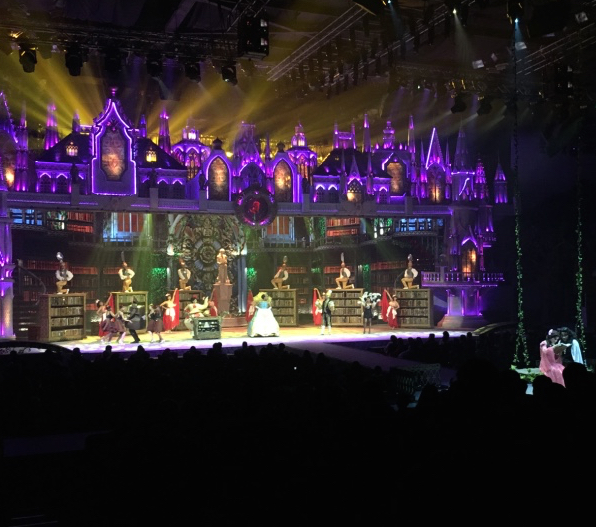
A half moon shaped lavish and large set (160 ft x 70 ft – normally used only for big budgeted televised awards shows) with ramps bisecting the front audience vertically and horizontally (giving it an H-shape) from those in the middle greeted the fans. Constructed by art director Varsha Jain at a cost of around Rs 1.80 crore, it is the centre-piece of Beauty and the Beast’s Indian production. It probably is the biggest stage ever constructed by Disney for the show anywhere in the world. Then there is the attention to detail and quality that Varsha has put into the set. You are almost lulled into believing that you are in the village with its marketplace, its main street, the roadside café, the bakery, the vendors, where Belle lives in her small home with her father.
A few minutes later the stage transforms itself into the dark castle wherein resides the young prince who was cursed to be a beast on account of his arrogance with a beggar. From the dark exterior to a well lit dining room to the dungeon to the balcony to the porch the shifts happen quickly.
3D Projection mapping, LEDs and large curtains, focused lighting – every trick in the book has been used to make the transitions easy and seamless. Additionally the props too have a sense of realism about them as compared to the shoddy fare that we often see in use in Indian theatrical productions.
It obviously is director Vikranth Pawar ‘s (he of Jhumroo and Zangaroo fame) vision. And choreographer Terence Lewis has ridden with him and made use of every inch of the stage and beyond for the sequences during the play. And he has adapted the choreography including styles such as ballet, jazz, breakdance and even classical ballroom dance depending on the scene’s requirement. One of the most memorable ones is the opening act with the song “Belle” wherein there are more than 60 actors and dancers on stage and you can’t seem to get enough of any of them. Overall the production has more than 250 dancers back stage through its 130 minute duration.
The musical score – like the original by Alan Menken – by Leslie Lewis for the Indian edition is flawless. Recorded in Prague with a Philharmonic Orchestra and mastered in Los Angeles, it is Lewis at his best, something that even Menken has acknowledged.
The costumes by Gavin Miguel – around 400 of them – for both the lead and support cast again are a class apart and make the show probably the biggest costumed theatrical show in India so far. The impeccable make up and hair design by Pallavi Devika take us back to the time and the place of the fairy tale. Vocal trainer Suzanne D’Mello is reported to have put her heart and soul into lifting the singing performances of the cast, and it shows for almost the entire duration of the show.
The technical production and direction are another highlight of the show and credit for that should go to Vikas and Vevek Menon (from Production Crew). Apparently, the lighting is being technically directed and programmed by foreign crew while it is being manned by Beckett.
Onto the cast. The deep, grain rich voice of Amitabh Bachchan as he introduces the long-loved fairy taile sets the tone for its quality. Meher Mistry as Belle fits and plays her part to the T, effortlessly becoming self-assured, vulnerable, loving, distraught and then joyous as she progresses from her ennui with the boor Gaston to meeting up with the Beast and her disgust with him transforming into love. And her singing is near perfect throughout as she easily croons the demanding tracks with lyrics from famed writers such as Howard Ashman and Tim Rice.
Edwin Joseph essays the role of the Beast with finesse and a gentle touch. His agony at being trapped in an ugly body, his realization of his love for Belle, his heroic battle while saving Belle from the wolves, and then his joy at his transformation into a handsome young prince are emotion-filled scenes. The young 21 year older is someone we will hear a lot more of both for his acting and singing prowess. Veteran actor Bugs Bhargava as Cogsworth and Nichols Brown as Lumiere, Sanjiv Desai as Maurice, and the actors who play Lefou, Gaston, Mrs Potts, Ayudh Jatin Parikh (as Chip) deserve a mention for fabulous performances.
In summation, Disney India’s Beauty and the Beast was made in India but better than world class. And that was echoed by almost all those who watched it to the end. Something that should warm the cockles of Narendra Modi’s heart.

Comment
GUEST COLUMN: The year OTT grew up and micro-drama took over India’s screens
MUMBAI: 2025 will be remembered as the year India’s OTT industry stopped chasing scale for its own sake and began reckoning with how audiences actually consume content. Completion rates fell, patience wore thin and the limits of long-form excess became impossible to ignore. In this guest column, Pratap Jain, founder and CEO of ChanaJor, traces how micro-drama moved from the fringes to the centre of viewing behaviour, why short-form fiction emerged as a retention engine rather than a trend, and how platforms that respected time, habit and emotional payoff were the ones that truly grew up in 2025.
If there is one thing 2025 will be remembered for in the Indian OTT industry, it’s this: the industry finally stopped pretending.
Stopped pretending that bigger automatically meant better.
Stopped pretending that viewers had endless time.
Stopped pretending that scale without retention was success.
What began as a quiet reset in 2023 and a cautious correction in 2024 turned into a very visible shift in 2025. Business models matured. Content strategies tightened. And most importantly, platforms started aligning themselves with how Indians actually watch content, not how the industry wished they would.
At the centre of this shift was micro-drama—not as a trend, but as a behavioural inevitability.
When OTT finally understood the time problem
For years, long episodes were treated as a marker of seriousness. A 45–60 minute runtime was almost a badge of credibility. Shorter formats were pushed to the margins, labelled as “snack content” or “mobile-only.”
That belief quietly collapsed in 2025.
What platform data showed very clearly was not a drop in interest—but a drop in patience. Viewers weren’t rejecting stories. They were rejecting commitment.
Across platforms, the same patterns appeared:
* First-episode drop-offs on long-form shows kept increasing
* Completion rates continued to slide
* Viewers were sampling more titles but finishing fewer
At the same time, shows with episodes in the six to 10 minute range started showing the opposite behaviour: higher completion, higher repeat viewing, and stronger daily habit formation.
Micro-drama didn’t win because it was short. It won because it respected time.
Micro-Drama didn’t arrive loudly. It took over quietly.
There was no single moment when micro-drama “launched” in India. It crept in through dashboards and retention charts.
By mid-2025, it was clear that viewers were happy watching four, five, sometimes six short episodes in one sitting—even when they wouldn’t finish a single long episode. Romance, relationship drama, slice-of-life conflict, and grounded comedy worked especially well.
This wasn’t disposable content. It was compressed storytelling.
In shorter formats, there was no room for indulgence. Every episode had to move the story forward. Weak writing was punished faster. Strong writing was rewarded immediately.
Micro-drama raised the bar instead of lowering it.
Where ChanaJor naturally fit into this shift
ChanaJor didn’t pivot to micro-drama in 2025 because the market demanded it. In many ways, the platform was already built around the same viewing behaviour.
From the beginning, ChanaJor focused on short-to-mid-length fictional stories that felt close to everyday Indian life—hostels, rented flats, office romances, small-town relationships, young people figuring things out. Stories that didn’t need heavy context or cinematic scale to connect.
What worked in ChanaJor’s favour in 2025 was clarity:
* A clearly defined audience
* Tight episode lengths
* Storytelling that prioritised emotion and pace over spectacle
While several platforms rushed to copy global micro-drama formats, ChanaJor stayed rooted in familiar Indian settings and conflicts. That familiarity mattered. Viewers didn’t have to “enter” the world of the show—it already felt like theirs.
Why audiences started responding differently
One of the biggest misconceptions going into 2025 was that audiences wanted shorter content because their attention spans had reduced. That wasn’t entirely true.
What viewers actually wanted was meaningful payoff per minute.
On platforms like ChanaJor, episodes didn’t waste time setting the mood for ten minutes. Conflicts arrived early. Characters were recognisable within moments. Emotional hooks landed fast.
A typical consumption pattern looked like real life:
* One episode during a break
* Two more before sleeping
* A few the next day
This is how viewing habits are built—not through marketing spends, but through comfort and consistency.
Viewers came back not because every show was a blockbuster, but because they knew what kind of experience to expect.
2025 was also the year OTT faced business reality
The other big change in 2025 was on the business side. Subscriber growth slowed. Discounts stopped hiding churn. Customer acquisition costs rose.
Platforms were forced to ask harder questions:
* Are viewers finishing what they start?
* Are they returning without reminders?
* Is this content worth what we’re spending on it?
This is where micro-drama began outperforming expectations. A well-written short series could deliver sustained engagement without massive budgets. It didn’t peak for one weekend and disappear—it stayed alive through repeat viewing.
Platforms like ChanaJor benefited because they weren’t chasing inflated launch numbers. The focus was on consistency and retention, not noise.
Failures Became Visible Faster
2025 also exposed weaknesses brutally.
Several platforms assumed micro-drama was a shortcut—short episodes, quick shoots, instant traction. What they discovered was that bad writing fails faster in short formats than in long ones.
Viewers dropped off within minutes. Episodes were abandoned mid-way. Weak stories had nowhere to hide.
Micro-drama didn’t forgive laziness. It amplified it.
The platforms that survived were the ones that treated short storytelling with the same seriousness as long-form—sometimes more.
OTT Stopped Chasing Prestige and Started Chasing Habit
Perhaps the most important shift in 2025 wasn’t technical or creative—it was psychological.
OTT stopped trying to look like cinema. It stopped chasing validation through scale and awards alone. It began behaving like what it actually is in people’s lives: a daily companion.
Platforms like ChanaJor found their space here because that mindset was already baked in. The goal wasn’t to dominate a weekend launch. It was to quietly become part of someone’s everyday viewing routine.
That shift changed everything—from release strategies to how success was measured.
What 2025 Ultimately Taught the Industry
By the end of the year, three truths were impossible to ignore:
* Time is the most valuable thing a viewer gives you
* Retention matters more than reach
* Format must follow behaviour, not ego
Micro-drama didn’t take over because it was fashionable. It took over because it fit real life.
Looking Ahead
Micro-drama is not replacing long-form storytelling. It is redefining the baseline of engagement.
Longer shows will survive—but only when they earn their length. Short-form fiction will continue to evolve, becoming sharper, more emotionally confident, and better written.
Platforms like ChanaJor have shown that it’s possible to grow without shouting—by understanding the audience, respecting their time, and telling stories that feel real.
2025 wasn’t the year OTT became smaller. It was the year it became smarter.
Note: The views expressed in this article are solely the author’s and do not necessarily reflect our own.