News Broadcasting
Big Fight in Hindi news turf

R iding high on the claim of carrying ‘exclusive’ and ‘breaking’ stories, news channels are rating their success stories. The route is not through digging a story from the rubles of Nandigram or Singur but the passing game of the pot of gold begins with high end stories on the World Cup, Shilpa Shetty winning the Big Brother title or being kissed by Richarsd Gere and the great Indian Abhi-Ash wedding.
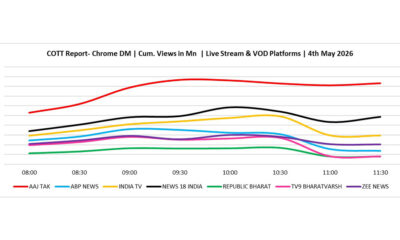
Indiantelevision.com’s analysis of Hindi news channels using Tam data (HSM, C&S 15 + years) during the six-month period beginning January 2007 throws up some interesting insights into the genre while the battle among the players intensifies.
 The reigning Hindi news channel in the category during this period is TV Today’s flagship channel Aaj Tak. The channel has held on to its top position. With a six month average of 21.3 per cent (Tam C&S 15 + years, HSM), it has topped the chart with a share of 23 in January. But it has yielded ground in June and has shared the top slot in this month with a 19 per cent share.
Meanwhile, Aaj Tak’s sister concern Tez has managed to be consistent in its performance with an average of 4 per cent for the period.
 Second in the ratings game performance is Star News which has been consistent and stable across the period. Securing the second spot in the January to May period, Star news has gripped the market with 17 per cent share. However, in the month of June, it soared to the very top, sharing position with Aaj Tak. Star News clocked a six month average of 16.8 per cent.
But a closer look at the half-yearly score card (January -June 2007) of news channels across the Hindi speaking belt reveals grave concerns for some players.
 One that has seen the slide is NDTV India. From January to June, the relative market share has been dipping considerably. From a 13 per cent market share in January, the channel reached 9 in June, while the six-month average stood at 10.8 per cent, which does not even place the channel among the top three.
Explains NDTV group CEO Narayan Rao, “It is a short term passing phase. In the long term for any news channel it is credibility and authencity that matters. Whatever the situation is, we never opted to go down a certain route. We still have the same philosophy as we had when we conceived the channel.”
The channel had the guts to stay out of sensationalism which was grabbing eyeballs. “News can be of any kind. It depends on the channel’s ideology to present the same story without sensationalising it. We strive to get the hard core stories. Dibang who was our managing editor, on his special request, is now sent on special assignment. He will travel across India and bring core issues into light,” Rao says.
 NDTV’s hope is that sensationalism would ease out in the long run. Says Rao, “Undoubtedly the differentiating factor is how we package the content. We never want to titillate the viewer but rather have a impact on him. On 14 and 15 August, when all the news channels were showing the footage of the gory fake encounter in Allahabad, we edited the video and showed it only for a limited number of times. This makes a difference in the long run.”
As a rule, somebody’s loss is somebody’s gain. Giving tough competition to the other news channels, India TV has upped its status in the ranks. Holding 11 per cent share in January (Tam C&S 15 + years, HSM), the channel jumped up to 16 cent and 15 per cent in May and June to clutch the second position in the respective months.
 Is Hindi journalism in the electronic media going the tabloid way?
A media observer says, “The division is like the caste system in India. When the bigger channels show anything exclusive, people say the channel deserved it. Yet, people call it ‘tabloidisation’ when a smaller channel shows anything of that sort.”
The news is not so good for Zee News. A matter of concern is that Zee News has not been able to go beyond the third spot. In the January to June period, Zee News’ has been hovering around 13 to 11 per cent (Tam C&S 15 + years, HSM). However in the month of June, the channel lost its long held third position to IBN 7.
IBN 7, a later entrant into the space, has been working hard to get into the top league. The channel leaped into the competition in the months of May and June with 12 per cent each, prior to which it accounted for merely 9 per cent of the market in the month of January.
Says IBN 7 managing editor Ashutosh, “We were the first to expose the Nithari case. It was us first who brought to light the first case of cannibalism in India.”
“These days hardcore news is disappearing from the channel. It is not that all the news channels are here to do moral lesson stories. The news stories are selected on the basis of popularity. However, we at IBN 7 have always invested in the hardcore stories. This is the USP of the channel,” he explains further.
 The other channels in the fray have not been able to stand the heat of the competition in the Hindi speaking belt. Whatever the reasons may be, the Hindi heartland fails to be satisfied by the likes of DD News, Sahara Samay Rashtriya and Janmat (now re-positioned as Live India).
The figures of the government run DD News tells a sad story. Starting as low as three in the month of January, DD News could only manage a mere four per cent in June.
Lagging further behind is Broadcast Initiatives’ Janmat with an average of 1.83 per cent over the six month period. Following its recent re-positioning from a ‘views’ channel to adopting the live news approach, the challenge ahead will be to make its mark in the market.
Sahara Samay Rashtriya has also been losing its existing hold in the market with a share of 7 per cent in January, slipping down to 5 in the month of May.
Currently obsessed with the three C’s – crime, cricket and cinema – another C (for comedy) has become the new found love of Hindi news channels.
Meanwhile, the deadly Content Code proposed by the information and broadcasting ministry is threatening to whack news channels going astray. Facing much opposition from these channels, the restrictions of the Content Code might, in fact, turn the tables of the numbers game or even determine whether tabloidisation or credible and authentic journalism is what will rule the roost.
Once the ‘big brother’ steps in, it will be interesting to see the strategy each news channel churns out to outdo competition and be ahead of the game.
But that is another story we will have to wait for as the government is coming under increasing pressure to bow down on the Content Code.
Graphs by Roshnni