
Sports
A Perfect Sunday: when Women’s Day met the World Cup final
What the World Cup final and Women’s Day revealed about how India still chooses to celebrate


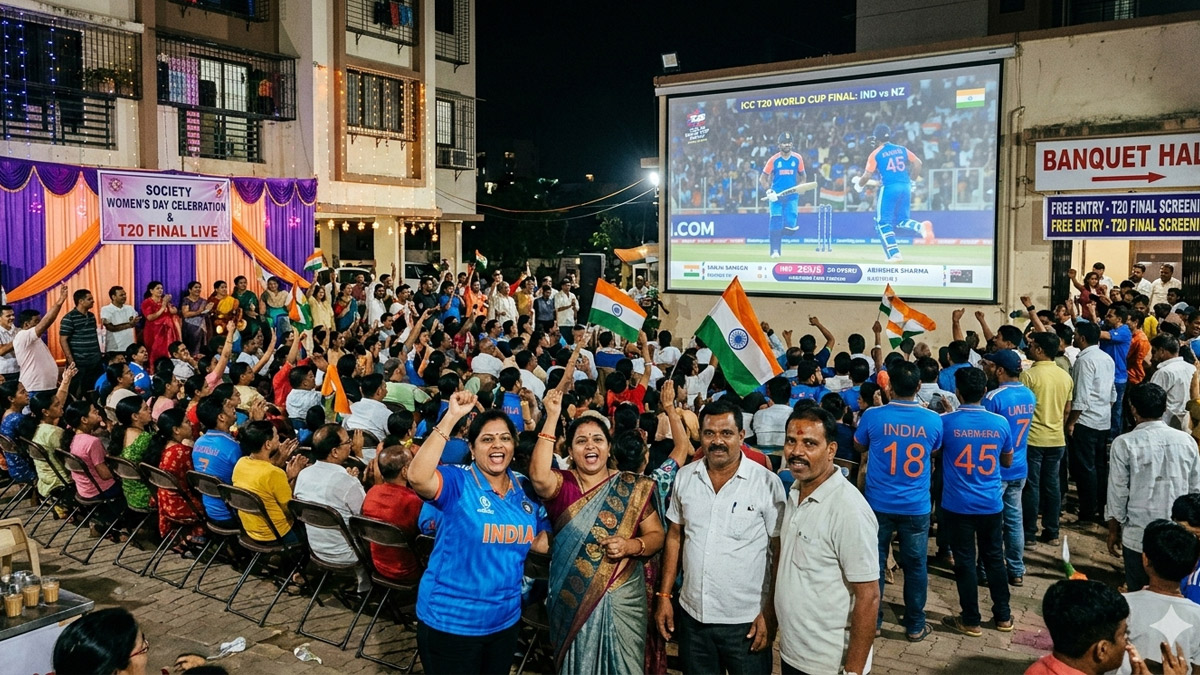
MUMBAI: India doesn’t do things by half. So when International Women’s Day fell on the same Sunday as the ICC T20 World Cup final, India vs New Zealand, the country didn’t have to choose between celebrations. It simply merged them into one glorious, chaotic, joyful day.
In an age where every match is a tap away and scores arrive before the commentator has drawn breath, India chose to watch together. Projectors replaced phone screens. Courtyards replaced living rooms. The instinct to gather, it turns out, outlasted the algorithm.
Across Mumbai, the pattern repeated itself in neighbourhood after neighbourhood. By the time Abhishek Sharma smashed 52 off 21 balls, screens were already up and crowds already restless. Banquet halls, the kind usually reserved for weddings and corporate dinners, threw open their doors for free. Folding chairs filled up fast. Chai arrived in batches. Strangers became neighbours.
In Mumbai’s Virar, the mood ahead of the India vs New Zealand final was impossible to miss. Housing societies set up projectors in their grounds, pulling residents out of their flats and into the open air. Local banquet halls went further, throwing their doors open at no charge to anyone who walked in. The streets carried the match too, the sound of commentary drifting from one open gate to the next, the crowd thickening wherever a screen was visible. It was not organised. It did not need to be.
India’s batting was a spectacle made for big screens, and it delivered one of the great final innings in the tournament’s history. Sanju Samson blazed his way to 89 off 46 balls. Ishan Kishan added 54 off 25. The powerplay alone yielded 92 for 0 in six overs, the highest-ever powerplay score in a T20 World Cup final. By the time the innings closed at 255 for 5, the highest total ever posted in a T20 World Cup final, 18 sixes and 19 fours had been struck, 184 runs coming from boundaries alone. Every boundary landed twice: once on the pitch, once in the room.
New Zealand walked in needing 256 off 120 balls, a run rate of 12.80, the kind of target that turns dressing rooms quiet. At 32 for 2 inside four overs, with Bumrah striking first ball of his spell and Axar Patel removing Finn Allen, the chase was faltering before it had found its footing. It never recovered. India won the T20 World Cup, and within minutes, the streets of Virar responded. Crackers went off across the city, the sky punctuated with light before the presentation ceremony had barely begun. The courtyards that had spent the afternoon holding their breath erupted. The banquet halls, still full, shook. But the day had never been only about cricket.
Brands had been circling Women’s Day all week on social media, scheduling posts, curating reels, deploying hashtags. On Sunday, the street upstaged them all. Yet some read the room well. Tanishq and CaratLane, the two names most Indian women associate with jewellery worth wanting, opened their doors not just for sales but for something less transactional. Free nail art, complimentary styling consultations, small gestures that turned a showroom visit into an occasion. Salons across neighbourhoods offered flat discounts, some as steep as 30 to 40 per cent, on services for the day. Clothing retailers followed with their own offers, the kind that are easy to dismiss as marketing until you see the queues outside.
What made Sunday different was not the discounts. It was the timing. Women stepped out in the morning for Women’s Day, for the offers, the felicitation programmes in their societies, the small acknowledgements that the day demands. By afternoon, those same women were in courtyards and banquet halls watching Bumrah dismantle a New Zealand top order. The two halves of the day were not in competition. They flowed into each other with an ease that no campaign planner could have engineered.
The numbers told their own story. Early projections suggested that the combined effect of Women’s Day spending and World Cup final viewership drove a 40 per cent surge in digital transactions compared with a standard Sunday. In the Vasai-Virar belt alone, complimentary services, food delivery orders placed during the match and retail footfall combined to make this one of the highest-grossing Sundays on record for the local service economy. Economists call it the orange economy, the creative and experiential end of consumer spending. On this particular Sunday, it needed no encouragement.
There was something quietly telling about it. Streaming had spent a decade making the act of watching a private one, each viewer siloed behind their own screen, their own data plan, their own algorithm. On Sunday, India simply ignored all of that. Inside homes, televisions did what they have always done best: gathered families around a single screen, the volume turned up, the commentary bouncing off kitchen walls. Outside, the projector took over, scaling that same instinct to the street, the courtyard, the banquet hall. Neither is new technology. Both did something a smartphone cannot: they made watching a shared act. The device changed by generation. The need to watch together never did.
A 40 per cent spike in digital transactions. A world record total. A nation that watched it all together, on televisions inside and projectors outside, without anyone having to organise it. And when the last wicket fell, crackers over Virar.
India won the T20 World Cup. It had already won the day.
NOTE: The cover image used is AI generated.






