Regulators
Supreme Court to hear Meta-Whatsapp CCI penalty appeals
Rs 213 crore fine challenged over 2021 privacy policy, bench led by CJI Surya Kant takes up matter on 23 February 2026.

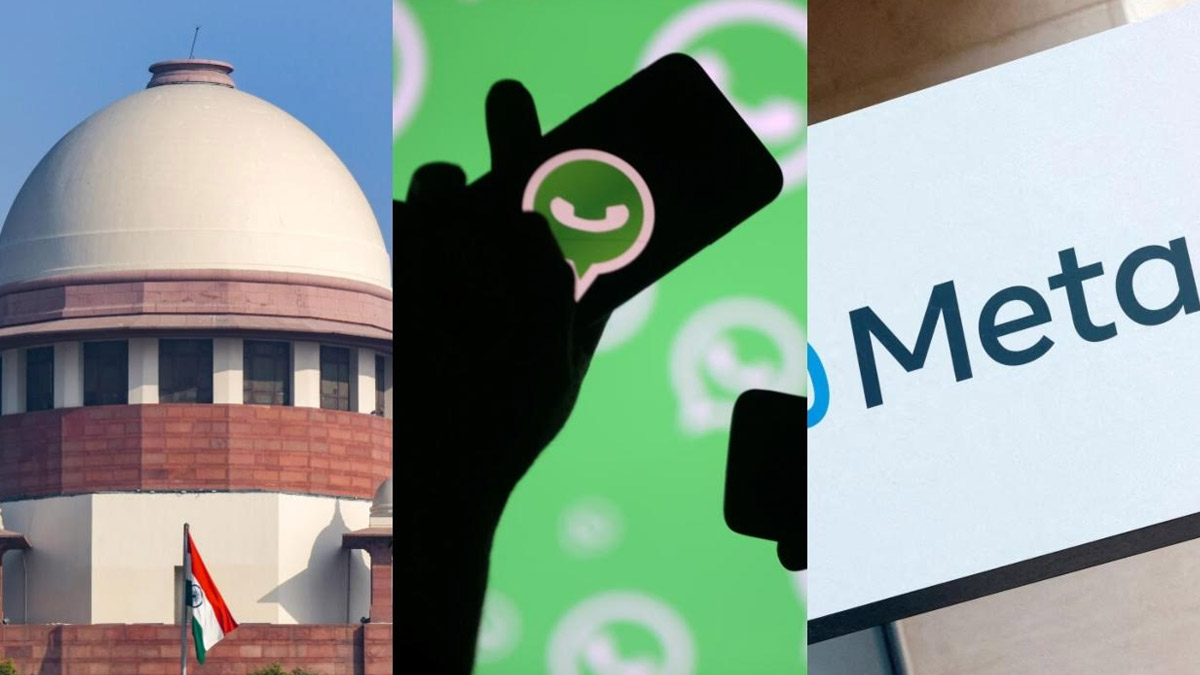
MUMBAI: Meta and Whatsapp are about to face the music in court because when privacy policies play loose, even billion-dollar apps can get a stern privacy lecture from the bench. The Supreme Court is set to dive into the high-stakes appeals filed by Meta Platforms and Whatsapp against a Competition Commission of India (CCI) order slapping them with a Rs 213.14 crore penalty. A bench headed by Chief Justice of India Surya Kant, alongside Justices Joymalya Bagchi and Vipul M Pancholi, is expected to hear the matter, with an interim order likely on 23 February 2026.
The penalty stems from Whatsapp’s controversial 2021 privacy policy update, which expanded data-sharing with parent company Meta for commercial use sparking concerns over market dominance, user consent, and misuse of personal information. In earlier hearings on 3 February, the bench didn’t mince words: it questioned whether the companies were compromising citizens’ privacy rights under the guise of data practices, called many users “silent customers” digitally dependent and often unaware of how their data is leveraged, and made clear that constitutional privacy protections won’t be diluted.
The saga took a turn in November 2025 when the National Company Law Appellate Tribunal (NCLAT) set aside part of the CCI order banning WhatsApp from sharing user data with Meta for advertising for five years. However, NCLAT upheld the Rs 213 crore fine and later clarified the ruling allowed data collection and sharing for both advertising and non-advertising purposes beyond WhatsApp’s core service. The CCI has filed a cross-appeal challenging that part of the NCLAT decision.

The Supreme Court has directed the ministry of electronics and information technology be impleaded as a party, signalling the case’s broader implications for digital regulation. With the appeals now before the top court, the proceedings sit at the tense crossroads of competition law, data privacy, and platform accountability in India’s fast-growing digital economy.
Whether the bench reins in cross-app data flows or upholds the status quo, this showdown could redraw the rules for how tech giants handle user information proving that in the privacy game, even the biggest players can’t always message their way out of a tough spot.





I&B Ministry
CBFC speeds up film certification; average approval time cut to 22 days
Over 71,900 films cleared in five years as digital system shortens approval timelines

MUMBAI: The Central Board of Film Certification (CBFC) has significantly reduced the time taken to certify films, with the average approval timeline now down to 22 working days for feature films and just three days for short films.
Operating under the Ministry of Information and Broadcasting, the statutory body certifies films for public exhibition in line with the Cinematograph Act, 1952 and the Cinematograph (Certification) Rules, 2024. The rules prescribe a maximum certification period of 48 working days, though the adoption of the Online Certification System has sharply accelerated the process.
Over the past five years, from 2020-21 to 2024-25, the board certified a total of 71,963 films across formats. Of these, the majority fell under the U category with 41,817 titles, followed by UA with 28,268 films and A with 1,878 films. No films were certified under the S category during the period.
Film approvals have also steadily risen in recent years. The CBFC cleared 8,299 films in 2020-21, a figure that peaked at 18,070 in 2022-23 before settling at 15,444 films in 2024-25. During the same period, 11,064 films were certified with cuts or modifications.
Despite the high volume of certifications, outright refusals remain rare. Only three films were denied certification over the last five years, with one refusal recorded in 2022-23 and two in 2024-25.
The board may recommend cuts or modifications if a film violates statutory parameters relating to the sovereignty and integrity of India, security of the state, friendly relations with foreign states, public order, decency or morality, defamation, contempt of court or incitement to an offence.
Filmmakers can challenge CBFC decisions in court. Data shows that such disputes remain limited but have seen some fluctuation. Between 2021 and 2025, a total of 21 certification decisions were challenged before High Courts, with the number rising to 10 cases in 2025.
Responding to a question in the Rajya Sabha, minister of state for information and broadcasting L. Murugan shared the data. The question was raised by Mallikarjun Kharge.
With faster timelines and a largely digital workflow, the certification process appears to be moving at a far brisker pace, signalling a shift towards quicker clearances for India’s growing film output.