
People
Attention is the new currency, says Kevin Vaz at FICCI Frames 2026
In his inaugural address, Vaz says India’s media and entertainment industry grew 9 per cent to Rs 2.78 lakh crore in 2025, and calls for value, not volume, to define the country’s media moment


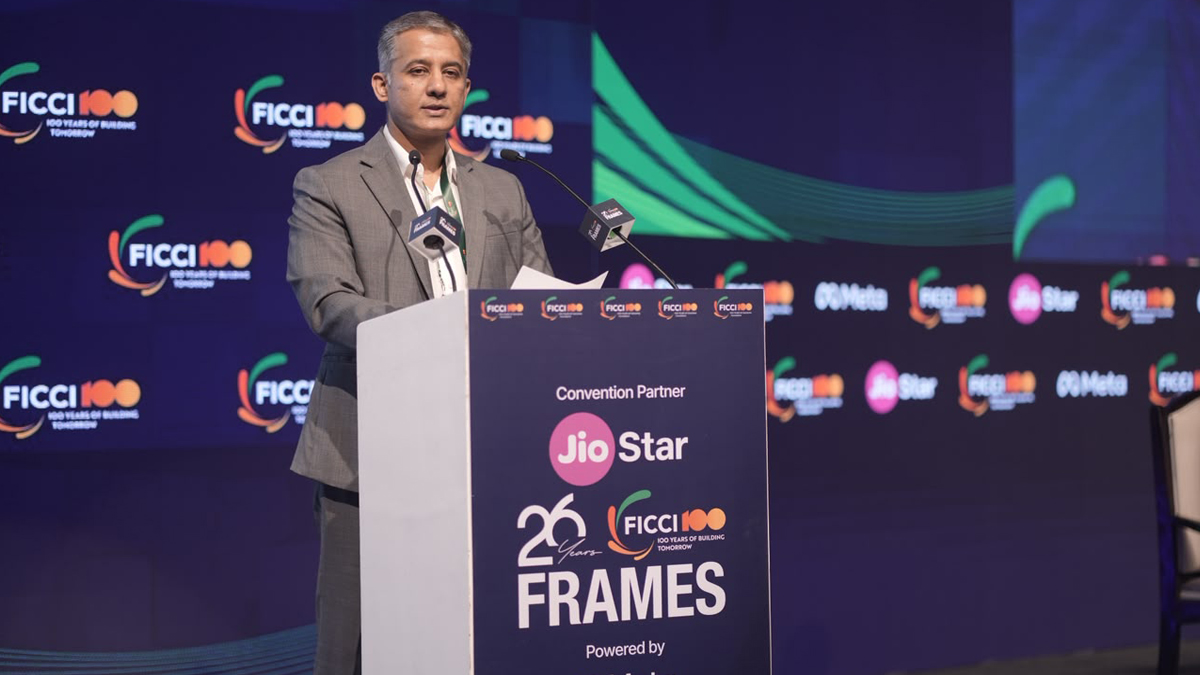
MUMBAI: Infinite content, finite attention. That is the puzzle Kevin Vaz put to the industry at FICCI Frames 2026, and his answer was bracing: the winners will be those who make the thumb stop. Delivering the inaugural address, Vaz said India’s media and entertainment industry grew 9 per cent in 2025 to Rs 2.78 lakh crore, with digital crossing Rs 1.1 lakh crore and live events growing 47 per cent. “While these numbers are encouraging, the bigger opportunity lies in what is happening beneath them,” he said.
Vaz opened by welcoming Gajendra Singh Shekhawat, union minister of tourism and culture, government of India; Prabhat, additional secretary (I&B), ministry of information and broadcasting; Anant Goenka, president, FICCI; Ayushmann Khurrana, acclaimed actor and FICCI Frames ambassador; Arjun Nowhar, co-chair, FICCI M&E committee, and managing director, South Asia, Warner Bros Discovery; Jyoti Vij, director general, FICCI; and Ashish S Kulkarni, chief mentor, FICCI Frames 2026 and Frame Your Idea. A room bringing together policymakers, creators, businesses, platforms and the wider ecosystem, he said, is invaluable because it allows the industry to thrive and do the impossible.
Vaz, who has been closely associated with the FICCI media and entertainment committee for almost two years, said it was a privilege to see the committee mark 26 years of shaping the conversation through FICCI Frames. Before beginning, he asked the gathering to observe a moment of silence for the late Leena Jaisani, deputy secretary general and head of media and entertainment at FICCI. Jaisani was among the founding members of the committee and a true torchbearer of its legacy. She worked, he said, with extraordinary commitment, warmth and purpose, and her contribution to the industry will endure.
The theme this year is India’s Media Moment: Creating Value in an Age of Infinite Content. It asks something critical of the industry: in an age of infinite content, how do we continue to create value? Vaz set out where the industry stands. “For much of our history, the biggest constraint was distribution, with limited channels, screens and ways for stories to find their audiences, whereas today what is scarce is not content but attention,” he said. “Attention is the new currency,” he added, and in an era where ideas seem endless, the magic lies in creating something that makes the “thumb stop”.
Here is where India gets interesting. The country is not watching one ecosystem replace another. Television, streaming, mobile and connected TV coexist, converge and create new opportunities. Linear television remains deeply embedded in Indian households even as connected TV and digital consumption accelerate, and the story of the large screen is far from over. The same television now brings together linear channels, streaming, live sport and on-demand entertainment. “What was once a television set is increasingly becoming a connected entertainment hub,” he said.
Unlike the smartphone, the large screen remains a shared screen, bringing families and communities together around stories, sport and moments that matter. Recent industry estimates suggest more than 80 per cent of connected TV viewing is shared with family or friends, and the CTV universe in India is estimated at over 200 million viewers. That makes CTV a compelling proposition, combining the scale and lean-back experience of the large screen with the capabilities of digital: search, recommendation, personalisation, addressability and measurability. The opportunity, Vaz said, is not to choose between screens but to let audiences move seamlessly across them, while giving the industry better ways to understand and serve those audiences.
Linear TV streaming is a good example of that evolution. It marries the scale and familiarity of television with the flexibility of streaming, lets consumers watch live channels on the screen and connection of their choice, expands television’s reach and opens new opportunities for measurement and advertising. When these worlds come together at scale, the opportunity becomes more powerful still. TATA IPL 2026 is perhaps the clearest expression of this convergence, reaching more than 1.2 billion viewers and showing the extraordinary scale possible when television, streaming, sport, technology and fandom meet.
The evolution is also in the shape of the stories themselves. New formats such as micro-drama are opening creative and commercial possibilities, with the category worth Rs 650 crore in 2025 and expected to grow at over 50 per cent annually by 2028. That matters for the creative ecosystem, because new formats bring new creators, writers, producers and production houses into play. JioStar’s entry into micro-drama through TADKA, and its engagement with more than 50 production houses, is helping broaden the production ecosystem and bring more creators into the fold.
Then there is content commerce, where attention translates directly into action. During TATA IPL 2026 and the live stream of Dhurandhar The Revenge, JioHotstar enabled viewers to discover and purchase products without leaving the app. It is a simple idea, said Vaz, but an important one: reducing the distance between discovery, engagement and action. “Content Commerce is becoming a third meaningful value pool for our industry, alongside advertising and subscriptions,” he said.
New value pools need the right conditions to grow, which brought Vaz to regulation. Broadcasters have long asked for forbearance, because innovation needs room to evolve, and as the industry pursues its next phase of growth, self-regulation and strong industry best practices should be central. A tangible roadmap is needed, he said, to remove the regulatory burden and cost of linear broadcasting, allowing it to evolve alongside digital and giving consumers greater choice in how, where and on which screen they consume content.
The broadcast industry welcomed and thanked the ministry of information and broadcasting for removing the 10+2 advertising cap, an important step towards a regulatory framework that reflects the changing realities of linear broadcasting and the wider media landscape. At the same time, the industry strongly urged the ministry to restore the release of BARC audience ratings immediately. The absence of credible, verifiable audience data, Vaz said, is creating uncertainty for broadcasters, advertisers and agencies, particularly during the crucial festive season. Reliable measurement is essential for brands to plan campaigns and reach audiences efficiently.
Television, he reminded the room, remains one of India’s most widely consumed and affordable media platforms, and broadcasting and advertising play an important role in the wider economic ecosystem. At a time of global economic uncertainty, reliable audience measurement is critical to keeping that ecosystem efficient, supporting advertisers and broadcasters, and keeping domestic economic activity moving.
No speech, Vaz said, would be complete without artificial intelligence, which is transforming everything from production and storytelling to workflows, analytics and personalisation. Yet even as technology expands what is possible, the human being must remain at the centre of the creative ecosystem. That means building responsibly, with clarity around copyright, consent, attribution and fair value for creators. “The goal is not to slow innovation down but to ensure technology and creativity grow together,” he said.
His parting thought was the sharpest of the address. In an age of infinite content, success cannot be measured by how much the industry produces or how many screens it reaches, but by the value and impact it creates. He posed three tests. Did we make something people genuinely cared about? Did we build intellectual property that could travel from India to the world? And did we create value for everyone in the ecosystem, from the audience to the creator and the business? “That, to me, is what India’s media moment is really about,” said Vaz, wishing all present a productive and inspiring FICCI Frames 2026.
Volume is easy. Value is the hard bit, and India’s media industry looks ready for it.






