e-commerce
Zepto gets to the root of fresh supply with farmer-first new playbook
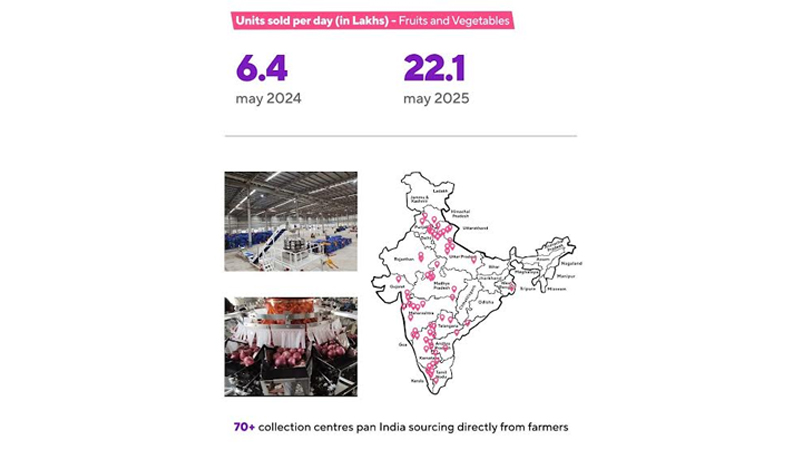
MUMBAI: From mandi mayhem to farm-fresh flair, Zepto’s shaking up the supply chain. Zepto co-founder and CEO Aadit Palicha has revealed how the quick commerce player is rewriting the rules of India’s fragmented fresh produce market, one collection centre at a time. In a detailed post, he shared how the startup has quietly scaled its fresh category by 4x in just 12 months, leaping from 6.4 lakh to 22.1 lakh units sold per day.
What’s behind this massive growth spurt? A shift away from the traditional mandi-led chaos to a tech-powered, decentralised model built on trust with farmers and rapid movement of goods. Zepto now sources directly from thousands of farmers across 70-plus Collection Centres hyperlocal hubs where fruits and vegetables are graded, packed, and dispatched within 12 hours of harvest.
A key weapon in Zepto’s fresh arsenal is the Bloom app, the startup’s proprietary sourcing platform that turns real-time mandi price tracking, vendor scoring, and dynamic procurement into a science. The result? Better price visibility for farmers, automated planning for Zepto, and a win-win loop that cuts out intermediaries and reduces waste.
This model isn’t just about speed, it’s also about dignity and predictability. “For the first time, Indian farmers are becoming part of a demand-driven, digital-first ecosystem,” Palicha noted. Through Bloom, they gain access to live market benchmarks, input support, and assured offtake features unheard of in India’s informal agri-supply chains.
Even last-mile delivery hasn’t been spared a makeover. Zepto has invested in smart handling systems that preserve freshness while slashing delivery timelines. Combined with direct relationships with farmers, this allows the company to keep quality high and prices sharp, something traditional retail has long struggled with.
In a sector long marred by price volatility and perishability, Zepto’s fresh strategy is a rare blend of logistics, localisation, and digital insight. The real disruptor here isn’t just tech, it’s trust.

e-commerce
American Express to acquire AI startup Hyper to boost automation
Deal targets expense management as AI reshapes corporate spending tools.
MUMBAI: From receipts to robots, the expense sheet is getting a brain upgrade as American Express moves to bring artificial intelligence into the heart of corporate spending. The company has announced plans to acquire Hyper, a relatively young but fast-rising startup founded in 2022 that builds AI-powered agents capable of organising expenses, generating reports, verifying compliance with budgets and policies, and nudging users with timely reminders. The deal, expected to close in the second quarter of 2026, underscores a growing shift among financial institutions to automate traditionally manual, time-heavy workflows.
Hyper counts Sam Altman among its backers, adding a layer of Silicon Valley credibility to the acquisition. While financial details remain undisclosed, the strategic intent is clear: deepen automation capabilities and sharpen American Express’s position in the competitive corporate spending ecosystem.
The two companies are not strangers. They previously collaborated in 2024 on a co-branded credit card product, suggesting that the acquisition is less a cold buy and more an extension of an existing relationship. With this move, American Express is effectively bringing that capability in-house, aiming to embed AI directly into its commercial services stack.
Chief executive Stephen Squeri had already signalled the direction of travel in a recent shareholder letter, describing AI as a “structural shift” in how businesses operate. The Hyper acquisition appears to be a direct response to that shift, particularly in expense management, where processes such as approvals, compliance checks and reporting remain ripe for automation.
Alongside the acquisition, the company is also expanding its product suite. A recently launched business credit card offers cashback and benefits at an annual fee of $295, with another card expected later this year moves that complement its broader push into commercial services.
Taken together, the strategy points to a future where managing expenses may require fewer spreadsheets and more algorithms. For American Express, the bet is simple, if businesses are rethinking how work gets done, the tools that power that work need to evolve just as quickly.