News Broadcasting
Zee Media Corp revenue rises 28.8 % to Rs 170 crore in Q1


Mumbai: Zee Media Corporation’s operational revenue was up 28.8 per cent to Rs 170.18 crore for the quarter ended in June 2021 as against Rs 132.14 crore in the corresponding period of the previous fiscal.
The network has reported a consolidated net loss of Rs 9.06 crore for the quarter under review on account of exceptional items. The company has posted a net profit of Rs 12.26 crore during the April-June quarter of the previous fiscal, Zee Media Corporation Ltd (ZMCL) said in a regulatory filing.
ZMCL’s total expenses were at Rs 157.70 crore, up 35.16 per cent Q1/FY 2021-22, as against Rs 116.68 crore. The company suffered a loss of Rs 17.11 crore for exceptional items and tax for April-June quarter.

ZMCL comprises of 14 news channels, including one Global, three National and ten Regional/language channels – Zee News, Zee Business, WION, Zee Hindustan, Zee Punjab Haryana Himachal, Zee Madhya Pradesh Chhattisgarh, Zee 24 Taas, Zee 24 Ghanta, Zee Odisha, Zee Bihar Jharkhand, Zee Rajasthan, Zee Salaam, Zee 24 Kalak, and Zee Uttar Pradesh Uttarakhand.
The company said its digital news portfolio continues to witness growth across the properties. The language news properties spanning 16 brands in 12 languages received 1.9 billion views in Q1 FY22 compared to 1.6 billion views in Q4FY21. Monthly Average Users (MAUs) grew from 107.7 million in Q4FY21 to 141.9 million in Q1FY22.
Meanwhile, the company has appointed Swetha Gopalan as an Independent director of the company for a term of five consecutive years with effect from 1 August. Gopalan started her career in 2010, when she joined Johns Hopkins Medicine International, USA, and has worked with Parkway Health and The Noble Group, both in Singapore. She also worked as a Business Analyst with Tata Consultancy Services in the USA from 2015 to 2016.






News Broadcasting
News18 India launches Command Centre war explainer with Arya
New show shifts from debates to decoding global conflicts and impacts
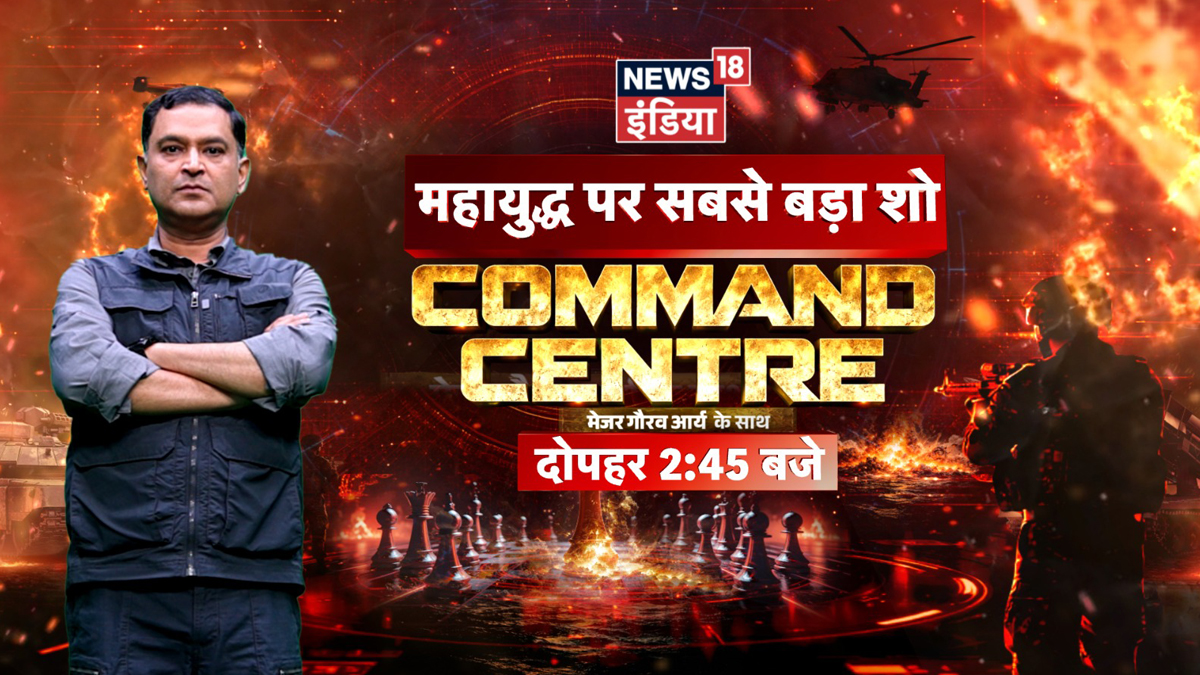
MUMBAI: News18 India has rolled out a new war-focused programme, Command Centre, featuring Gaurav Arya, as it looks to offer viewers a sharper, more grounded take on global conflicts amid rising tensions in West Asia.
Positioned as an “insider war room”, the show moves away from conventional panel debates and instead focuses on explaining military developments, decoding strategy and connecting global events to their everyday impact, from fuel prices to economic shifts.
The format leans heavily on visuals and data. The studio has been designed like a command hub, complete with large LED war maps, real-time graphics and an alert system to track developments as they unfold.
At the centre of it all is Arya, who brings his military background to simplify complex war strategies for viewers. His signature line, “Seedhi baat samjhiye”, anchors the show’s promise of clarity over noise.
News18 India managing editor Jyoti Kamal said, “Command Centre, featuring Major Gaurav Arya is designed to deliver accurate insights and a clear perspective on how evolving conflicts impact everyday life, from household budgets to national security. With expert voices analysing every development in real time, the show goes beyond headlines to decode what’s happening now, what it means, and what could come next.”
Echoing the intent, Gaurav Arya added, “In times of war, confusion is the biggest threat. With News18 India’s Command Centre, we are bringing viewers inside the war room, decoding strategies, tracking every escalation, and explaining, in the simplest terms, what it means for India and for every household. Seedhi baat samjhiye, this is where you understand not just what is happening, but what happens next.”
The weekday show will air in the afternoon slot and will also feature Gaurav Shukla, adding to its editorial depth.
With its mix of analysis, visuals and a clear focus on impact, the show reflects a broader shift in news consumption. Viewers are no longer just watching events unfold, they are looking to understand what those events mean for them.






