iWorld
Why Indian OTT services should adapt to survive after pandemic


Despite huge spikes in streaming service viewership during Covid209 lockdown, OTT streaming services in India need to remain vigilant in these uncertain times, especially with the global recession reaching its worst. The stakes are especially high for independent players who have heightened pressures to meet their metrics, or else face the same fate as OTT platforms like Viu and HOOQ.
According to Evergent VP and GM Paolo Cuttorelli, streaming services need to entice consumers to keep their memberships for the months ahead with new bundles, services, and special retention offers to keep users on their platform. a global provider of revenue and customer management for telcos, streaming providers, and digital entertainment companies. In an interview with Indiantelevision.com, he provides some insights on the pitfalls streaming services in India have to avoid at this time.
Excerpts:

What are some pitfalls streaming services in India have to avoid during this time?
Currently, streaming services around the world, India included, are capitalizing on an increase in subscribers during country lockdowns. Having said that, Covid2019 will pass, meaning viewership and subscriber numbers may fall as individuals are allowed to socialize and resume their everyday activities. Streaming services need to entice consumers to keep their memberships for the months ahead and can do so by having the agility to respond accordingly with new bundles, services, and special retention offers to keep users on their platform. With respect to India in particular, overall video viewing behaviour continues to increase in both the traditional Pay TV or OTT segments. We expect this trend to continue beyond COVID for the foreseeable future.
How can streaming services stand out from the crowded space of OTT?
To stand out, OTT players need to leverage innovation and digitalization. The legacy mindset must be replaced with a new approach focused on delivering value to customers. Digital (and even traditional) players need to utilize integrated revenue and customer management platforms to help reduce time to market for products and services. This also helps them simplify the complex monetization models and back-office processes so that they run more efficiently.
OTT businesses must also genuinely engage with consumers to help them manage and subscribe to new services without being invasive. The ability to listen to their audience and quickly pivot both systems and people will help keep Indian video streaming businesses on course for continued success. Combining these improvements together will result in dramatically improved customer experiences. Enabling customers to digitally manage all aspects of their connected services provides superior customer experience and sets the stage for personalized offers that are much more likely to succeed.
How can OTT streaming services navigate the landscape in India post-pandemic?
As mentioned above, businesses must understand the need to convince customers to continue with their services post-COVID or risk getting left behind. An unwillingness to innovate, listen to their customers, and adapt, coupled with a refusal to evolve with the market will have devastating effects on any business — it is crucial that streaming services keep this top of mind post-pandemic. Streaming services must respond accordingly to the needs of their customers with new bundles, services, special retention and win-back offers.
For streaming services in India to be successful, it's absolutely critical to have a deep understanding of payment, product and content preferences specific to each market. It’s also important for OTT providers in India to look beyond their borders and understand how they can best service their international audiences who may be more inclined to pay for access to OTT services that give them a taste of home. Getting the mix of offers, promotion and payment types right by region is critical to the success of any OTT platform with global aspirations. In addition, it is essential to adopt a continuous learning mindset and avoid the temptation of replicating models that work elsewhere — all markets are completely different and streaming services need to acknowledge this from the get-go.





eNews
Barc India, Nielsen launch Barc | Nielsen One Ads, a unified cross-media ad measurement tool
JioHotstar to deploy cross-screen measurement during T20 World Cup 2026
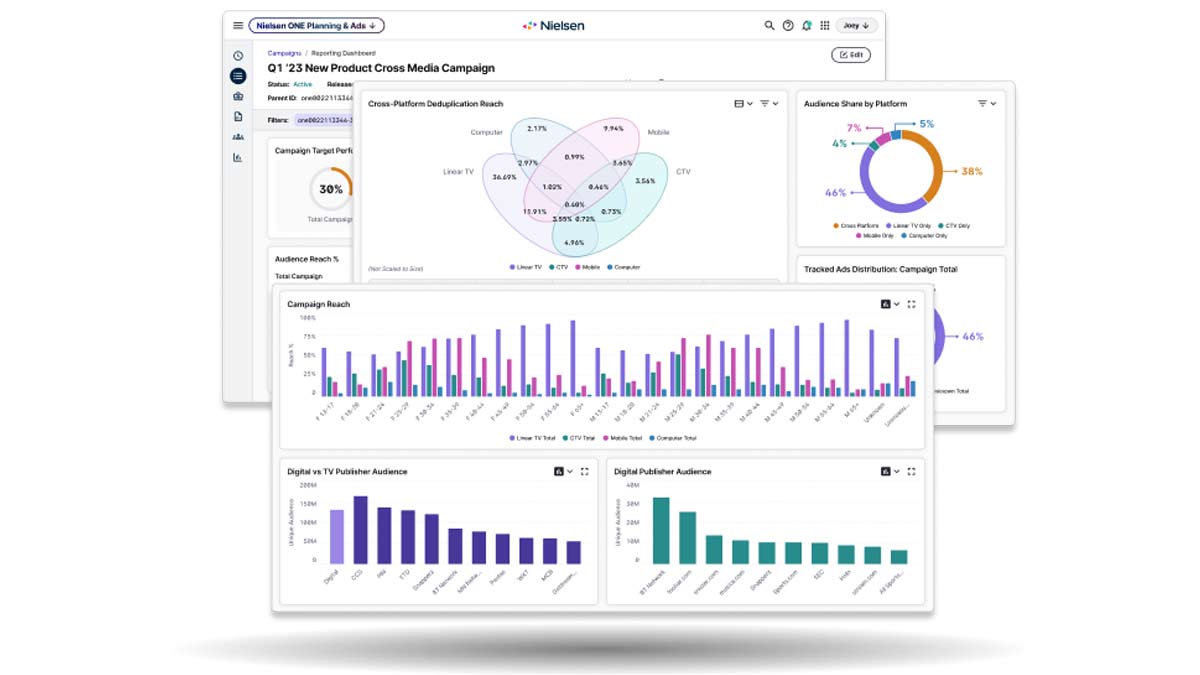
MUMBAI: Broadcast Audience Research Council India and Nielsen have joined forces to launch Barc | Nielsen One Ads, a cross-media measurement system designed to give advertisers a unified view of advertising performance across television and digital platforms.
The new framework combines Barc India’s linear television viewership data with digital audience measurement from Nielsen One Ads. The result is a single dataset that measures advertising reach and frequency across four screens: linear tv, connected tv, mobile and computer, while removing duplicated audiences across devices.
The move comes as India’s media landscape grows increasingly fragmented, with advertisers struggling to reconcile data from multiple platforms. The joint system aims to provide a single, deduplicated picture of campaign performance and audience reach.
“This marks a defining moment for cross-media ad measurement in India,” said Barc India chief executive Nakul Chopra. “Barc | Nielsen One Ads brings together television and digital screens in a unified system, enabling advertisers to understand their true reach and incremental impact across the entire media ecosystem.”
Nielsen chief product officer Akhil Parekh, said the collaboration addresses a long-standing challenge for advertisers. “Brands have had to stitch together fragmented data to understand how campaigns perform. A single, deduplicated view across screens is something the industry has needed for years.”
The first deployment will take place on JioHotstar, which will use the system to measure advertising during the ICC Men’s T20 World Cup 2026 hosted by India and Sri Lanka. Barc India said the framework could expand to include more broadcasters and platforms if industry demand grows.
Among the system’s key features are unified four-screen reporting, advanced reach deduplication to eliminate duplicate viewers across devices, and detailed metrics including average frequency, gross rating points and demographic performance.