iWorld
VidNet 2022: Why do narratives like ‘Gullak’ work on OTT?

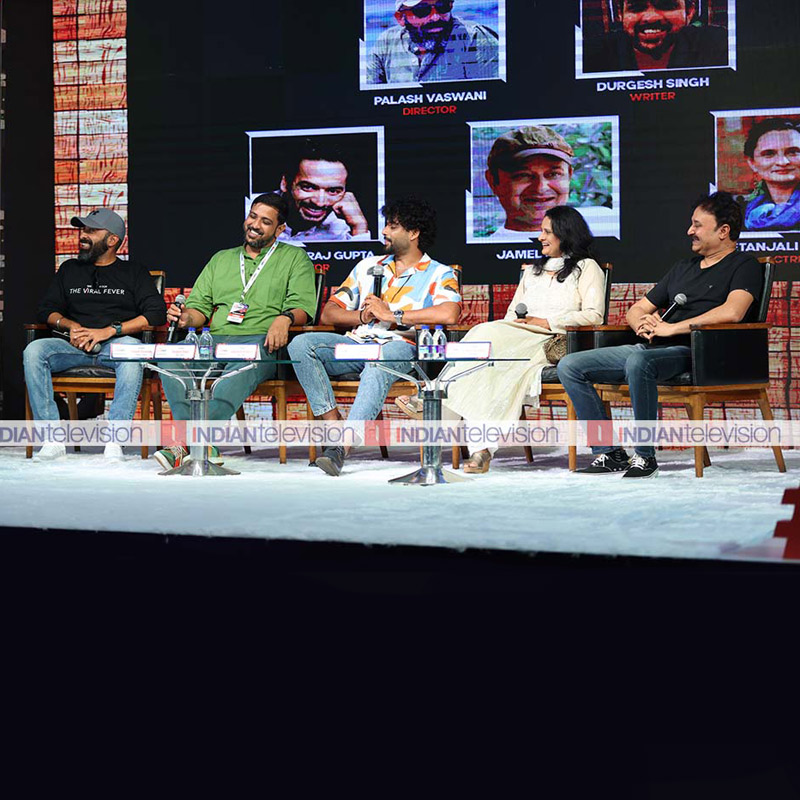
Mumbai: SonyLiv web series “Gullak” produced by The Viral Fever, which concluded its third season recently, is a revelation for OTT platforms on creating franchises that span multiple seasons and do not lose their appeal. The simple premise of the show revolves around the interactions of a middle-class family ‘The Mishras’ including the father Santosh Mishra (played by Jameel Khan), mother Shanti Mishra (played by Geetanjali Kulkarni), elder son Anu Mishra (played by Vaibhav Raj Gupta) and younger son Aman Mishra (played by Harsh Mayar). The outstanding response to the web series in its third season highlights the importance of good writing when creating for OTT platforms.
At IndianTelevision.com’s VidNet Summit 2022, held recently, the director, writer and cast of the show for the third season of “Gullak” gave a masterclass on the making of the series. The creators spoke about sustaining the relatable middle-class aesthetic and narrative of the show and the cast spoke about the evolving traits of each character in successive seasons. The session was joined by director Palash Vaswani, writer Durgesh Singh, actor Vaibhav Raj Gupta, Geetanjali Kulkarni, and Jameel Khan.
The two-day industry event was supported by technology partners Dell Technologies and Synamedia, summit partners Applause Entertainment and Viewlift, industry support partners Gupshup, Lionsgate Play and Pallycon, community partners Screenwriters Association and Indian Film and Television Producers Council, and gifting partner The Ayurveda Co.
The director of the show Palash Vaswani started the masterclass session by stating that the content we see made for audiences in the Hindi-speaking belt depicts characters holding a gun or presented as caricatures. “Gullak is different because it is not a show about the ten per cent of the population but the other 90 per cent who are underrepresented in the media. This is a life that we’ve all lived and the show is a potent ground for telling stories that have not been heard before. I found the opportunity to tell that story exciting.”
Writer Durgesh Singh spoke about the moments that inspire the writing of the show. “I was in Bhopal two days back at an Indian coffee house. There were four uncles in their mid-fifties discussing Ukraine president Volodymyr Zelensky. Mind you, they were not talking about the ongoing Ukraine-Russia conflict but they were commenting on how fit Zelensky was at the age of 44,” he shared. “In this country, while infrastructure is developing fast, people’s mindsets and attitudes are changing more slowly. The reason small-town stories are working in cinema, TV and OTT is that people in small towns have migrated to big cities and they want to see the stories that take them to the space where they have spent their childhood. That’s the insight behind the success of ‘Gullak’.”
Actor Vaibhav Raj Gupta who plays the elder son in the Mishra household ‘Anu Mishra’ spoke about his character arc in the latest season. He said, “Whenever a new season of ‘Gullak’ launches, I go watch the previous season to understand the character arc. Earlier, Anu Mishra has been struggling to earn money and, in this season, he’s finally begun earning. That’s the new dynamic that we explored.”
Speaking about his inspiration for bringing out the character traits in Anu Mishra, he noted, “I also come from a middle-class household and I have a younger sibling. I’ve noticed how the people at home treat you if you’ve not excelled academically or are an earning member. For example, parents start treating you with respect once you become an earning member. I learned from those interactions and incorporated that experience into my character.”
Geetanjali Kulkarni, a Marathi theatre actor, who played the role of ‘Shanti Mishra,’ said that season three continues with the arc after her character is diagnosed with diabetes in season two. She reflects that there is a lot more sensitivity to the character interactions in season three, where the characters fight, but there’s also more making up. “There’s a maturity and wisdom in the characters of ‘Gullak’ because the characters are growing older. As a theatre actor, after doing 25-50 shows we start playing around with the material, not necessarily worrying about the lines or people’s responses. Similarly, in the third season of ‘Gullak’, we’ve become more playful with our characters.”
Jameel Khan, who plays Santosh Mishra, agreed with Kulkarni and affirmed, “There’s a lot less conflict and yelling in the third season of ‘Gullak’ as compared to season one and two. There was also sensitivity in the season where we paid close attention to every relationship in the family. There has always been a ‘dostana’ between the parents and children in the Mishra household but the third season also brought a sensitivity to the relationship between husband and wife. In a middle-class household, there is an attitude that we must suppress the womenfolk in the household and I find that disturbing. ‘Gullak’ takes a mirror to society in an entertaining manner and reflects their aspiration to move ahead in life.”