News Broadcasting
UK audience want TV, radio content regulated


BIRMINGHAM: Audiences want television and radio content to be regulated, but they can imagine a future in which a ‘multi-layered’ approach to regulating channels might be possible. This was revealed in a joint research published by the Broadcasting Standards Commission (BSC), Independent Television Commission (ITC) and Radio Authority yesterday.
The report called Broadcasting Standards Regulation provides opinions from groups of adults about current regulatory codes for radio and television. Groups of 20 participants in the UK were interviewed during a series of three one-day participative forums, a company release states.
The survey showed that participants consider regulation necessary to ensure acceptable standards and to protect children from offensive or harmful material. Television, in particular, is felt to be a dominant and influential medium, which both mirrors and influences society.

The survey also showed that according to most respondents, regulating broadcasting content is something which contributes to the general good of society. Participants expressed concern that without regulation, broadcasters would show “what they like, when they like”.
A female viewer from Birmingham was quoted in the release as saying, “If there was no regulation you could have porn movie at nine o’clock in the morning followed by cartoons, followed by something else.”
The area causing most concern was violence, with sexual content and strong language following behind. Some participants, especially parents, worry that strong language, in particular, might encourage imitative behaviour.
There was concern about radio talk shows featuring strong language or sexual innuendo. A sizable minority have fears about the breakdown of society and the influence of television on young people, with portrayals of casual sex, drug taking, gang culture and crime.
When asked whether all radio and television channels should be treated in the same way, with the same rules, at first participants agreed. However, over the course of the discussions, they said they could conceive of a future in which a ‘multi-layered’ approach was adopted, with some differences between expectations of the most popular channels (such as the terrestrial channels, Sky One, etc) and the smaller, niche channels, the release says. Similarly, there could be differences between the expectations of national and local radio stations.
The survey also reveal that participants feel radio should be regulated with a ‘safe zone’ policy priority for all listeners, including children, not to create a watershed but a sense of reasonable expectation from radio stations, so they know how and when to avoid potentially offensive material.
For television, in addition to the Watershed, ideas suggested to complement the current regulatory environment include pre-transmission and on-screen warnings, helping people to make informed opinions about programme content. Sky viewers feel more in control of their viewing, with devices such as locks and PIN numbers to monitor and regulate viewing, the study shows.
UK participants also want to see regulation of broadcast advertising continue, at least as strictly as that for other broadcasting content, since it is unplanned viewing and viewers don’t get a choice about whether to see it or not. They were in favour of teleshopping channels having to comply with the same rules as spot advertising – and some consider even stricter rules should apply to teleshopping. Radio advertising caused less concern than television advertising.
Sponsorship of programmes is tolerated by most, who accept that it is a useful source of revenue for the broadcasters and one which, under current regulation, does not impact on the editorial integrity of editorial content. However, participants do not want to see sponsorship of news, current affairs or investigative programmes allowed, or for more direct relationships between sponsors and programmes, the survey suggests.
Editorial integrity is particularly important in news programmes, where viewers and listeners want facts to be clearly distinguished from opinion. They are tolerant of opinionated news on local radio, but not on national radio or on television.
Overall, British news services were felt to be trustworthy and impartial, although interestingly it appears that a degree of partiality is expected during a war, so as to speak from a national perspective.







News Broadcasting
Network18 channels lead YouTube news viewership in March 2026
CNN-News18, News18 India and CNBC channels top categories with record views
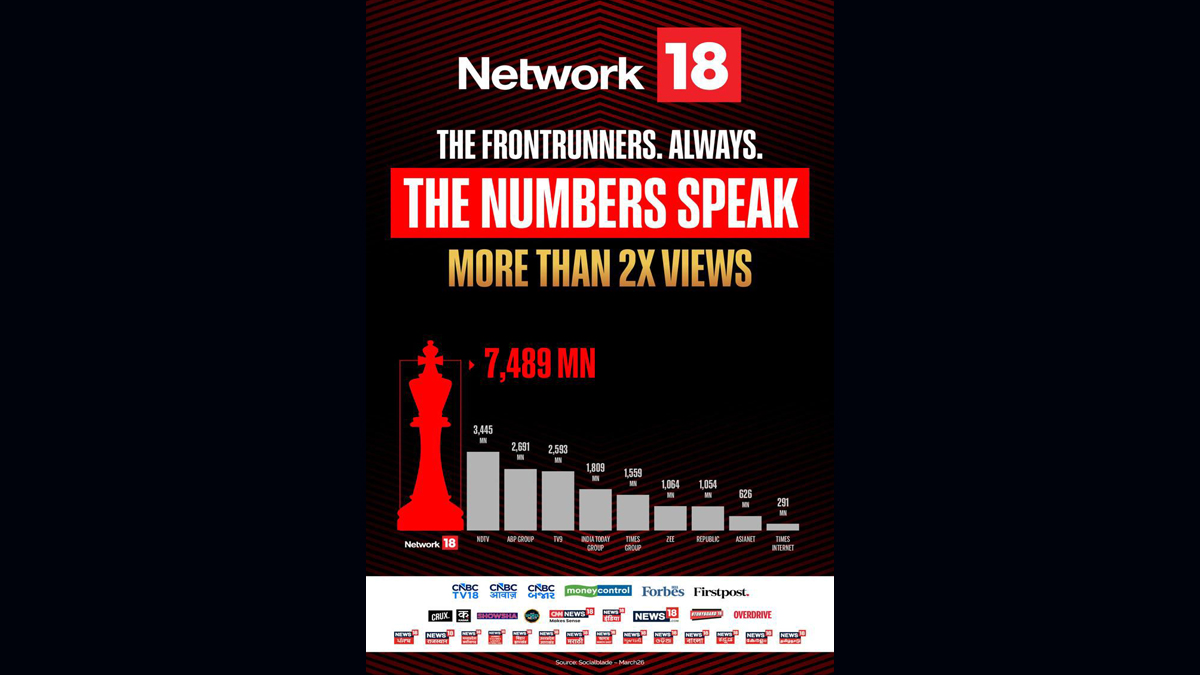
MUMBAI: When the world hit refresh on breaking news, Network18’s channels were already streaming ahead. As geopolitical tensions and war-driven headlines fuelled a surge in global news consumption, the network’s digital playbook delivered big clocking record Youtube viewership across English, Hindi and business news categories in March 2026.
At the forefront was CNN-News18, which emerged as the clear leader in the English news segment with 130 million live and video-on-demand views. The channel edged past competitors such as Times of India (126.5 million), Times Now (101.1 million), India Today (88.2 million) and NDTV (77.5 million), according to Databeings data for March.
In the Hindi news arena, News18 India delivered a commanding performance, racking up a staggering 3,297 million views on YouTube. The channel comfortably outpaced NDTV India, which recorded 3,119 million views, underlining its deep reach and consistent engagement with mass audiences, as per Playboard data.
The network’s dominance wasn’t confined to general news. In the Hindi business segment, CNBC Awaaz topped the charts with 92 million views, narrowly ahead of Zee Business (90 million) and well ahead of ET Now Swadesh (57 million). Meanwhile, its English counterpart CNBC-TV18 posted a strong 58 million views, reinforcing the network’s cross-category strength.
The spike in viewership reflects a broader shift in audience behaviour, with viewers increasingly turning to digital platforms particularly Youtube for real-time updates and in-depth coverage during high-intensity news cycles. For Network18, the numbers signal more than just scale; they underline the effectiveness of a multi-platform strategy that blends speed, credibility and continuous coverage.
In a month where the news never paused, it seems viewers chose to stay tuned where the stream never stopped.






