iWorld
Twitter records over 700K Tweets with #Budget2017

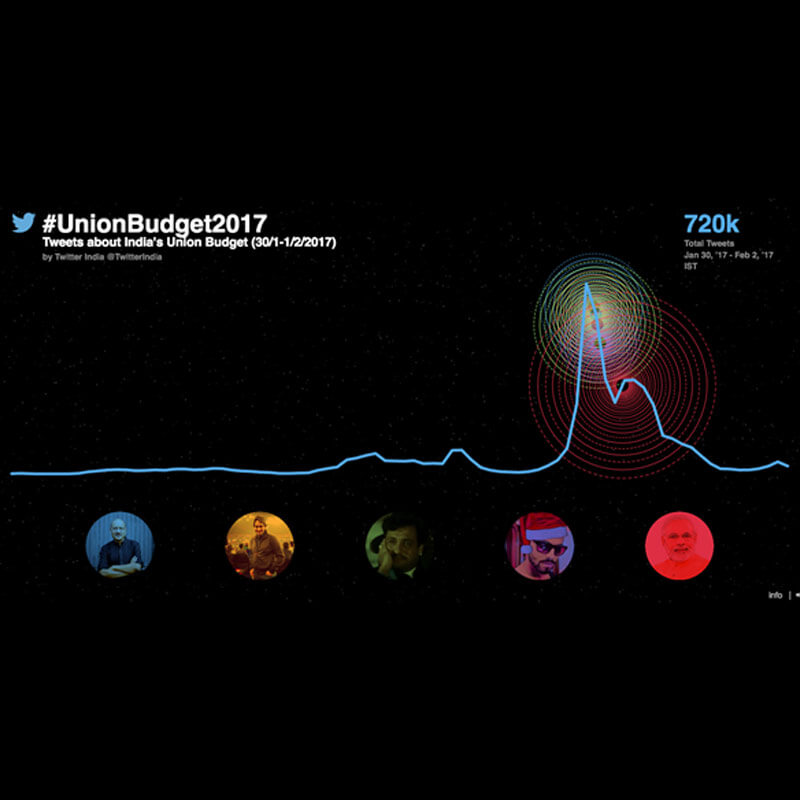
MUMBAI: Twitter is the live connection to news and culture and this reflected during the recently concluded #Budget2017 when people flocked to the platform for live breaking news and to know what’s happening. Conversations on Twitter on the Union Budget 2017 echoed the nation’s mood and its temperament towards an event of national significance.
From common man to well-known personalities, everyone took to Twitter to express their opinions regarding the Budget. The platform recorded 720,000 Budget-related Tweets between January 30 – February 2, 2017.
The conversations on the platform peaked at 12:01 PM with 1.5K Tweets per minute.
Here’s a snapshot of what people were saying about #Budget2017:
#BudgetForBetterIndia reforms old processes, empowers our human capital & aims to rejuvenate the economy.
— Narendra Modi (@narendramodi) February 1, 2017
Glad the government is upping investments in solar power.
The sun is still the world's cheapest power plant.#Budget2017— Sorabh Pant (@hankypanty) February 1, 2017
Together with the Finance Ministry (@FinMinIndia), Ministry of Information and Broadcasting (@MIB_India), CNBC-TV18 (@CNBCTV18News), SBI (@TheOfficialSBI), as well as Bloomberg-Quint (@BloombergQuint), Twitter provided live updates from #Budget2017, showcasing the presentation of the Union Budget and initiated conversation amongst policy makers, influencers, journalists, opinion-makers, and the public in general.
#Budget2017: FM presents the budget https://t.co/Iprm4P00mQ
— CNBC-TV18 News (@CNBCTV18News) February 1, 2017
LIVE on #Periscope | Tax expectations from #Budget2017
Join the discussion with @menakadoshi https://t.co/dC9nsko1pz
— BloombergQuint (@BloombergQuint) February 1, 2017
This year, Finance Minister @ArunJaitley did two Q&As on Twitter, taking questions with the hashtags #MyQuestionToFM and #AskYourFM after the Budget itself, expanding the #Budget2017 discussion with the public and gathering feedback in real-time. @FinMinIndia also posted exclusive behind the scenes peek into the highly secretive process of the making of the #Budget2017 with an autographed picture of the Finance Minister @ArunJaitley via Twitter’s Challenger app as well as a video Teaser to the Q&A session.
Ask your questions to FM using #MyQuestionToFM pic.twitter.com/SP63OwyOT8
— Ministry of Finance (@FinMinIndia) January 31, 2017
Post your Qs on #Budget2017 using #AskYourFM & get live Ans from FM Sh @arunjaitley on #Talkathon at 6.30pm today: https://t.co/BcUOkOoHDB pic.twitter.com/ihUaEE2YrR
— MIB India (@MIB_India) February 1, 2017
@arunjaitley what is going to be done with UBI in this session with India's interest #MyQuestionToFM
— Praneeth Reddy (@praneethcars) February 1, 2017
#MyQuestionToFM Dear Sir congrats for budget 2017. With reference to section 80D shouldn't the state reduce service tax on Health Insurance
— MUNISH PRABHAKAR (@PRABHAKARMUNISH) February 1, 2017
Live Talkathon
Tweet your Qns to @arunjaitley using #AskYourFM on #Budget2017 and get Ans live here https://t.co/Sq4XeaK0E9— MIB India (@MIB_India) February 1, 2017
In a first of its kind Twitter collaboration, CNBC-TV18 and SBI joined forces for the first-ever Amplify partnership in the news category for India, providing video highlights of #Budget2017 on the platform. The highly informative content approach featured #Budget2017 videos from CNBC-TV18 and pre-roll ads from SBI.
We are happy to announce our partnership with @TwitterIndia and @TheOfficialSBI for #Budget2017. Details here: https://t.co/eoF91vBjcK
— CNBC-TV18 News (@CNBCTV18News) January 31, 2017