I&B Ministry
Quantum, AI sovereignty key to India’s next growth phase: Jitendra Singh
TDB signs five deep-tech RDI projects as Centre pushes quantum-safe innovation

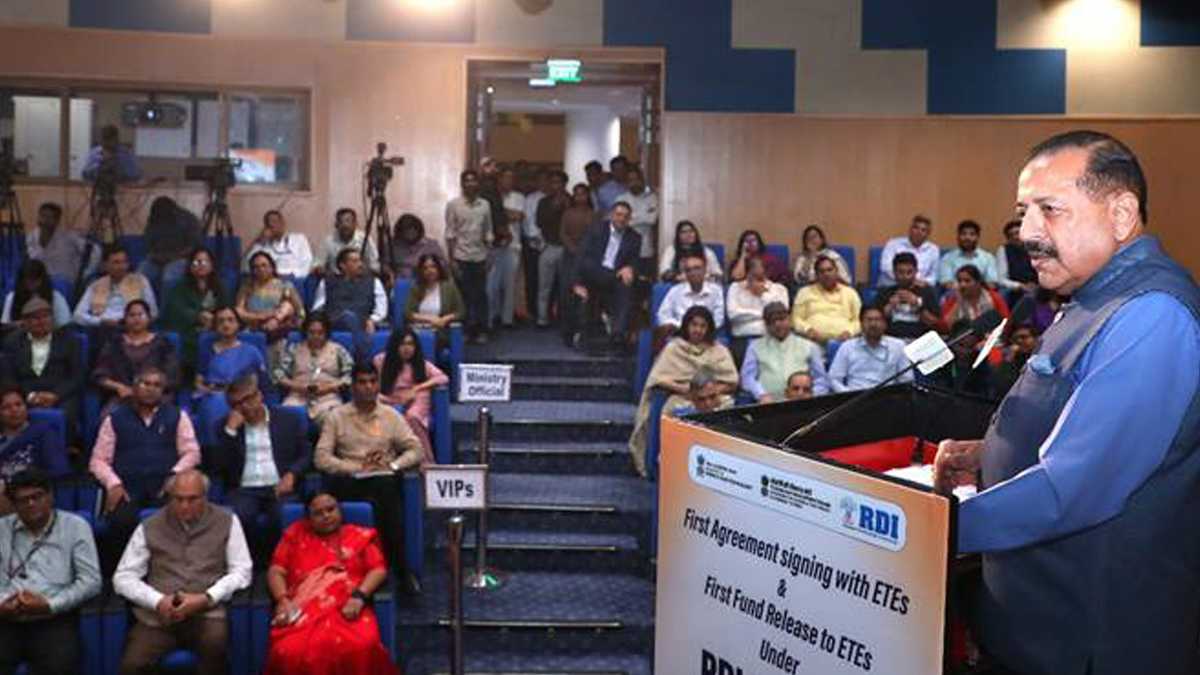
NEW DELHI: Union minister of state (independent charge) for science & technology and earth sciences, and minister of state for PMO, personnel, public grievances and pensions, department of atomic energy and department of space, Jitendra Singh, has said that quantum and artificial intelligence sovereignty, backed by strong indigenous ecosystems, will define India’s next phase of economic and technological growth.
Speaking at a programme organised by the Technology Development Board (TDB) under the Department of Science & Technology (DST) in New Delhi, the minister said India’s future growth in advanced technology sectors would depend on adopting a “trusted integrated approach” combining research, industry participation and strategic national capabilities.
The event marked the signing of agreements for five projects under the government’s Research, Development and Innovation (RDI) Fund Scheme, alongside the release of the first electronic fund disbursement under the initiative and the launch of a report on building a “Quantum-Safe Ecosystem in India”.
Jitendra Singh said the RDI Fund had been launched to accelerate private sector participation in research and development while strengthening India’s innovation ecosystem in areas including quantum technologies, AI, healthcare, energy and space systems.
Among the projects approved under the initiative was “Project Garud” by Dhruva Space, aimed at developing indigenous modular satellite platforms capable of large-scale deployment for strategic and commercial applications.
Bengaluru-based Eyestem Research signed an agreement for developing advanced cell therapies targeting diseases such as Geographic Atrophy and Idiopathic Pulmonary Fibrosis. The company also received the first electronic fund disbursement under the scheme, with Rs 50 crore released to support commercialisation of its indigenous cell therapy platform.
Meanwhile, Noccarc Robotics signed an agreement to develop an Intelligent Mobile Life Support System, a portable ICU-grade emergency healthcare platform designed for Indian conditions and rural deployment.
Other projects include advanced lithium-ion battery technologies by e-TRNL Energy and an indigenous unmanned helicopter platform, Project Sabal-200, by Endure Air Systems.
Highlighting India’s quantum ambitions, Jitendra Singh said the country is now among a select group of nations investing actively in quantum communication, quantum computing, quantum sensing and quantum materials under the National Quantum Mission.
He noted that while India originally targeted building 2,000 km of quantum-secure communication infrastructure over eight years, nearly half the target had already been achieved in under four years.
The minister also warned that rapid advances in quantum computing could eventually challenge existing cryptographic systems used in banking, governance, telecom and strategic infrastructure. He stressed that post-quantum cryptography, quantum key distribution and quantum-safe systems would become critical pillars for long-term national security and trusted digital governance.
Principal scientific adviser to the Government of India Ajay Kumar Sood said the RDI Fund could become a transformative initiative for catalysing large-scale private investment in deep-tech innovation. He also highlighted the need for India to prepare proactively for a future “Q-Day” scenario where existing encryption systems may become vulnerable to quantum technologies.
Department of Science & Technology (DST) secretary and Technology Development Board (TDB) chairperson Abhay Karandikar described the RDI initiative as one of the government’s most significant interventions aimed at strengthening private-sector-led research and innovation in India.
Technology Development Board (TDB) secretary Rajesh Kumar Pathak said the initiative had already received 124 project proposals representing demand worth more than Rs 25,000 crore, with selected projects spanning startups, MSMEs and listed companies across sectors including healthcare, energy, advanced manufacturing and quantum technologies.
The programme concluded with discussions around strengthening India’s quantum-safe ecosystem through indigenous innovation, secure communication systems and collaborative technology development frameworks aligned with the government’s Atmanirbhar Bharat and Viksit Bharat 2047 vision.
As countries worldwide race to secure leadership in quantum and AI technologies, India’s message is becoming increasingly clear: future technological sovereignty will depend not only on innovation, but on owning the ecosystem powering it.