News Broadcasting
TV9 Network to shut English news channel News9 to focus on digital medium


MUMBAI: With the huge audience shift from television to digital, staying relevant in the broadcast industry is challenging. With that goal, TV9 is all set to venture into the digital medium for its English news. In a fireside chat with Indiantelevision.com founder, CEO and editor in chief Anil Wanvari, TV9 Network CEO Barun Das said that the company will shut down its English channel News9 to focus on expanding its digital platform.
He said, “Traditional format of television would go and it will get more into the digital space. People below the age of 18 years are not watching news channels. If you see English news channels have shrunk to an extent that they will not sustain. We had News9, a Bangalore-based channel, but I believe city-based English news offerings in the Indian market are not ready yet. We had to take a business call, so we are coming up with a national version of that but on a digital platform. We are coming up with digital web TV.”
He further explained that the television news genre is overly crowded and even the regional channels are exploding. According to Das, news channels have more than “pure business reasons” to launch channels. So, that is the reason why fringe channels come in and the market gets crowded.

He added, “But I think viewers and advertisers filter them out. In the regional market, there are not more than four big channels. In Hindi it is a larger market, 45 per cent of our population speaks Hindi. Advertisers look at the top nine channels so every leading new channel gets the share of the pie.”
As per Das, in the past 10 years Hindi and regional news channels have moved in the same way print has moved in 10 years.
He pointed out that the channel will continue to grow in double digits leaving out exceptions like Covid2019 period and slowly it will taper into single-digit. Das also clarifies that the content on news will not disappear but the way it is being packaged and distributed will change.
“In India, digital revenue will overtake the traditional medium by 2025. This scenario will happen to Hindi and regional channels by 2028. We still have good seven to eight years to go. Hence we are currently focusing on the digital front. As TV9 group was not digital-savvy, our focus has turned to embark on a major expansion on the digital side,” he said.
Das highlighted that the channel has already set up an infrastructure for Studio9 where the team will look to work with clients to develop creative solutions. Studio9 will look at the convergence of television and digital revenue with a solution-driven approach. As a major expansion in the digital medium, TV9 Network has set up a new office of 20,000 square feet where it is briefing teams across the country. The company has recruited close to 400 employees.
He quipped, “Digital is a big game for us going forward. Raktim Das will be looking at the convergence side. Slowly you will see we will be moving with digital but also keeping a stronghold on TV side revenue. I am also planning to do anchoring in the coming future. I am working on a concept that will see the light of the day, but it will be on the English side.”
You can catch the full fireside chat here:






News Broadcasting
UDF poised to return to power in Kerala, says Manorama-CVoter survey
Massive opinion poll projects shift in Kerala politics ahead of 2026 Assembly elections.
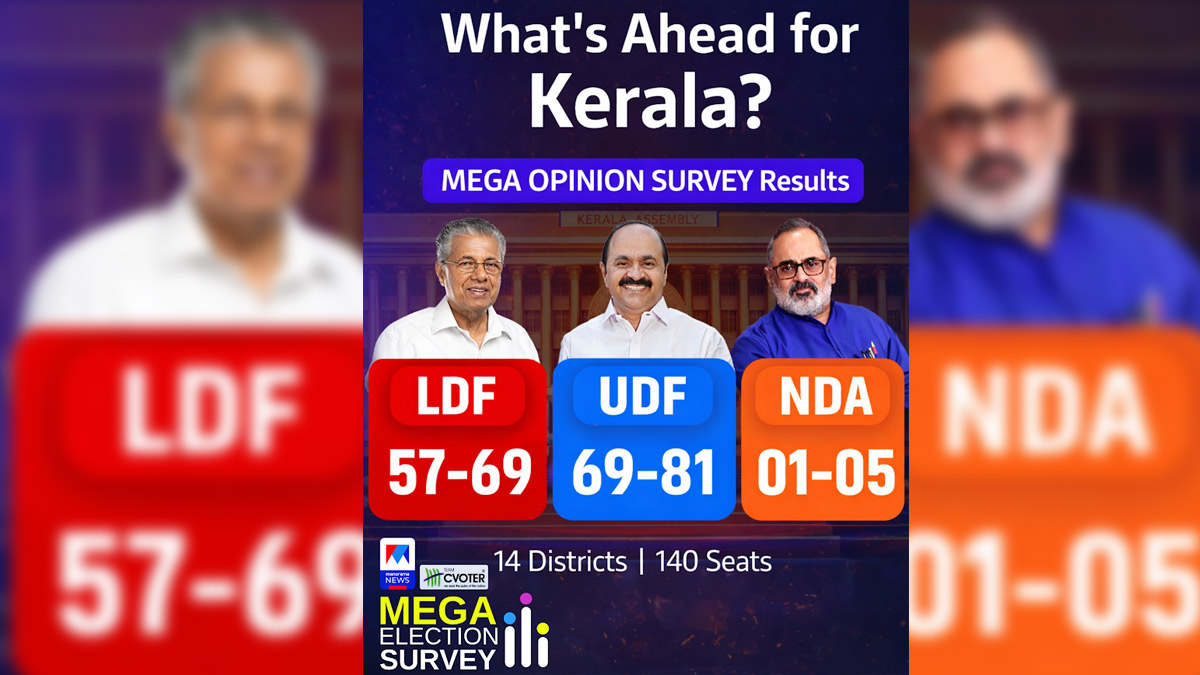
MUMBAI: The winds of change appear to be blowing through Kerala’s political landscape and this time, they seem to favour the United Democratic Front. A comprehensive mega opinion survey conducted by Manorama News in partnership with CVoter projects a potential comeback for the UDF in the upcoming Kerala Legislative Assembly Elections 2026. The survey, covering all 140 constituencies with a massive sample size of nearly 90,000 respondents, predicts the UDF could win between 69 and 81 seats.
The ruling Left Democratic Front (LDF) is expected to secure 57 to 69 seats, a significant drop from the 99 seats it won in the 2021 elections. This would mean the LDF losing 30 to 42 of its sitting seats. Meanwhile, the National Democratic Alliance (NDA), which drew a blank in 2021, is projected to open its account with 1 to 5 seats.
Region-wise, the UDF is expected to make strong gains in Malabar, winning 25 to 34 out of 48 seats, and in Central Kerala, where it could bag 29 to 33 out of 53 seats. In South Kerala, the LDF is likely to retain an edge with 21 to 25 seats, while the UDF may improve to 12 to 16 seats. The NDA could pick up 1 to 3 seats in the southern region.
The survey was conducted between 14 and 26 March 2026, with additional tracker and snap polls carried out from December 2025 to March 2026. A total of 89,693 respondents participated, ensuring representation across all demographics and social segments.
Manorama News has a strong track record of accuracy, with its previous projections closely matching the actual results of the 2019 and 2024 Lok Sabha elections as well as the 2021 Kerala Assembly polls.
In Kerala’s famously fierce political battles, this survey suggests the pendulum may be swinging back. Whether the final verdict matches these numbers or throws up another surprise, one thing is clear, the 2026 Assembly elections are shaping up to be one of the most keenly watched contests in the state’s history.






