iWorld
Tinder redefines modern dating rules for Women on International Women’s day
MUMBAI: This Women’s day, Tinder unveils her new dating rulebook where modern Indian women prioritize respect, safety, and authenticity over outdated chivalry.
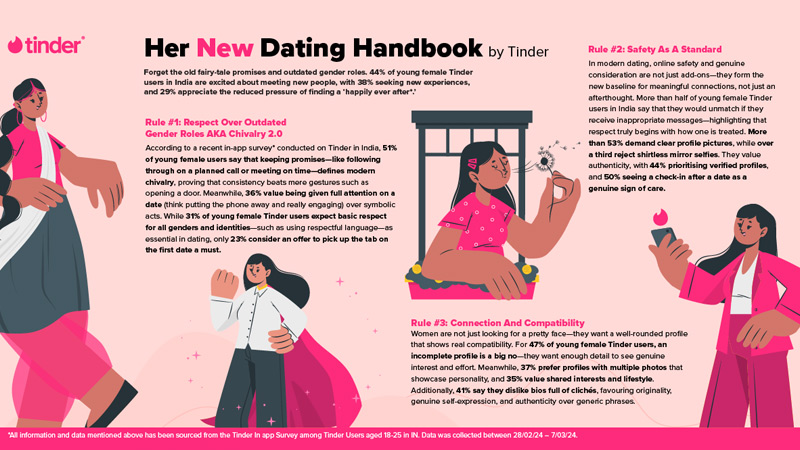
According to a recent in-app survey by Tinder, 51 per cent of young female users believe modern chivalry is about keeping promises and showing consistency, rather than grand romantic gestures. 36 per cent value undivided attention on a date over symbolic acts, while 31 per cent prioritise basic respect for all identities. The traditional expectation of men paying on the first date is fading only 23 per cent see it as essential, with many preferring to split the bill as a sign of equality.
Security remains a top priority, with over half of young female Tinder users in India stating they would unmatch anyone who sends inappropriate messages. Tinder’s AI-powered safety tools, including are you sure? and does this bother you?, are designed to curb unwanted behaviour. Profile authenticity is also key 44 per cent of young women prefer verified profiles, and 53 per cent reject profiles lacking clear photos.
Today’s single women seek genuine connections beyond appearances 47 per cent consider incomplete profiles a red flag, while 37 per cent favour profiles showcasing personality. Originality also matters, with 41 per cent disliking cliché bios and preferring honest self-expression.
Tinder India, communications lead Aditi Shorewal highlights, “Women are reshaping dating norms by prioritising respect, effort, and safety. Tinder continues to evolve, offering features that empower women to date on their own terms, free from outdated expectations.”
With this new rulebook, Tinder is redefining modern dating where equality, security, and meaningful connections come first.

e-commerce
American Express to acquire AI startup Hyper to boost automation
Deal targets expense management as AI reshapes corporate spending tools.
MUMBAI: From receipts to robots, the expense sheet is getting a brain upgrade as American Express moves to bring artificial intelligence into the heart of corporate spending. The company has announced plans to acquire Hyper, a relatively young but fast-rising startup founded in 2022 that builds AI-powered agents capable of organising expenses, generating reports, verifying compliance with budgets and policies, and nudging users with timely reminders. The deal, expected to close in the second quarter of 2026, underscores a growing shift among financial institutions to automate traditionally manual, time-heavy workflows.
Hyper counts Sam Altman among its backers, adding a layer of Silicon Valley credibility to the acquisition. While financial details remain undisclosed, the strategic intent is clear: deepen automation capabilities and sharpen American Express’s position in the competitive corporate spending ecosystem.
The two companies are not strangers. They previously collaborated in 2024 on a co-branded credit card product, suggesting that the acquisition is less a cold buy and more an extension of an existing relationship. With this move, American Express is effectively bringing that capability in-house, aiming to embed AI directly into its commercial services stack.
Chief executive Stephen Squeri had already signalled the direction of travel in a recent shareholder letter, describing AI as a “structural shift” in how businesses operate. The Hyper acquisition appears to be a direct response to that shift, particularly in expense management, where processes such as approvals, compliance checks and reporting remain ripe for automation.
Alongside the acquisition, the company is also expanding its product suite. A recently launched business credit card offers cashback and benefits at an annual fee of $295, with another card expected later this year moves that complement its broader push into commercial services.
Taken together, the strategy points to a future where managing expenses may require fewer spreadsheets and more algorithms. For American Express, the bet is simple, if businesses are rethinking how work gets done, the tools that power that work need to evolve just as quickly.