News Broadcasting
The strange case of NDTV and the taxman


MUMBAI: The share price rise, a comment about it always being open to potential partnership, has got the income tax department running to news network NDTV’s doors again. And a war of letters has broken out between the two with the taxman once again reiterating his demand for alleged unpaid taxes from the broadcaster, promoters Prannoy and his wife Radhika Roy, which they have disputed for a long time.
What got the IT department’s attention was the sharp 20 per cent rise in the NDTV share price last month. Speculative reports appeared in the media which hinted that the broadcaster was a takeover target and the stalker was allegedly the Adani group. The company issued a clarification to the Bombay stock exchange stating that it is regularly in discussions with various potential partners to further its business interests. And that it would make the appropriate disclosure when the talks reach a concrete stage or a transaction is happening.

The circle 13 deputy commissioner of income tax (D-CIT) in New Delhi responded to this announcement a few days later by writing to the company, Prannoy and Radhika Roy, forbidding them from selling or taking a charge against their shareholding in NDTV without taking permission from the assessing IT officer during the pendency of assessment/reassessment of tax demands proceedings. He said that section 281 of The Income Tax Act (which prescribes this) is applicable in the broadcaster’s case as it had not met the department’s tax demands against it for the assessment years 2003-2004 (Rs 9.16 crore), 2006-2007 (Rs 4.21 crore), 2007-2008 (Rs 6.80 crore), 2008-2009 (Rs 22.99 crore) and 2009-2010 (Rs 449.24 crore).
The D-CIT also wrote to Prannoy and Radhika Roy claiming unpaid taxes of Rs 69 lakh (2009-2010) and Rs 22.81 crore (2010-2011) and Rs 68 lakh (2009-2010)and Rs 22.61 crore (2010-2011), respectively.
NDTV responded to the D-CIT’s order through a notice to the Bombay stock exchange yesterday by stating that section 281 does not have a bearing on NDTV shares held by individual shareholders and could only apply on assets of the company. The company also stated that the claims by the Tax department prima facie don’t exist or are unsustainable or are stayed by Income Tax Appellate Tribunal. In fact, it has argued in the stock exchange notice that the department owes it Rs 40.84 crore in tax refunds. Hence, there is no case of section 281 being applied in NDTV’s case.
It has “further prayed that the records of the department may kindly be rectified to reflect the correct position of the amount of refunds due to the company.”
The chartered accountancy firm of RKACA & Associate which is advising both Prannoy and Radhika Roy later informed the tax authorities and the stock exchange that both are aware of the provision of the law referred in D-CIT’s letter and that both will comply with the same in both “letter and spirit.”
Ever since the media reports about the NDTV takeover broke last month, the company’s shares have been climbing northwards. NDTV got listed on May 2004 at an issue price of Rs 70, and hit an all time high of Rs 511.75 in 2008 and all time low of Rs 24.75 in 2011. The share closed today at Rs 91.55. It was trading at Rs 66.25 a share on 16 May, the day Narendra Modi was elected prime minister but then recovered to hit Rs 82.95 on 26 May and Rs 89.05 on 6 June 2014.







News Broadcasting
UDF poised to return to power in Kerala, says Manorama-CVoter survey
Massive opinion poll projects shift in Kerala politics ahead of 2026 Assembly elections.
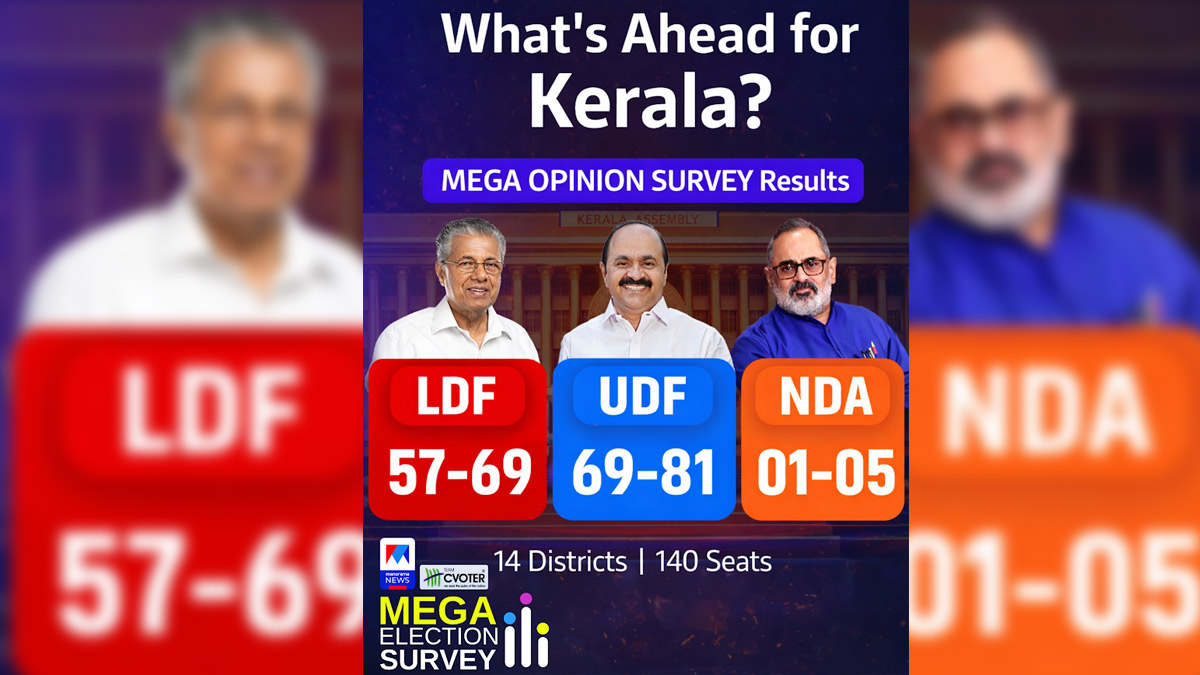
MUMBAI: The winds of change appear to be blowing through Kerala’s political landscape and this time, they seem to favour the United Democratic Front. A comprehensive mega opinion survey conducted by Manorama News in partnership with CVoter projects a potential comeback for the UDF in the upcoming Kerala Legislative Assembly Elections 2026. The survey, covering all 140 constituencies with a massive sample size of nearly 90,000 respondents, predicts the UDF could win between 69 and 81 seats.
The ruling Left Democratic Front (LDF) is expected to secure 57 to 69 seats, a significant drop from the 99 seats it won in the 2021 elections. This would mean the LDF losing 30 to 42 of its sitting seats. Meanwhile, the National Democratic Alliance (NDA), which drew a blank in 2021, is projected to open its account with 1 to 5 seats.
Region-wise, the UDF is expected to make strong gains in Malabar, winning 25 to 34 out of 48 seats, and in Central Kerala, where it could bag 29 to 33 out of 53 seats. In South Kerala, the LDF is likely to retain an edge with 21 to 25 seats, while the UDF may improve to 12 to 16 seats. The NDA could pick up 1 to 3 seats in the southern region.
The survey was conducted between 14 and 26 March 2026, with additional tracker and snap polls carried out from December 2025 to March 2026. A total of 89,693 respondents participated, ensuring representation across all demographics and social segments.
Manorama News has a strong track record of accuracy, with its previous projections closely matching the actual results of the 2019 and 2024 Lok Sabha elections as well as the 2021 Kerala Assembly polls.
In Kerala’s famously fierce political battles, this survey suggests the pendulum may be swinging back. Whether the final verdict matches these numbers or throws up another surprise, one thing is clear, the 2026 Assembly elections are shaping up to be one of the most keenly watched contests in the state’s history.






