iWorld
The shape of Indian OTT universe circa 2021 according to Rethink Tech Research

MUMBAI: This should put OTT players on alert and gladden the hearts of linear TV distribution and programming executives. The latest numbers about how India’s video guzzlers are going to consume VoD services by the UK-based industry tracker Rethink Technology Research reveal that India will have about 14.6 million VoD subscribers by 2021. Indiantelevision.com estimates are that, comparatively, Indian DTH will account for about 75 million active subscribers and cable TV more than 100 million by then.
Clearly, VoD will have made a marginal dent in eroding linear TV distribution platforms stranglehold on Indian viewers thanks to the lower sticker prices for cable TV and DTH, which will possibly continue to be in play even in 2021. Cord-cutting, which is becoming increasingly common in many markets, may not really make its way to Indian shores.
Yes, the data suggests that India will be the second largest market in Asia Pacific after China which will account for 60 per cent of the Asia Pacific’s $10 billion subscription revenues and 200 million subs, by 2021. (The corresponding figures for 2016 are at $6.5 billion and 100 million respectively.)

“Asia Pacific is made up of a multitude of contrasting individual markets, making it fragmented and complex with broadband penetration above 50%, in some regions and below 10% in others,” said a statement from Rethink Technology Research.
There will be a hard pitched battle for subscription shares between the 30 odd OTT players in the game in India. By then probably many more OTT providers will have stomped into the terrain. And hence one wonders how many of them will be profitable.
Both, Netflix and Amazon Prime, are just about beginning to plonk down top dollars – like India has not seen before – on original shows which should hop on to their India – and later global – offering by next year. Hotstar and Viacom18’s Voot have also been investing heavily to acquire customers. Estimates are that the two have pumped in around Rs 4000 million and Rs 1400 million, respectively, since launch. Others such as Viu, NextGTV, Spuul, ErosNow, Hooq, SonyLiv, YuppTV and Alt Balaji too are in a customer acquisition phase, having just got onto the runway.
The good news, according to Rethink, is that pure play SVoD services in APAC (expected revenues by 2021: $6.29 billion) will dominate operator-supplied services.
As far as APAC is concerned, the research house predicts that Indonesia and Japan will be third and fourth, with each increasing to 9.96 million and 8.1 million by 2021, respectively.






iWorld
Micro-Dramas Surge in India, Redefining Mobile Content Habits
Meta-Ormax study maps rapid rise of short-form storytelling among 18–44 audiences.
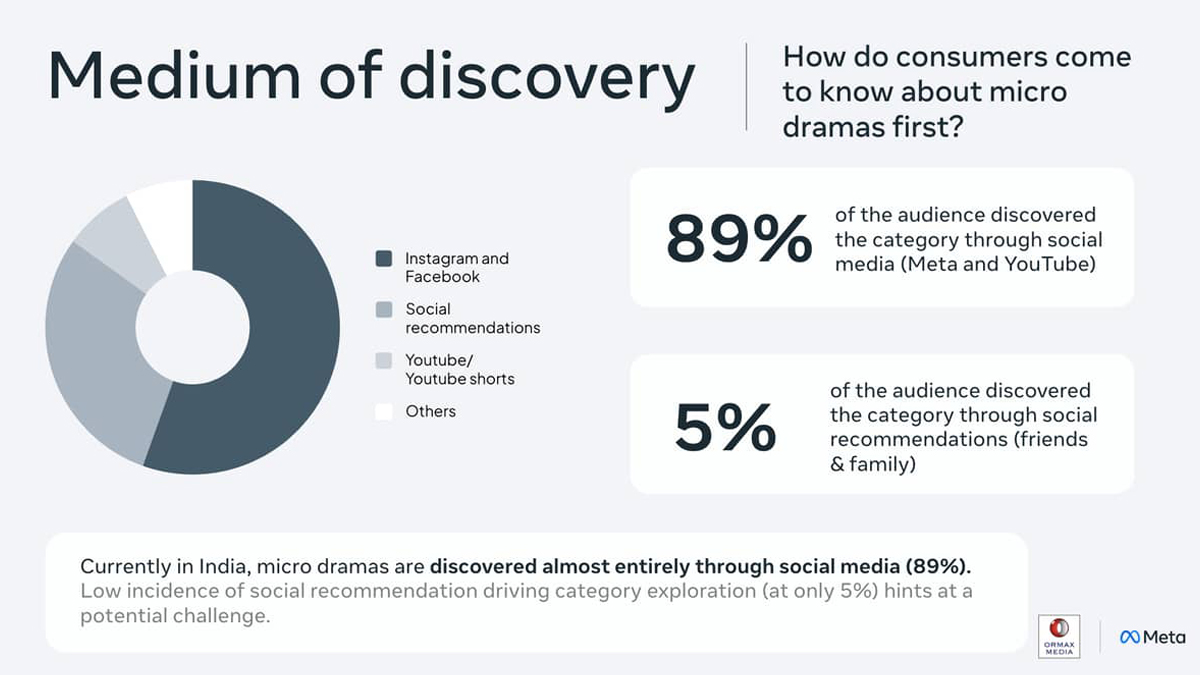
MUMBAI: Micro-dramas aren’t just short, they’re the snack that ate Indian entertainment, and now everyone’s bingeing between the sofa cushions. Meta, in partnership with Ormax Media, has released ‘Micro Dramas: The India Story’, a comprehensive study unveiled at the inaugural Meta Marketing Summit: Micro-Drama Edition. The report maps how the vertical, bite-sized format is reshaping content consumption for mobile-first audiences aged 18–44 across 14 states.
Conducted between November 2025 and January 2026 through 50 in-depth interviews and 2,000 personal surveys, the research reveals that 65 per cent of viewers discovered micro-dramas within the last year proof of explosive adoption. Nearly 89 per cent encounter the format through social feeds and recommendations, making algorithm-driven discovery the primary engine rather than active search.
Key viewing patterns show a median of 3.5 hours per week (about 30 minutes daily) spread across 7–8 short sessions. Consumption peaks between 8 pm and midnight, with additional spikes during commutes and work breaks classic “in-between moments” that the format fills perfectly. Around 57 per cent of viewing happens in ambient mode (while doing something else), and 90 per cent is solo, enabling more intimate, personal storytelling.
Romance, family drama and comedy lead genre preferences. Audiences show growing openness to AI-generated content, 47 per cent find it unique and creative, while only 6 per cent say they would avoid it entirely. Regional languages are surging after Hindi and English, Tamil, Telugu and Kannada dominate consumption.
Meta, director, media & entertainment (India) Shweta Bajpai said, “Micro-drama isn’t a passing trend, it’s rewriting the rules of Indian entertainment. In under a year, an entirely new category of platforms has emerged, built audience habits from scratch, and created a business vertical that is scaling fast.”
Ormax Media founder-CEO Shailesh Kapoor added, “Micro-dramas are beginning to show the early signs of becoming a distinct content category in India’s digital entertainment landscape. When a format aligns closely with how audiences naturally engage with their devices, it has the potential to scale very quickly.”
The study proposes ecosystem-wide responsibility, universal signposting of commercial intent, shared accountability among advertisers, platforms, creators, schools and parents, built-in safeguards, and formal media literacy in schools.
In a feed that never sleeps and a day that never stops, micro-dramas have slipped into the cracks of every spare minute turning 30-second stories into the new national pastime, one vertical swipe at a time.







