News Broadcasting
The sad demise of ethics & sensitivity in Indian media’s reporting


NEW DELHI: It was the afternoon of Sunday, 14 June 2020 when the news of the untimely demise of 34-year-old film actor Sushant Singh Rajput hit the headlines of all mainstream news channels in India with sensational headlines and a disturbing reportage such included revealing sensitive details of his death. The whole circus that ensued during the day brought widespread criticism to the state of media in the country.
IIMC professor and course director department of English journalism Surbhi Dahiya shares with Indiantelevision.com that some news channels not only sensationalised the matter but also flouted guidelines on reporting a suicide. The Press Council of India had advised media to not publish such stories prominently, not describe the methods of suicide and be sensitive in their reportage.
She continues, “Not just pictures of him lying dead on his bead circulated on social media were picked up by one of the news channels, most of the headlines were sensational and passed sarcastic comments on this death.”

IIMC Dhenkanal professor Mrinal Chatterjee adds that such insensitive reporting not only hurts the sentiments of the family of the deceased but also leaves a bad taste for the viewers.
DCAC department of journalism assistant professor Tarjeet Sabharwal notes, “The whole reportage around Sushant Singh Rajput’s death was not only insensitive but unethical too. I strongly feel that the media of today has lost its basic ethical, moral and human sense. The anchors and reporters who are covering these stories are working hard to get into news the accurate facts but don’t bring out any emotions in reporting. Media today is nothing but mockery.”
But what has brought the fate of Indian media to such low standards?
According to Dahiya, it can be attributed to the mad race to gain TRPs, while Sabharwal feels that the cut-throat competition within the media ecosphere, especially the rising popularity of digital media is forcing the mainstream channels to present a different narrative, which is not always ethical.
However, assistant professor Ankhi Mukherjee believes that the TRPs come because Indian audience likes to follow such news. “Indian media has completely forgotten ethics and I am not talking about the periphery media when I say it. I had rejected TV a long time back and I think that all viewers must be doing that. They get advertisers because there are people watching their channels. Indian culture is based on discrimination and we like to follow such (sensational) news. We thrive into this news and there has been no attempt made to change this mindset (by the media).”
University of Mumbai department of journalism and communication assistant professor Sanjay Ranade further highlights that the workforce in most of the mainstream news organisations today are not trained well enough to understand the nuances of journalism. “The media of today is totally corrupt – morally, ethically, and financially and that has started reflecting in the type of reporting they are doing," he says.
“When 26/11 happened, we treated it as a crime story but later we realised it was not another crime story but terrorism. Similarly, when floods happened in Mumbai, we saw it as a civic story and not as the humanitarian crisis it was. And when we talk about Sushant Singh Rajput’s case, it was not another crime or entertainment story, but it was death by suicide and mental health problems. But not a single journalist today is trained to cover sensitive issues like that. Journalists of today are lacking intellectual, emotional, and social training,” he adds.
He elaborates that media houses today need a complete shake-up and owners of media companies need training in journalism. Most importantly, other departments like marketing and especially HR need training in what journalism actually means.
He insists, “All journalists are trained well, I believe, but the organisations don’t let them work the way they want to. A journalist is trained to stand against the system, but all the MBA graduates who work as leaders and HR are trained to work under a system, then how do you think they can do justice to the professional role!”
It seems that media houses need to relook at the way they approach their reporting, especially when it comes to sensitive issues.




News Broadcasting
UDF poised to return to power in Kerala, says Manorama-CVoter survey
Massive opinion poll projects shift in Kerala politics ahead of 2026 Assembly elections.
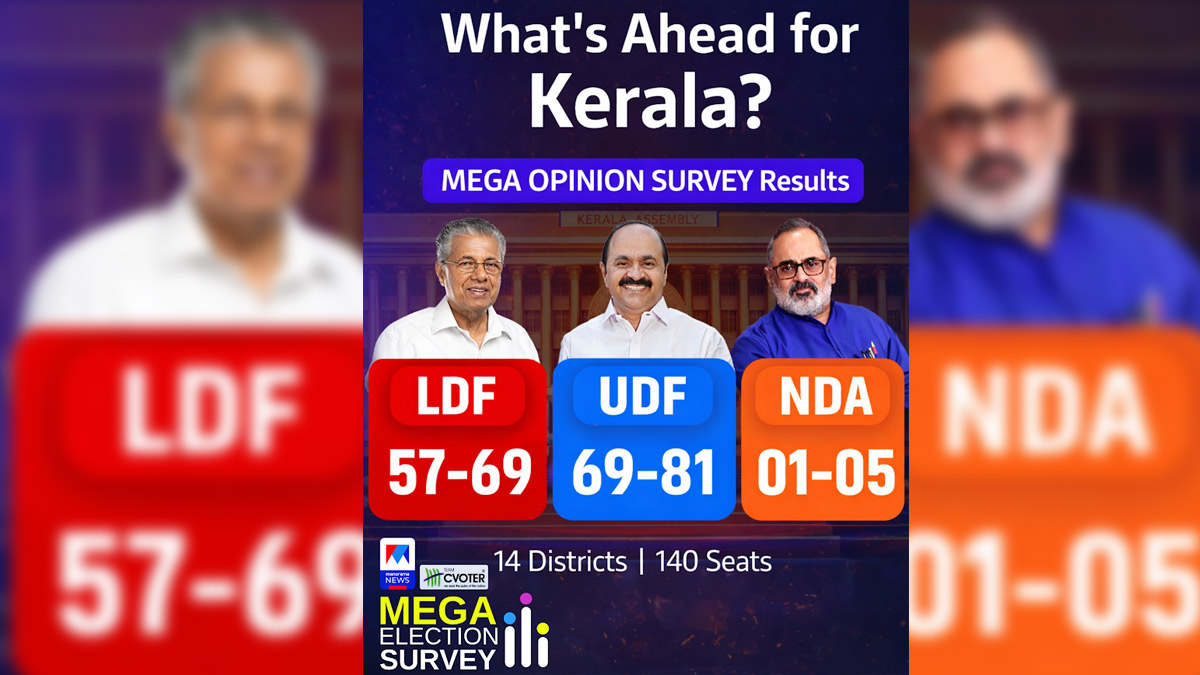
MUMBAI: The winds of change appear to be blowing through Kerala’s political landscape and this time, they seem to favour the United Democratic Front. A comprehensive mega opinion survey conducted by Manorama News in partnership with CVoter projects a potential comeback for the UDF in the upcoming Kerala Legislative Assembly Elections 2026. The survey, covering all 140 constituencies with a massive sample size of nearly 90,000 respondents, predicts the UDF could win between 69 and 81 seats.
The ruling Left Democratic Front (LDF) is expected to secure 57 to 69 seats, a significant drop from the 99 seats it won in the 2021 elections. This would mean the LDF losing 30 to 42 of its sitting seats. Meanwhile, the National Democratic Alliance (NDA), which drew a blank in 2021, is projected to open its account with 1 to 5 seats.
Region-wise, the UDF is expected to make strong gains in Malabar, winning 25 to 34 out of 48 seats, and in Central Kerala, where it could bag 29 to 33 out of 53 seats. In South Kerala, the LDF is likely to retain an edge with 21 to 25 seats, while the UDF may improve to 12 to 16 seats. The NDA could pick up 1 to 3 seats in the southern region.
The survey was conducted between 14 and 26 March 2026, with additional tracker and snap polls carried out from December 2025 to March 2026. A total of 89,693 respondents participated, ensuring representation across all demographics and social segments.
Manorama News has a strong track record of accuracy, with its previous projections closely matching the actual results of the 2019 and 2024 Lok Sabha elections as well as the 2021 Kerala Assembly polls.
In Kerala’s famously fierce political battles, this survey suggests the pendulum may be swinging back. Whether the final verdict matches these numbers or throws up another surprise, one thing is clear, the 2026 Assembly elections are shaping up to be one of the most keenly watched contests in the state’s history.






