Hollywood
‘The Monuments Men’ team get an access to Da Vinci’s ‘The Last Supper’
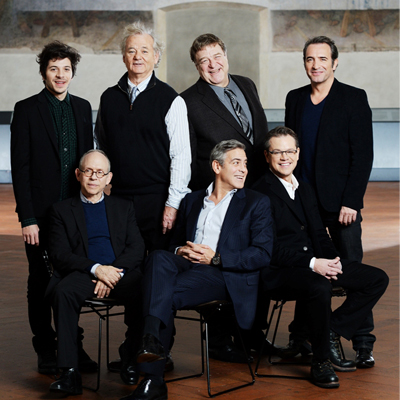
MUMBAI: The team of The Monuments Men got an unprecedented access to photograph the cast of the movie in front of one of the world’s greatest art masterpieces – Leonardo Da Vinci’s The Last Supper.
This art masterpiece was in danger of being lost during WWII and was rescued by the Monuments Men as depicted in the film, so there is a direct correlation to the film. These images have been shot exclusively for Fox by Italian photographer Gianmarco Chieregato.
It became possible because of the cooperation among the Italian Ministry for Culture and Tourism, the Milan’s Monuments, Fine Arts and Landscape Department, and Twentieth Century Fox, the film distribution company.
“The Magificent Seven” in the snapshot are: the director, screenwriter, producer and star of the film George Clooney and co-stars Matt Damon, Jean Dujardin, John Goodman, Bill Murray, Bob Balaban, and Dimitri Leonidas.
The Last Supper by Leonardo Da Vinci is the set of one of the opening scenes of the film that will release on 21 February, because the bombing that endangered Leonardo’s masterpiece strongly contributed to the decision to set up the Monuments Men, a group of art critics, museum curators, and archivists, who towards the end of the Second World War, saved thousands of artworks from bombings, pilfering, looting and Nazi barbarity.

Hollywood
Utopai Studios partners Huace to deploy PAI for long form content
Deal includes revenue sharing as Huace adopts AI engine across global ops
MUMBAI: Lights, camera… algorithm, the script just got a silicon co-writer. In a move that signals how storytelling itself is being re-engineered, U.S.-based Utopai Studios has partnered China’s Huace Film & TV Co. Ltd. to bring artificial general intelligence into the heart of long-form content creation.
At the centre of the deal is PAI, Utopai’s cinematic storytelling system, which Huace will deploy as a core engine across its production pipeline from development and creative iteration to global localisation. The partnership includes a large-scale annual usage commitment from Huace, alongside a usage-based revenue-sharing model, underscoring both ambition and commercial confidence on both sides.
For Huace, one of China’s largest film and television companies, the bet is not on automation alone but on scale with control. With distribution spanning over 200 countries and a presence across more than 20 international platforms, including Netflix and YouTube, the company brings a vast content ecosystem where even marginal efficiency gains can translate into significant output shifts. Its extensive TV IP library further positions it as fertile ground for AI-assisted storytelling workflows.
The choice of PAI follows what Huace described as a rigorous evaluation of existing AI tools, many of which remain limited to fragmented use cases such as video generation or editing. What tipped the scales, according to the company, was PAI’s ability to handle long-form narrative complexity maintaining continuity, structure, and creative coherence across entire story arcs rather than isolated clips.
Utopai, for its part, is using the partnership to anchor its international expansion strategy, pitching PAI as an enterprise-ready system built for customisation, privacy, and regulatory adaptability across markets. That positioning becomes particularly relevant as global media companies increasingly scrutinise how AI integrates into proprietary workflows.
The timing is notable. Earlier this month, Utopai upgraded PAI to support three-minute 4K video generation and advanced multi-shot sequencing features designed to tackle one of AI storytelling’s biggest hurdles: consistency across scenes.
What emerges is not just another tech collaboration, but a glimpse into how the grammar of filmmaking could evolve. Because if stories were once crafted frame by frame, the next chapter might just be coded scene by scene.