News Broadcasting
Television Media Segment leads NDTV’s loss in Q2-2015


MUMBAI: Announcing the current quarter results (Q2-2014), news broadcaster NDTV reported a net loss of Rs 26.89 crore. The loss for the company for the quarter had widened from Rs 1.49 crore in the preceding quarter (Q1-2014) and Rs 15.26 crore in the corresponding quarter last year (Q2-2013).
But the loss before tax for the HY-2014 has decreased to Rs 26.05 crore from Rs 33.56 crore in HY-2013.
The loss for the company for this current quarter is led by its television media and related operations segment. The segment reported a loss of Rs 15.22 crore in Q2-2014 as compared to a profit of Rs 7.95 crore in Q1-2014 and loss of Rs 1.98 crore in Q2-2013. Half yearly, the segment also reported a decline in loss. In HY-2014 (first half of 2014), the loss for the segment was reported as Rs 7.27 crore as compared to Rs 19.38 crore in the first half last year (HY-2013).

In the current quarter, the company also reported a fall in its Total Income from Operations (TIO) on a q-o-q basis contributing to its widening loss in the current quarter. TIO in Q2-2014 was Rs 110.38 crore, 25.12 per cent less than Rs 147.42 crore in the last quarter while the company reported a 3.9 per cent rise in its TIO at Rs 106.19 crore on a y-o-y basis.
In H1-2014, NDTV’s TIO at Rs 257.80 crore was 23.5 per cent more than Rs 208.59 crore in HY-2013, explaining the contraction in the HY-2014 loss.
The revenue on television media and related operations segment decreased 24.4 per cent q-o-q, from Rs 143.96 crore in Q1-2014 to Rs 108.83 crore in Q2-2014, another factor in the widening loss in Q2-2014. The revenue for the segment was almost flat (1.3 percent rise) at Rs 1.7.42 crore in Q2-2013.
In HY-2014 the revenue for the segment at Rs 252.79 crore was 20.37 per cent more than Rs 210.01 crore in HY-2013, another element in the reduction in the HY-2014 loss while the Q2-2014 loss had expanded.
Total expenses for the company in Q2-2014 was reported at Rs 132.43 crore, 10.6 per cent less than the Rs 148.18 crore in Q1-2014 and 2.3 per cent lower than Rs 135.58 crore in Q2-2013.
NDTV’s production expenses decreased 40.9 per cent from Rs 36.67 crore in Q1-2014 to Rs 21.64 crore in Q2-2014 and 5.2 percent from Rs 22.84 crore in Q2-2013.
According to the company statement, NDTV Convergence showed revenue growth of 22% in this quarter and a growth of 34% for H1-2014 on a y-o-y basis.
Also, NDTV Profit / Prime achieved a major turnaround by turning EBITDA positive in Q2 FY15, within six months of its re-launch, added the statement.
The company also announced on BSE that the board had ‘mandated the management to focus’ on the following: accelerate growth in core business; fix, restructure or sell non-core businesses; further invest in online assets to accelerate the Company’s leadership position to benefit from the digital revolution and explore all options to unlock and maximise shareholders’ value.
“NDTV’s losses are lower in the first half of this year than in the previous year and are narrowing down over time. A major step forward is that NDTV Profit / Prime was EBITDA positive this quarter (this is after making losses of Rs 40+ crore last year and losses in earlier years too). This will help the company to move towards profitability. Further, profitability can also be achieved by restructuring of businesses or selling of loss-making units while ensuring a hard focus on the core business,” said the company in a statement.







News Broadcasting
News18 India launches Command Centre war explainer with Arya
New show shifts from debates to decoding global conflicts and impacts
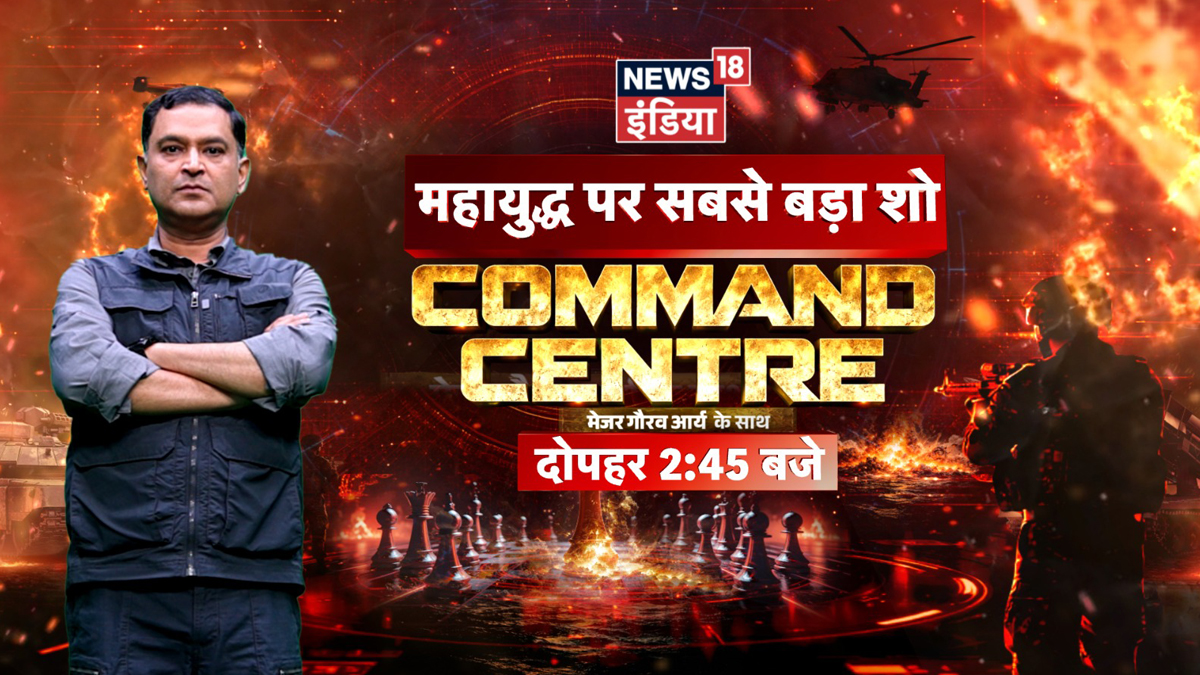
MUMBAI: News18 India has rolled out a new war-focused programme, Command Centre, featuring Gaurav Arya, as it looks to offer viewers a sharper, more grounded take on global conflicts amid rising tensions in West Asia.
Positioned as an “insider war room”, the show moves away from conventional panel debates and instead focuses on explaining military developments, decoding strategy and connecting global events to their everyday impact, from fuel prices to economic shifts.
The format leans heavily on visuals and data. The studio has been designed like a command hub, complete with large LED war maps, real-time graphics and an alert system to track developments as they unfold.
At the centre of it all is Arya, who brings his military background to simplify complex war strategies for viewers. His signature line, “Seedhi baat samjhiye”, anchors the show’s promise of clarity over noise.
News18 India managing editor Jyoti Kamal said, “Command Centre, featuring Major Gaurav Arya is designed to deliver accurate insights and a clear perspective on how evolving conflicts impact everyday life, from household budgets to national security. With expert voices analysing every development in real time, the show goes beyond headlines to decode what’s happening now, what it means, and what could come next.”
Echoing the intent, Gaurav Arya added, “In times of war, confusion is the biggest threat. With News18 India’s Command Centre, we are bringing viewers inside the war room, decoding strategies, tracking every escalation, and explaining, in the simplest terms, what it means for India and for every household. Seedhi baat samjhiye, this is where you understand not just what is happening, but what happens next.”
The weekday show will air in the afternoon slot and will also feature Gaurav Shukla, adding to its editorial depth.
With its mix of analysis, visuals and a clear focus on impact, the show reflects a broader shift in news consumption. Viewers are no longer just watching events unfold, they are looking to understand what those events mean for them.






